When burn scar crosses the front of the elbow it shortens as it heals, and the arm settles into a bent position that will not open. Release surgery restores the length of that skin, so the elbow can straighten and work again.
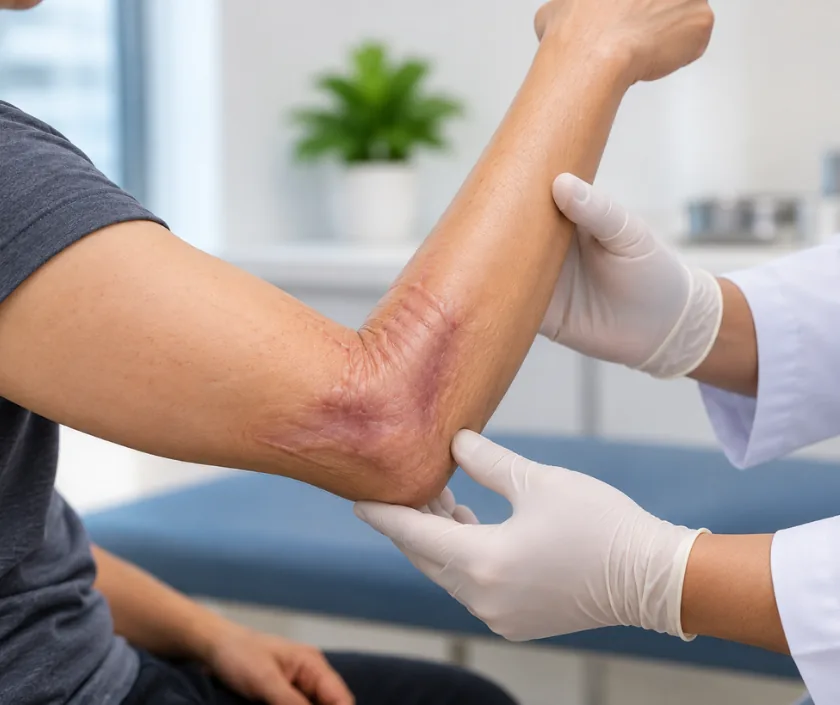
Elbow contracture release divides the tight scar across the front of the elbow and replaces the missing skin with a graft or a flap, so the arm can straighten. Nerves and vessels sitting under the band are protected during surgery. Afterwards an extension splint and steady therapy keep the elbow from folding back into its old position.
Skin in front of the elbow has to stretch every time the arm straightens. Burns here heal into scar that shrinks instead, so the joint settles into a bent position and stays there. Early on the loss is small and easy to ignore. Later the arm may sit at a fixed angle that cannot be pushed open, even with force.
Ordinary tasks change shape around that limit. Eating, brushing teeth, putting on a sleeve, carrying a bag or pushing a door all need a different technique, and the shoulder starts to compensate. Skin in the crease can split when the elbow is pulled straight, which is painful and tends to bleed.
Beneath the band lie the ulnar nerve and the vessels that supply the forearm. These structures shorten as well when a limb has been bent for a long time, so sudden full correction is not always safe. Release is therefore planned around what the deeper tissue will tolerate, and the last part of the correction is often gained slowly with splints.
The operation suits people whose elbow is held bent by skin and scar, once the burn itself has healed.
Movement is recorded with the arm relaxed and again with steady pressure, which shows how much of the limit comes from skin and how much from the joint itself. Nerve function in the hand is checked and noted.
Scar is divided across the crease under anaesthesia, while the ulnar nerve and the vessels underneath are kept in view. Correction is taken to the point the deeper tissues allow, not necessarily to a straight arm.
Narrow bands can be lengthened by turning local skin into Z shaped flaps. A wider raw area is resurfaced with a thick skin graft, and exposed tendon or joint may need a flap of nearby healthy tissue.
Before the patient wakes, a splint holds the elbow at the corrected angle. Holding that position protects the graft, keeps the crease open and prevents the scar from folding while it heals.
Therapy and adjustable splints work on the remaining tightness over the following weeks. Slow lengthening is safer for nerves and vessels than forcing a joint straight during the operation.
Arm rests in the splint with the hand kept raised to limit swelling. Circulation and sensation in the fingers are checked regularly.
Dressings come down, graft take is assessed and gentle movement out of the splint begins under supervision. Wound care at home is taught before discharge.
Stretching and strengthening step up, and the splint may be adjusted as the elbow opens further. Scar massage usually starts once the skin is fully closed.
Scar continues to soften and remodel. Night splinting often carries on well past this point, and children are reviewed regularly because growth can tighten the crease again.
Most people gain a useful amount of extension, though a completely straight elbow is not always possible when nerves and vessels have shortened over the years. Grafted skin stays paler or darker than the area around it and keeps a visible outline. Progress after the operation is gradual, and the final angle usually reflects how consistently splints and exercises are used. Some tightening can return, so review appointments matter.
Risks here are usually manageable, yet they should be understood clearly before a date is fixed.
Home routine carries most of the weight once the wound has healed, so build it into the day rather than leaving it to spare time.
Contracture release is often done years after the burn, and elbows bent for a long time can still be improved a great deal.
Correction is usually staged, because nerves and vessels need time to lengthen. Final position develops over weeks of therapy.
Exercises work while you are awake, whereas scar tightens most at night. Both together protect the range that surgery created.
Softening helps the scar surface, although a thick band blocking the joint needs to be divided and resurfaced with new skin.
At Elegance Clinic in Surat, elbow reconstruction is planned with the physiotherapy team from the start, so splinting and exercise are ready on the day the dressing comes down.

Elbow contracture release is reconstructive rather than cosmetic surgery, so it usually qualifies for mediclaim cover and for government schemes when the paperwork is complete. What you pay depends on the size of the release, the choice between a graft and a flap, anaesthesia, hospital stay and the splint and therapy that follow. A written estimate is shared before admission.
These are the questions that come up most often in consultation. If yours is not here, send it on WhatsApp and the team will reply, usually the same day.
Ask your question →Fees generally sit within Rs 45,000 to Rs 1.6L. Size of the release, the choice between a graft and a flap, anaesthesia, the splint and length of admission all shift the figure. An itemised estimate is prepared before the date is fixed.
Most policies treat burn contracture release as reconstructive surgery, since it restores lost movement. Approval usually needs photographs, a record of the limitation and a treatment plan. Check waiting periods, room rent limits and whether your employer scheme adds any conditions.
Nerve trouble is uncommon but possible, because the ulnar nerve runs close to the released band and shortens when an elbow has been bent for years. Correction is therefore taken gradually. Tingling or weakness in the hand should be reported the same day.
Light use often starts within the first weeks, once the graft has settled and the therapist allows movement out of the splint. Heavy lifting waits longer. Night splinting and daily stretches usually continue for months, which is what holds the correction.
Extension usually improves a great deal, though a few degrees of bend often remain when deeper tissues have shortened over the years. Skin will look grafted. Steady splinting and therapy tend to add range slowly rather than overnight.
Children are usually treated when tightening starts to affect daily activity, school work or the way the arm grows. Waiting can allow the joint to stiffen. Since scar does not grow with bone, further surgery may be needed later in childhood.
Movement is measured, the scar band examined and the hand tested for sensation and strength. Photographs are taken for the record and for insurance. Choices such as a graft or a flap, along with splinting and therapy, are discussed before any date is set.
Each technique below has its own page explaining how it works and when it is chosen.
Seeing patients from across the city and beyond: read about the practice on the plastic surgeon in Surat page, or check what a written estimate covers on the costs and insurance page.
