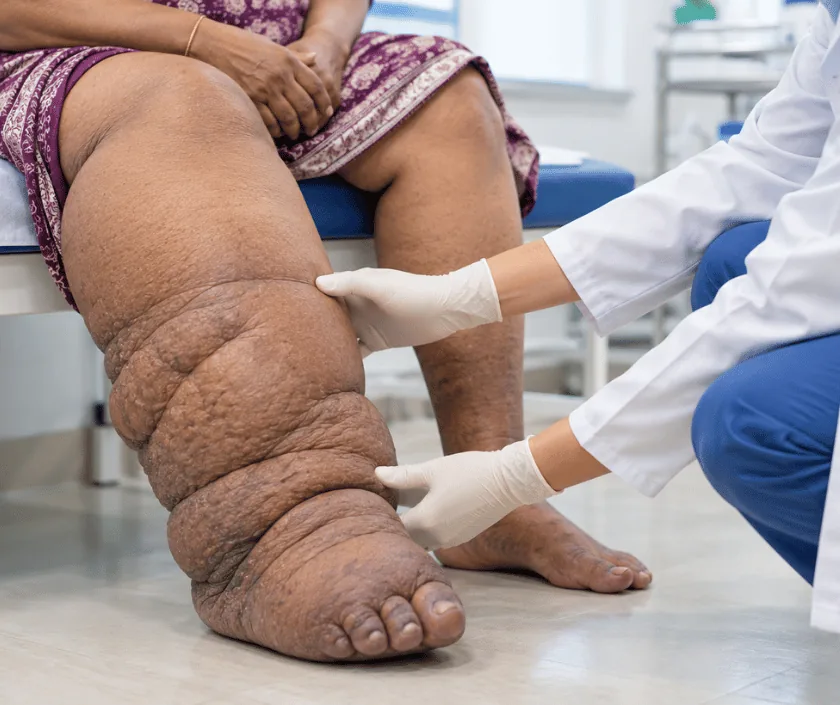
Advanced filarial swelling of the legs and genitals, reduced surgically so hygiene, mobility and daily life become possible again.
People with long standing filarial swelling of the limb or genitals that has stopped responding to conservative care.
Staging of the swelling, infection history and skin condition, and a staged reduction plan where surgery will help.
Theatre for staged debulking and reconstruction, with compression care around every stage.
Reduction of advanced disease is assessed for scheme and mediclaim cover case by case.
Nothing here is improvised. The sequence below is how care in this specialty is actually organised, and your own written plan follows it.
Antiparasitic treatment where active, and hygiene and compression routines that control episodes.
The limb or genital swelling is staged; surgery is planned only where it will genuinely change function.
Debulking removes the excess tissue in planned stages, with grafting where the skin cannot be preserved.
Compression and skin care continue after every stage to protect the result.
"The goal is a limb that can be washed, dressed and walked on. That is life changing, and it is achievable."
Advanced filarial swelling is disabling and stigmatising, and staged reduction surgery restores hygiene and mobility.
Genital filarial disease is treated with the same staged, function first approach, with privacy respected at every step.

Published with documented patient consent, generalised for age and sex, in line with advertising norms applicable to medical practitioners in India.
Published bands are for Surat and include surgeon, anaesthesia, theatre and standard stay. Where a band is not published, a written estimate follows examination. Cover under mediclaim and schemes is confirmed before admission.
Ask for an estimate →These are the questions that come up in consultation most often. If yours is not here, send it on WhatsApp and the team will reply, usually the same day.
Ask your question →Yes. Advanced swelling that no longer responds to compression can be reduced surgically in planned stages, restoring hygiene and mobility. It is major surgery and is planned honestly.
Reduction removes the bulk permanently, but compression and skin care must continue to protect the result and prevent new swelling and infection.
Large limbs are usually reduced over more than one stage, spaced weeks to months apart, which is safer and gives better skin healing than one massive procedure.
With the same staged reduction and reconstruction principles, restoring comfort, hygiene and function. Consultations and care are handled with complete privacy.
A written estimate is given after staging, because the number of stages depends on the limb. Scheme and mediclaim cover are checked case by case.
Surgery reduces bulk and improves hygiene, but medical treatment and infection prevention continue as advised, because the underlying lymphatic damage remains. Your physician guides the drug part of treatment.
Daily washing, careful drying, moisturising, prompt treatment of any skin break and compression are the routine that keeps the limb settled. Skin care is what prevents repeated infection, which is the main cause of further swelling.