Amputated fingers, hands and limbs reattached under the operating microscope, and free tissue transfer for defects nothing local can cover.
Anyone with an amputated part, a devascularised limb, or a defect needing free tissue transfer.
For emergencies there is no first visit, call while travelling. For planned flaps, vessels and donor sites are assessed with the plan.
Microscope equipped theatre with round the clock team activation for replantation.
Emergency replantation is generally payable under accident cover and mediclaim.
Each category opens a hub with its own treatment pages and patient information.
Nothing here is improvised. The sequence below is how care in this specialty is actually organised, and your own written plan follows it.
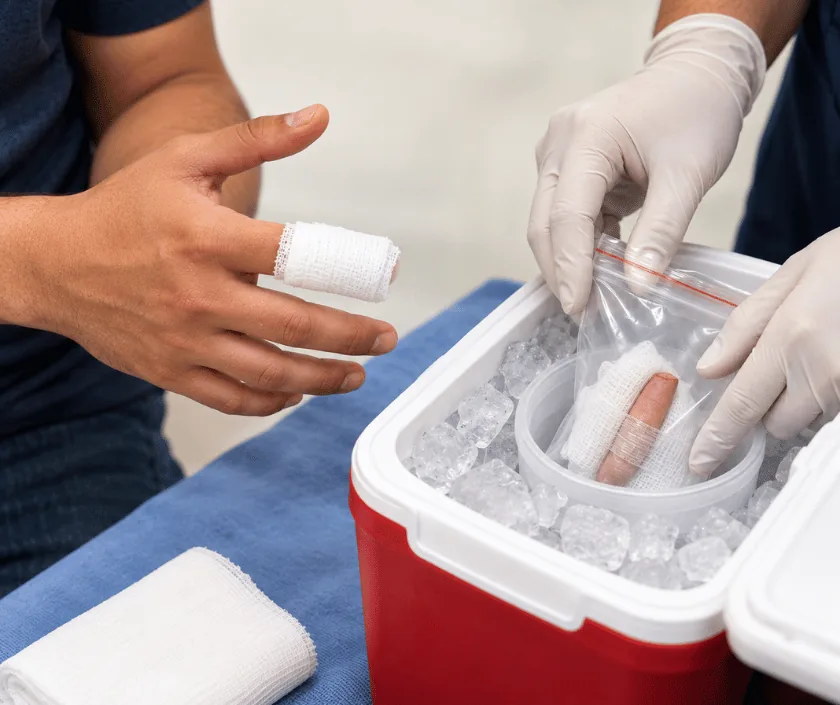
A finger is realistically viable for about six hours, less for a hand or forearm. The part travels cool, dry and sealed.
Bone is fixed, then tendons, arteries, veins and nerves are repaired in sequence under the microscope.
The replanted part is monitored continuously; early return to theatre saves a struggling replant.
Hand therapy rebuilds movement and strength; secondary procedures refine function where needed.
"Six hours decides more than sixty minutes of surgery. Call while you travel."
Replantation succeeds on logistics as much as technique: the storage of the part, the speed of transfer and a theatre that is ready.
The same microsurgical skills rebuild defects with free flaps when local tissue cannot close a wound.

Published with documented patient consent, generalised for age and sex, in line with advertising norms applicable to medical practitioners in India.
Published bands are for Surat and include surgeon, anaesthesia, theatre and standard stay. Where a band is not published, a written estimate follows examination. Cover under mediclaim and schemes is confirmed before admission.
Ask for an estimate →These are the questions that come up in consultation most often. If yours is not here, send it on WhatsApp and the team will reply, usually the same day.
Ask your question →Wrap it in clean gauze, seal it in a plastic bag and place the bag on ice or cold water. Never put the part directly on ice and never wash or soak it. Travel immediately and call ahead.
About six hours realistically, and less for a hand or forearm because muscle tolerates loss of blood supply poorly. Cool, correct storage buys time; delay and heat destroy it.
Most successful replants regain useful movement and protective sensation over months of hand therapy, though stiffness and cold sensitivity are common. Function keeps improving up to a year.
The stump is repaired for the best possible grip and comfort, and reconstruction options such as toe transfer can be discussed later, once healing is complete.
Emergency replantation is generally payable under accident policies and mediclaim. Documentation for reimbursement is completed alongside treatment in emergencies.
Reattaching bone, tendon, vessels and nerves under a microscope is slow work and can run for many hours, sometimes longer when more than one digit is involved. Families are told what to expect before the operation starts.
The early days need close observation of circulation in the replanted part, then a long programme of hand therapy to regain movement. Recovery of feeling and function continues for many months, so regular review matters as much as the surgery.