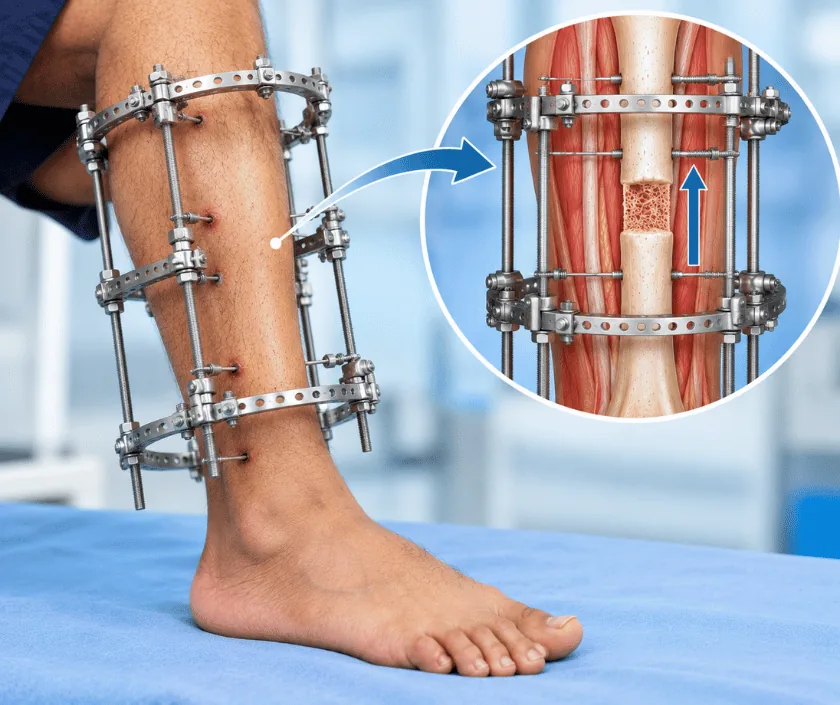
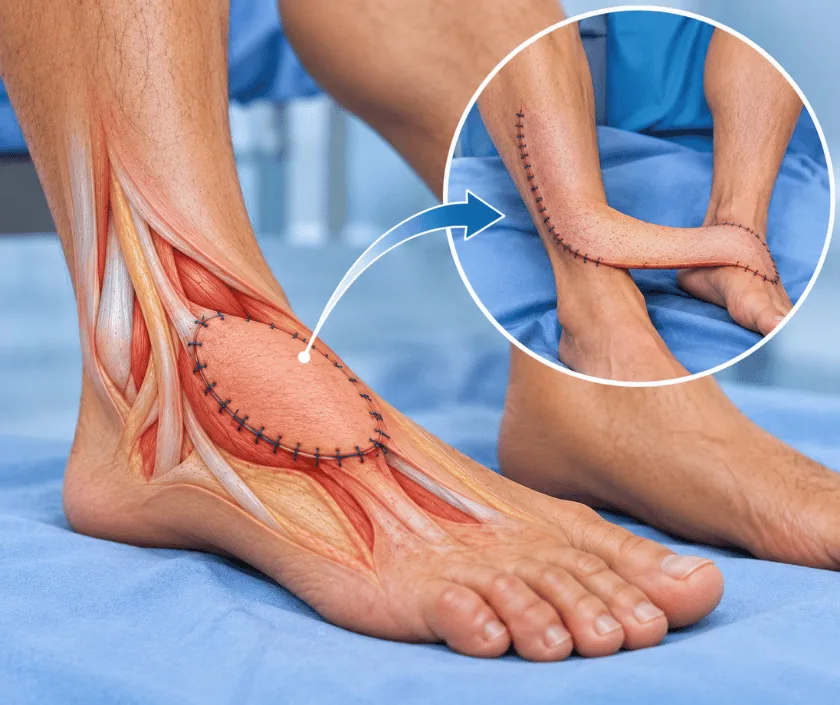
Open fractures, exposed bone and implants, and soft tissue loss of the leg and foot, covered with flaps so the limb is saved.
Anyone with an open fracture, exposed bone, tendon or implant, or a leg or foot wound that will not close.
Wound and vascular assessment with the orthopaedic team where a fracture is involved, and a written cover plan.
Microscope equipped theatre for free flaps; combined lists with orthopaedics for fix and flap surgery.
Cover after injury is generally payable under mediclaim and accident policies.
Each category opens a hub with its own treatment pages and patient information.
Nothing here is improvised. The sequence below is how care in this specialty is actually organised, and your own written plan follows it.
Dead and contaminated tissue is removed until the wound is clean, the foundation of every salvage.
The bone is stabilised and the wound covered with a local, regional or free flap, early cover prevents infection.
Walking returns in stages as the flap matures and the fracture unites, guided jointly with orthopaedics.
Flap thinning and scar revision once the limb is healed and walking is stable.
"Bone heals under living cover. Exposed bone under a dressing does not."
Limb salvage is a race between cover and infection: early flap cover of an open fracture changes the outcome of the whole limb.
Flap choice runs from local muscle to free tissue transfer, decided by the size of the defect and the state of the leg vessels.

Published with documented patient consent, generalised for age and sex, in line with advertising norms applicable to medical practitioners in India.
Published bands are for Surat and include surgeon, anaesthesia, theatre and standard stay. Where a band is not published, a written estimate follows examination. Cover under mediclaim and schemes is confirmed before admission.
Ask for an estimate →These are the questions that come up in consultation most often. If yours is not here, send it on WhatsApp and the team will reply, usually the same day.
Ask your question →Because the bone can only heal under healthy, living cover. Flap surgery closes the wound over the fracture and fixation, protecting the limb from infection and giving the bone a blood supply to heal beside.
Early cover, generally within days of a clean debridement, gives the best results. Exposed bone that stays open dries, gets infected and dies, which is why the plan is made with orthopaedics at the start.
Most patients return to independent walking as the fracture unites and the flap matures, in stages guided by both teams. The timeline depends on the fracture more than the flap.
Depending on the flap, skin, fascia or a portion of muscle, chosen so the donor limb keeps its function. The donor site closes directly or with a graft and is discussed before surgery.
Cover after injury is generally payable under mediclaim and accident policies, and approvals are coordinated with the orthopaedic admission.
Weight bearing is restricted at first so that the new tissue and its blood supply are not disturbed, then increased in stages with the team looking after the bone. The timeline is set for your case and reviewed at each visit.
Colour change, increasing swelling, fresh bleeding, a bad smell or rising pain in the operated area should be reported straight away rather than waiting for the next appointment. Early review gives the best chance of correcting a problem.