Charcot foot is bone and joint collapse inside a foot that has lost sensation. Because it rarely hurts much, many people keep walking on it, and the arch quietly flattens into a rocker shape that goes on to ulcerate.
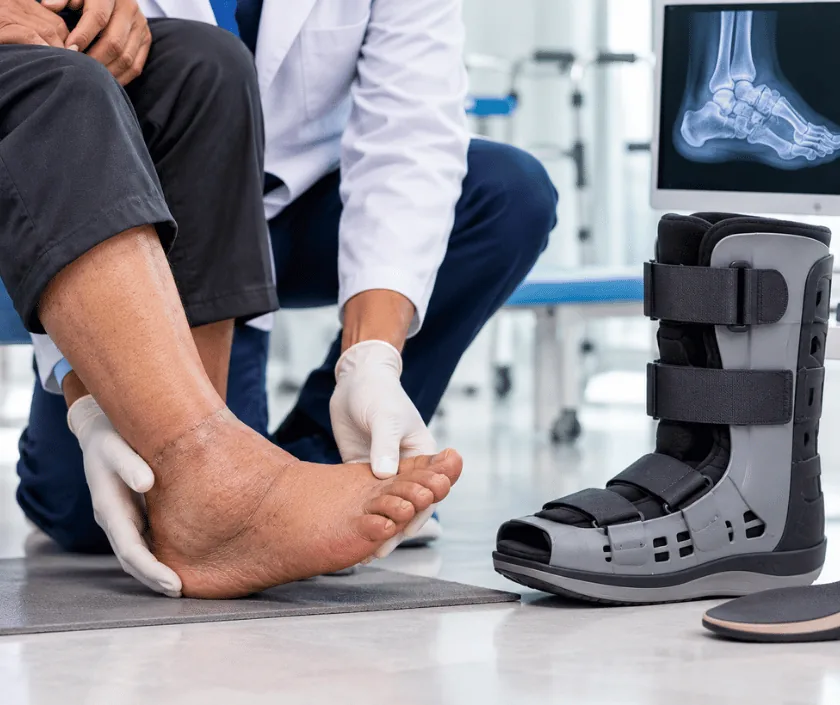
Charcot foot happens when weakened bones in a numb foot fracture and shift under ordinary walking. The foot looks hot, swollen and red, which is often mistaken for infection. Treatment starts by taking every bit of weight off it, usually in a cast, and surgery is added when the shape has already collapsed.
Nerve damage does two things to a foot. It removes the pain that tells you to rest, and it alters blood flow through bone, leaving it softer than it should be. When such a foot takes an ordinary knock, or simply carries daily walking, small fractures appear. Since nothing hurts, walking continues, and every step pushes the broken pieces further out of line.
The early stage looks alarming and is easy to misread. Swelling, warmth and redness appear together, so infection or gout is often suspected first. One useful clue is that raising the foot for several minutes usually settles the redness of Charcot, while infection tends to bring fever and a rising white cell count. Scans and repeat examination settle the question.
If the foot keeps taking weight through this phase, the arch drops and the midfoot bulges downward. That rounded underside is where ulcers form, because body weight now lands on bone that was never meant to touch the ground. Treatment therefore has two aims, stopping the collapse early and rebuilding a shape that can be braced and shod safely.
Many Charcot feet settle with protection alone, so surgery is reserved for feet that have already deformed or that keep breaking down. That decision follows a period of assessment rather than a single visit.
Examination compares warmth and shape between both feet, and imaging looks for fractures. Recognition matters more than anything else here, because the treatment clock starts on the day walking stops.
A total contact cast or removable boot takes weight off the foot. Casts are changed regularly as swelling settles, and the skin is inspected carefully at every single change.
Warmth, swelling and imaging are followed over months. Only once the foot has cooled and the bone has begun to consolidate is loading increased or reconstruction considered.
Collapsed bone is realigned and held with screws, plates or an external frame. Tight tendons may be lengthened at the same sitting, so the corrected shape is not pulled back down.
Once healed, a custom brace or moulded insole spreads load across the whole sole. Footwear becomes part of treatment for life rather than an optional extra.
The foot stays in a cast and off the ground. Swelling reduces, casts are changed, and moving about relies on a walker, crutches or a wheelchair.
Warmth and swelling settle gradually. Imaging is repeated, and casting continues until the bone shows signs of consolidating, rather than stopping by the calendar.
Weight returns in stages, first in a boot and later in a custom shoe or brace. After reconstruction, screws or a frame may still be in place through this period.
The foot is stable but its shape has changed for good. Lifelong bracing, moulded footwear and regular checks keep the sole intact, since the other foot is also at risk.
A Charcot foot does not go back to its original shape. The realistic goal is a stable, flat resting foot that fits into protective footwear and keeps its skin intact. Many people walk well afterwards, usually in a brace or moulded shoe. Healing after reconstruction is slow because the bone itself is abnormal, and recovery can vary a great deal from one person to another.
Charcot surgery works on soft bone in a limb that heals slowly, so complications are not rare and are discussed frankly before any decision is made.
Protection is the treatment here, and it only works when it continues between appointments.
Charcot foot creates exactly the same appearance without infection. Treating it as infection alone lets the bone collapse further.
Absent pain is the danger rather than the reassurance. Each step on softened bone pushes the deformity along.
Total contact casting remains the mainstay of the active phase, protecting the foot in a way no shoe can.
Reconstruction aims for a stable, braceable foot. Restoring the original shape and the lost feeling is not possible.
Elegance Clinic in Surat treats Charcot foot as a race against walking, so examination, casting and imaging are arranged quickly. Dr. Ashutosh Shah plans reconstruction only once the foot has settled and circulation has been checked.

Charcot care is usually a long treatment rather than a single procedure, so cost is spread across casts, imaging, footwear and, in some cases, reconstruction. A written estimate is prepared once the stage of the foot is clear. Admissions for reconstruction are commonly claimable under mediclaim, and cover is confirmed before a date is fixed.
These are the questions that come up most often in consultation. If yours is not here, send it on WhatsApp and the team will reply, usually the same day.
Ask your question →Cost depends on how long casting continues, how much imaging is needed and whether reconstruction becomes necessary. A written estimate is given once the stage of the foot is known. Surgical admissions are often covered by insurance, and cover is confirmed beforehand.
Surgery here is done on softened bone, so it carries a higher rate of complications than routine foot surgery. Circulation, infection and sugar control are checked first. When a foot cannot be braced safely, the risk of doing nothing is usually greater.
Offloading commonly continues for months rather than weeks, because bone healing in this condition is slow. Progress is judged by warmth, swelling and imaging instead of the calendar. Loading is then increased in supervised stages.
The aim is a stable foot that fits protective footwear and keeps its skin intact. Shape is improved rather than restored, and sensation does not come back. Many people walk comfortably again in a brace or moulded shoe.
Many feet settle with a total contact cast and strict offloading, with no operation at all. Surgery is added when the shape has already collapsed, the foot has become unstable, or ulcers keep returning over a bony point.
Every day of walking on an active Charcot foot moves the bones further out of line. A foot recognised early can often be saved in a cast, while a foot recognised late may need reconstruction to become braceable at all.
Both feet are examined and compared for warmth, swelling and shape. Sensation and pulses are tested, and imaging is arranged. If the foot is active, casting usually begins straight away, and the plan is explained to you and your family.
Seeing patients from across the city and beyond: read about the practice on the plastic surgeon in Surat page, or check what a written estimate covers on the costs and insurance page.
