Casts and special shoes take pressure off a foot from the outside, and they work while they are being worn. Internal offloading alters the foot itself, so load keeps shifting away from a damaged spot even without a device.
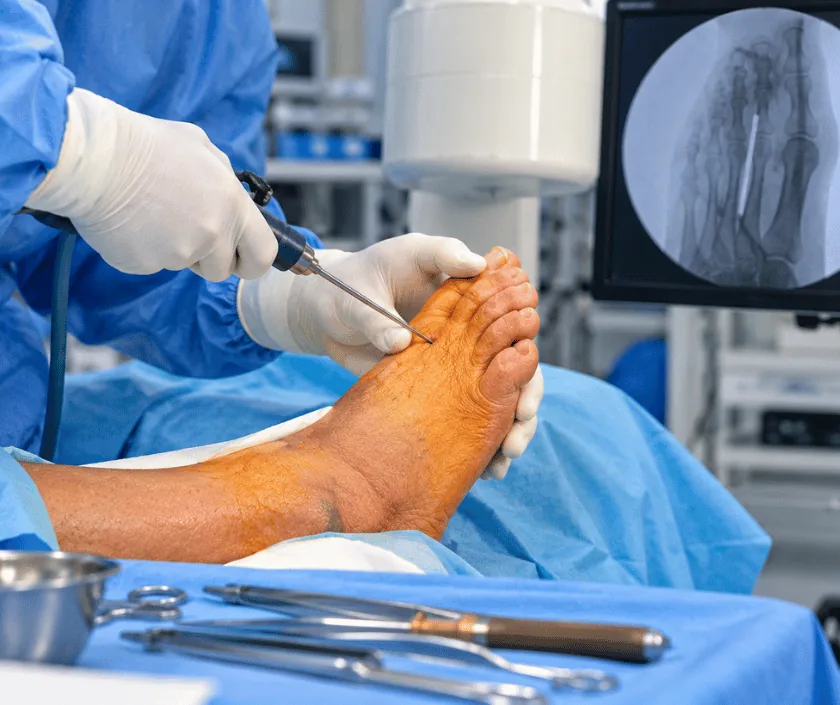
Internal offloading surgery is a group of small operations that move pressure away from an ulcer by changing the foot from within. A tight tendon may be lengthened, a prominent bone trimmed or a joint rebalanced. The aim is a sole that shares load evenly, so a stubborn wound can heal and stay healed.
Think of the sole as a surface that should share load across its whole area. Nerve damage, stiff joints and tight tendons upset that sharing, so a few small spots take far more pressure than they should. Skin over those spots thickens, breaks down and becomes an ulcer. Since sensation is lost, walking carries on and the ulcer deepens.
External offloading tackles this from outside, using total contact casts, removable boots and moulded insoles. Such methods are effective and are always tried first. Their weakness is simple, because they only work while the device is on the foot, and daily life makes that hard to sustain over months and years.
Internal offloading approaches the same problem from within. Lengthening a tight tendon lowers forefoot pressure. Trimming a prominent bone removes the point that keeps pressing through the skin. Straightening a clawed toe stops the tip and the knuckle from rubbing. These are modest procedures with a specific target, chosen after mapping exactly where the load is going wrong.
This approach suits someone whose ulcer is driven by a clear, correctable pressure point rather than by poor circulation. Assessment maps where the load falls before anything is planned.
Examination, callus pattern, joint movement and imaging show where load is concentrating. The calf is tested for tightness as well, since that alone can push pressure into the forefoot.
Procedure is matched to the finding. Options include lengthening a tendon, trimming a bone prominence, releasing a contracted toe or reshaping a joint that no longer moves.
Any infection is settled before elective correction. Where an ulcer is present but clean, correction and wound closure can sometimes be combined in a single visit to theatre.
Most of these operations are short and done through small incisions. Many people go home the same day or the next, with a protective shoe or cast already fitted.
Afterwards the corrected foot is loaded gradually and reassessed. Insoles and footwear are adjusted to match the new pressure pattern rather than the old one.
Discomfort is usually modest. The foot stays elevated, dressings remain dry, and moving about happens in a protective shoe or boot as instructed.
Stitches are checked and any existing ulcer is reviewed. Walking stays limited and controlled, since the point of the surgery is to keep load off the healing area.
Correction has settled and most wounds are closed. Pressure is measured again, and new insoles or footwear are made to suit the changed foot.
Skin over the treated area stays healthier when footwear is used consistently. Reviews continue so that a new pressure point can be caught before it ulcerates.
These are small operations with a focused purpose, and they do not make a diabetic foot ordinary again. Pressure is redistributed, so the treated area becomes much less likely to break down. What they cannot do is restore sensation or reverse nerve damage. A new pressure point may appear elsewhere in time, which is why footwear, insoles and regular reviews remain part of life.
Even a small operation on a diabetic foot deserves a careful discussion of what can go wrong.
Surgery changes the foot, yet daily habits decide whether that change lasts.
These are small, targeted procedures. They alter pressure rather than remove parts of the foot.
Healing without changing the pressure usually leads to the same wound returning in the same place.
Devices work while they are worn. When a wound keeps returning in normal shoes, changing the foot itself may be needed.
Nerve damage means many people feel little afterwards, which is exactly why the protective shoe must still be worn.
Elegance Clinic in Surat looks for the reason an ulcer keeps returning instead of dressing it once again. Dr. Ashutosh Shah plans the smallest procedure that can change the pressure pattern in a lasting way.

These procedures are shorter and less involved than major reconstruction, so the estimate is smaller and the stay is often brief. What moves the figure is how many corrections are combined, whether an ulcer needs closure at the same time, and the type of anaesthesia used. A written estimate follows assessment, along with clear guidance on insurance cover.
These are the questions that come up most often in consultation. If yours is not here, send it on WhatsApp and the team will reply, usually the same day.
Ask your question →Because these are smaller procedures, the estimate is usually well below that of major reconstruction. It varies with how many corrections are combined and whether a wound is closed at the same time. A written estimate is given after assessment, with insurance guidance included.
Small incisions and short operating times make these procedures well tolerated by most people. Circulation, infection and sugar control are still checked first, since a foot with poor blood supply cannot heal even a tiny wound reliably.
Walking is usually allowed straight away in a protective shoe, with normal footwear delayed for several weeks. Instructions differ between procedures. Recovery can vary depending on whether an ulcer was being closed at the same time.
Removing the pressure that caused it makes a return far less likely, which is the whole purpose of the operation. No result is certain, though, and load can settle at a new point instead. Reviews and proper footwear stay important.
It is not the right step when circulation is poor and untreated, when infection is spreading, or when the foot is deformed so severely that only a larger reconstruction would change the load. Those situations are explained honestly at assessment.
Consider it once an ulcer has failed to close with good dressings and offloading, or keeps returning after healing. Acting before infection reaches bone usually keeps the procedure small and the recovery straightforward.
The sole is examined for callus and pressure points, joints are moved, calf tightness is tested and imaging is arranged. Any wound is measured. Findings, the smallest sensible procedure and a written estimate are then discussed with you.
Seeing patients from across the city and beyond: read about the practice on the plastic surgeon in Surat page, or check what a written estimate covers on the costs and insurance page.
