An ulcer under the big toe is stubborn, because that joint carries a great deal of load at the end of every step. The Keller procedure opens up the joint so pressure falls and the skin below can finally heal.
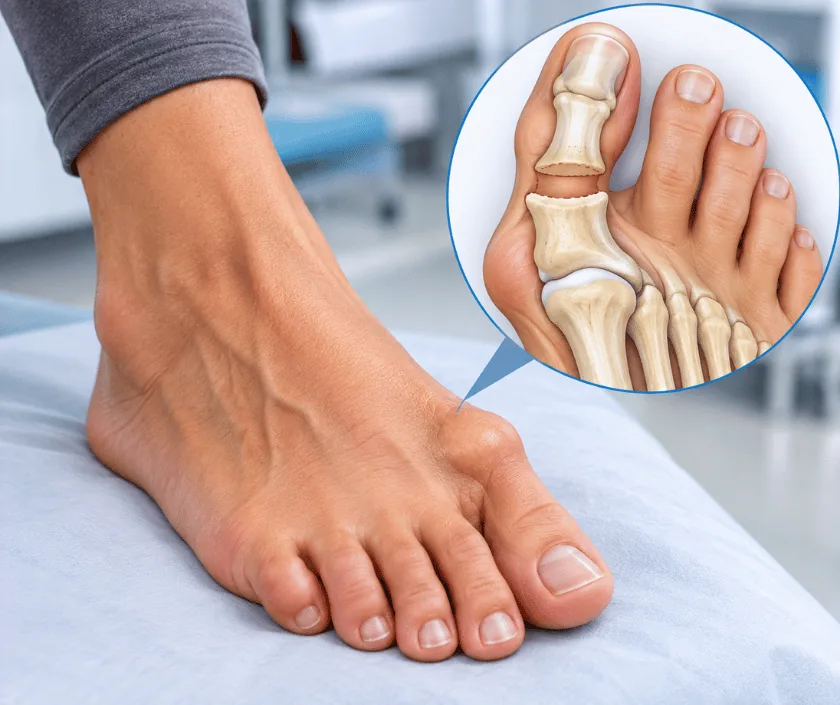
The Keller procedure treats an ulcer under the big toe by removing the base of the toe bone at the main joint. That small resection lets a stiff joint bend again, so the toe no longer grinds pressure into the skin beneath it. Many long standing ulcers in this position close afterwards.
The joint at the base of the big toe should bend upward as you push off. When arthritis, stiffness or years of nerve damage lock it, the toe cannot roll over the ground. Instead it presses down, and the skin beneath takes a crushing force with every step. That is why an ulcer there resists dressings, however carefully they are applied.
Surgery addresses the mechanics rather than the wound surface. A small amount of bone is removed from the base of the toe, which creates a gap at the joint and lets it move freely again. Pressure under the toe falls at once, and the ulcer below usually starts to contract. Infected bone can be cleared during the same procedure, which is a common reason for choosing this operation.
There is a cost to the change. The big toe becomes a little shorter, sits more loosely and pushes off less strongly. In a healthy foot that would matter a great deal. For someone facing a wound that has stayed open for months, a shorter toe with an intact sole is usually the better outcome.
This procedure suits someone whose big toe joint has stiffened and whose ulcer sits directly beneath it, with circulation good enough for the wound to heal.
Movement at the joint is tested, callus is mapped and imaging is reviewed. Suspected bone infection is confirmed as well, since it changes how much bone needs to be removed.
Any active infection is treated first. Circulation is checked, and sugar levels are steadied so that the wound has a fair chance of healing after surgery.
Through an incision near the joint, the base of the toe bone is taken out. Samples go for culture where infection is present, and the joint space is washed thoroughly.
The wound is closed or, where an ulcer is being managed, left to close gradually. A dressing and a protective shoe are fitted before you go home.
Weight returns early in the protective shoe, since the aim is to reduce pressure rather than to avoid it entirely. Footwear is then adjusted for the changed toe.
Swelling settles with elevation and simple pain relief. Walking in the protective shoe usually starts within a day or two, keeping load off the front of the foot.
Stitches are checked and the ulcer beneath is reviewed. Many wounds begin to shrink quickly once the pressure above them has been taken away.
Wounds are usually healed and the protective shoe gives way to fitted footwear. Gentle movement exercises for the toe may start at this stage.
Push off feels different but rarely causes trouble in daily walking. Insoles are adjusted, and the neighbouring toes are watched for new pressure.
Ulcers under the toe commonly heal once the pressure above them is relieved, and many people find that shoes fit better afterwards. The toe itself becomes shorter and less powerful, and it may look slightly floppy. Push off strength does not return to what it was. Since load has to move elsewhere, a new pressure point can appear under a neighbouring toe, which reviews and insoles are designed to catch early.
Trading some joint function for a healed sole is a considered decision, so the possible drawbacks are set out first.
The operation lowers pressure, and your habits at home decide whether that gain is kept.
The toe stays in place. Only a small section at its base is removed, which is what frees the joint.
In a numb foot a rigid joint concentrates force into the skin below, and that is exactly how the ulcer forms.
An ulcer driven by pressure rarely closes while the pressure remains, and waiting risks infection reaching bone.
Walking usually begins within days in a protective shoe, because the procedure removes pressure rather than adding it.
Elegance Clinic in Surat uses this procedure where the mechanics clearly point to the big toe joint, not as a routine answer to every forefoot ulcer. Dr. Ashutosh Shah explains the trade offs before proceeding.

This is a short procedure, often done as day care, so the estimate stays at the lower end for foot surgery. The figure depends on the anaesthesia used, whether infected bone is being removed and how the wound above is managed. A written estimate follows assessment, along with guidance on insurance cover.
These are the questions that come up most often in consultation. If yours is not here, send it on WhatsApp and the team will reply, usually the same day.
Ask your question →As a short day care operation, the estimate usually sits at the lower end for foot surgery. It changes with anaesthesia, whether infected bone is removed and how the ulcer is managed. A written estimate is shared after assessment, with insurance guidance.
Removing infected bone is often the safest route, since leaving it lets infection spread deeper. Circulation and sugar control are checked first, and cultures taken during surgery guide the antibiotics that follow.
Walking in a protective shoe usually begins within a day or two, because the procedure reduces pressure rather than adding to it. Ordinary shoes wait until the wound has healed. Recovery can vary with the size of the ulcer.
The toe becomes slightly shorter, sits a little more loosely and pushes off less strongly. Most people manage daily walking without difficulty. That change is accepted in exchange for closing an ulcer that would not heal.
Casting, insoles and dressings are tried first, and sometimes a calf lengthening or a different bone procedure suits better. Where the joint is rigid and the ulcer sits directly beneath it, this remains one of the most reliable options.
Not long, because a wound over a joint can reach bone quickly and infection there is harder to treat. If dressings and offloading have not closed it within a few weeks, surgical options should be reviewed.
The joint is moved to assess stiffness, callus and the ulcer are examined and measured, and pulses and sensation are tested. Imaging is arranged when needed. Options, expected changes and a written estimate are then discussed with you.
Seeing patients from across the city and beyond: read about the practice on the plastic surgeon in Surat page, or check what a written estimate covers on the costs and insurance page.
