Toes are small and have very little tissue to spare, so damage there moves quickly from skin to bone. Reconstruction repairs the cover and corrects the shape, so a toe stays useful instead of being lost to a wound that never closes.
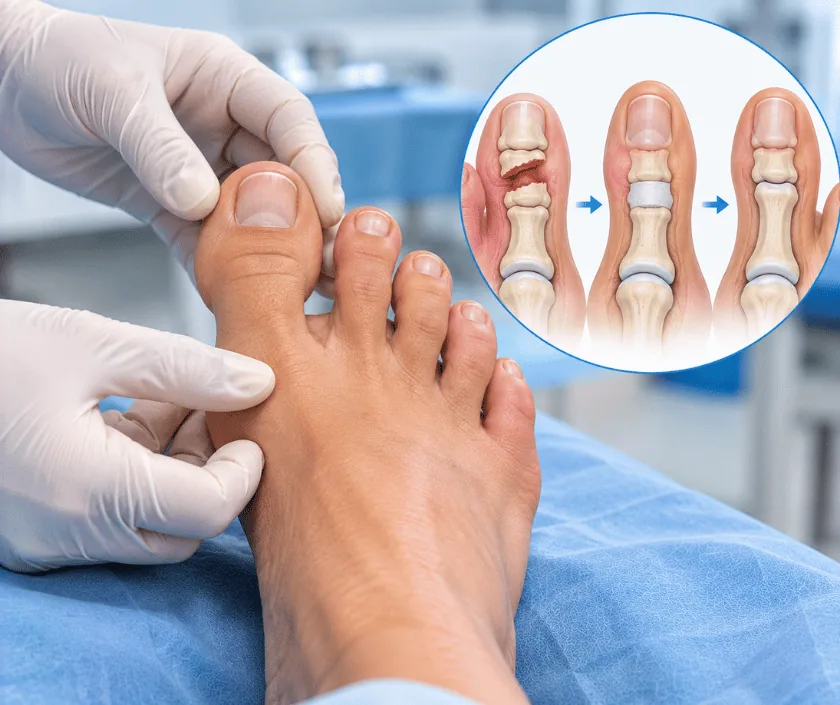
Toe reconstruction repairs a damaged toe so it can be kept rather than removed. Dead skin and infected bone are cleared, the toe is straightened or slightly shortened where needed, and the wound is covered with a graft or a small flap. Keeping a toe helps the forefoot stay balanced during walking.
Toes are mostly bone, tendon and skin with hardly any padding in between. A blister at the tip, a rub over a knuckle or a small burn can therefore reach bone within days. Add nerve damage and the person feels none of it, so such an injury is often found by a family member or at a routine check rather than through discomfort.
Surgery has several tools. Dead skin and infected bone are removed first. If the toe is curled, releasing a tendon or taking out a small piece of bone lets it lie flat and stops the rubbing. A slightly shortened toe with intact skin works better than a long toe with an open wound. Cover is then provided by direct closure, a skin graft or a small local flap that borrows tissue from beside the wound.
Not every toe can be saved, and honesty about that matters. When blood supply is very poor or infection has destroyed the joint, removing the toe protects the rest of the foot. That decision is made with the whole forefoot in mind rather than the toe alone.
Reconstruction suits a toe that still has blood supply and enough healthy structure to be rebuilt. Circulation testing and imaging come before that judgement is made.
Toes sit at the very end of the circulation, so pulses, doppler studies and sometimes angiography are used. Narrowing that can be treated is dealt with before reconstruction begins.
Dead skin, unhealthy tissue and infected bone are removed under anaesthesia. Bone samples go for culture, and antibiotics are then matched to whatever actually grows.
A curled toe is straightened by releasing a tight tendon or removing a small segment of bone. Slight shortening is often accepted, since a flat closed toe works better than a long open one.
The wound is closed directly where that is possible. Otherwise a skin graft or a small flap from nearby tissue is used, chosen by how much bone or tendon lies exposed.
A splint or protective shoe holds the toe and keeps footwear off it. Weight bearing is restricted at first, then increased as the skin proves it can cope.
The foot stays elevated and the toe is watched for colour and swelling. Dressings are light, and walking happens only in the protective shoe.
Stitches and grafts are checked, and antibiotics continue where bone was infected. Neighbouring toes are examined at each visit as well.
Most wounds have healed and fitted footwear can usually be introduced. The toe may look shorter or straighter than before, which is expected.
Skin toughens and the toe settles into walking. Regular checks and correct footwear protect it, since tissue there stays thin and vulnerable.
A reconstructed toe is usually shorter, straighter and stiffer than it was, and it may look different from its neighbours. What matters more is that the skin stays closed and the toe keeps contributing to balance. Sensation does not come back, so daily inspection continues. Some toes cannot be saved despite everything, and that possibility is discussed before surgery rather than afterwards.
Toes are unforgiving because of their size and their position at the very end of the circulation, so the risks are explained clearly.
Small wounds on toes need the same discipline as large ones, and shoes are the usual cause of setbacks.
Toes help share load and steady each step. Losing one shifts pressure onto the rest of the forefoot.
Some toes recover once circulation is improved and infection is cleared. Assessment decides that, not appearance alone.
Toes have almost no spare tissue, so a small wound can reach bone in a matter of days.
Absence of feeling hides the problem. Many toes are lost simply because nothing ever hurt early on.
Elegance Clinic in Surat tries to keep a toe wherever the blood supply allows it, and says so plainly when it does not. Dr. Ashutosh Shah plans toe surgery with the balance of the whole forefoot in mind.

Cost depends on how much tissue must be cleared, whether infected bone is involved and the type of cover chosen. A direct closure sits at the lower end, while a graft or flap with a longer stay costs more. A written estimate is prepared after assessment, and insurance cover is checked before the admission date.
These are the questions that come up most often in consultation. If yours is not here, send it on WhatsApp and the team will reply, usually the same day.
Ask your question →The estimate reflects how much tissue is cleared, whether infected bone is removed and how the wound is covered. Simple closure costs less than a graft or flap with a longer stay. A written estimate is shared after assessment, along with insurance guidance.
Removal is quicker, though it changes how the forefoot shares load and can lead to problems under the neighbouring toes. Where blood supply and remaining structure allow, keeping the toe is usually preferred. Both routes are explained honestly.
Small wounds often settle within a few weeks, while a graft or flap needs longer and more protection. Walking continues in a protective shoe during that period. Recovery can vary with circulation, infection and sugar control.
It usually ends up shorter, straighter and stiffer, and the skin over it may differ in colour or texture. Function and closed skin are the goals rather than appearance. Most people find footwear fits comfortably once healing is complete.
No. A toe that is already dead, or one supplied by arteries that cannot be reopened, will not heal a repair. Assessment of blood flow and the extent of infection decides what is realistic before anything is offered.
Very urgently. A toe that changes colour, swells, discharges or exposes bone needs review within a day, because there is so little tissue to lose. Early treatment often means a small procedure instead of losing the toe.
The toe is examined for colour, warmth and movement, the wound is probed and measured, and pulses and sensation are tested. Imaging and vascular studies are arranged as needed. Options and a written estimate are then discussed with you.
Each technique below has its own page explaining how it works and when it is chosen.
Seeing patients from across the city and beyond: read about the practice on the plastic surgeon in Surat page, or check what a written estimate covers on the costs and insurance page.
