Most people with Bell's palsy get better with medical treatment and time. This page is for the smaller group whose face has not recovered, and it explains what surgery can and cannot offer them.
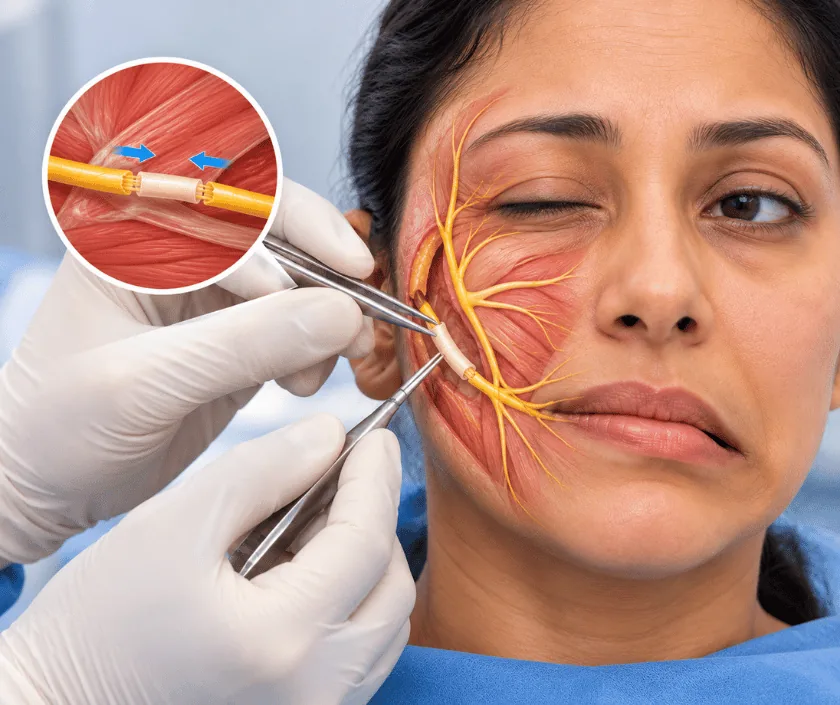
Surgery is not the first treatment for Bell's palsy. Medical care early on, eye protection and facial therapy come first, and many faces recover well. Surgery becomes relevant when weakness persists after many months, and the options are chosen by what is missing, whether that is eye closure, resting balance or movement.
The first weeks after sudden facial weakness are a medical matter, and treatment given early has the greatest influence on the outcome. Alongside that, the eye is protected and facial therapy is arranged. A good proportion of people recover well enough that no further intervention is needed, which is why patience is genuinely part of the treatment.
Assessment changes when many months have passed without meaningful improvement. At that point the useful question is no longer what caused the palsy but what function is missing. If the eye will not close, eyelid procedures come first. If the face sags and food escapes, a static sling or a nerve transfer may help. If the smile is gone but the muscles are thought to be viable, a nerve based option is considered.
Time also decides what remains possible. Facial muscles that have received no signal for a long period waste away, and once that has happened a new muscle must be brought in instead. Partial recovery brings its own problems, since tightness and linked movements are treated with therapy and injections rather than with an operation.
A consultation is worthwhile once recovery has clearly stalled, and earlier still if the eye is at risk.
The pattern of weakness is documented in detail, along with what has already been tried. Photographs and video make later comparison possible and honest.
Closure, corneal sensation and lower lid position are checked. Anything threatening the eye is addressed before other procedures are scheduled.
Length of paralysis, examination and sometimes nerve testing indicate whether the facial muscles can still respond. This determines the whole direction of treatment.
Options are then discussed one by one, with what each can achieve and what it cannot. A written estimate follows once a plan is agreed.
Facial therapy runs alongside surgery, and procedures are staged where combining them would be unsafe or would compromise the result.
Recovery depends on the procedure. Eyelid work is usually a day case with bruising, while nerve or muscle surgery involves a hospital stay and more swelling.
Wounds are reviewed and most patients resume light activity. Swelling falls steadily and any dressings are simplified.
Healing is largely complete for smaller procedures. Nerve based operations show no movement yet, which is the expected pattern at this stage.
Nerve related movement begins to appear and is shaped by therapy. Reviews continue while the face keeps changing.
Surgery after incomplete recovery improves specific functions rather than returning the face to how it was. Eye closure can usually be made safe. Resting balance often improves markedly. Movement is the hardest to restore and takes many months when it comes at all. Most patients end up with a combination of procedures, and the honest measure of success is comfort, protection of the eye and confidence in ordinary conversation.
Each option carries its own risks, and these are set out individually before any consent is taken.
Whatever is done, the same few habits protect the result and the eye during healing.
Early treatment is medical. Operating too soon would interrupt a recovery that often happens on its own within months.
Several options exist even years later, although the choice narrows as facial muscle wastes and shifts towards muscle transfer.
Care is usually staged, with the eye, the resting face and movement addressed separately.
Tightness and linked movements come from nerve fibres regrowing to the wrong places, and they are managed with therapy and injections.
Elegance Clinic in Surat gives a plain assessment of whether surgery is needed at all, and Dr. Ashutosh Shah is willing to advise waiting when recovery still looks likely.

Because this page covers several different procedures, no single figure would be meaningful. An eyelid procedure is usually a short day case, while a muscle transfer involves a longer operation and a hospital stay, and the estimates differ accordingly. After assessment you receive a written estimate for the specific plan agreed, itemised by stage so you can see what each part contributes. Where the paralysis has left a functional problem, insurance may contribute, and the team can help with the paperwork.
These are the questions that come up most often in consultation. If yours is not here, send it on WhatsApp and the team will reply, usually the same day.
Ask your question →Several months at least, since many faces continue improving during that time. Eye protection is the exception and is arranged straight away. If there is little or no change after many months, a surgical opinion becomes reasonable.
Rarely, and mainly to protect the eye. Early treatment of sudden facial weakness is medical, and most recovery happens without an operation. Rushing into surgery risks intervening on a face that would have improved anyway.
Partial recovery often leaves tightness and movements that fire at the wrong time. Those are usually treated with facial therapy and small injections rather than surgery, though a procedure may still help the eye or the resting face.
It depends entirely on the procedure. A written estimate is prepared after assessment and itemised by stage, covering theatre time, anaesthesia, hospital charges and follow up. Insurance may contribute when a functional problem is being corrected.
Yes, although the options shift. Once facial muscle has wasted, nerve repair alone will not work and a new muscle is transferred instead. Eyelid procedures and static support remain available at almost any stage.
Often, because the eye, the resting face and movement are usually addressed separately. Staging keeps each procedure safer and lets the result of one guide the next. The likely sequence is explained before you commit.
The face is examined at rest and in motion, the eye is checked carefully, and photographs or video are recorded. You then get a clear account of the options, including the option of waiting, along with a written estimate.
Seeing patients from across the city and beyond: read about the practice on the plastic surgeon in Surat page, or check what a written estimate covers on the costs and insurance page.
