A hypoglossal nerve transfer redirects part of the nerve that moves the tongue towards the paralysed side of the face. It is chosen mainly to restore resting tone and balance, with movement that improves through practice.
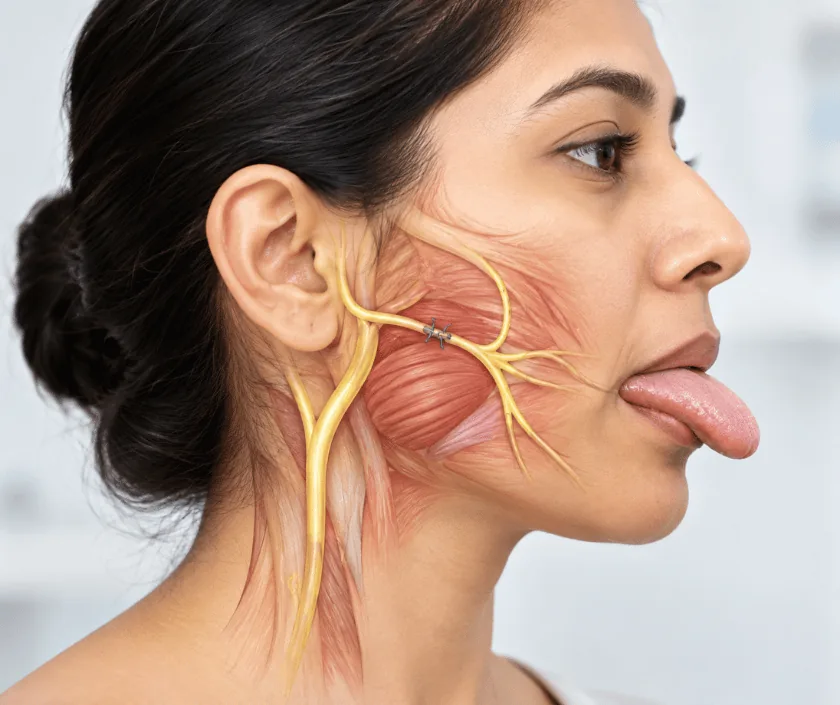
The hypoglossal nerve controls the tongue and sits close to the facial nerve in the neck. Part of it can be redirected to the facial nerve so that the paralysed muscles receive a signal again. Modern technique uses only some of the fibres, which protects speech and swallowing while restoring tone and gradual movement.
Deep in the upper neck, the nerve that moves the tongue runs close to the trunk of the facial nerve. When the facial nerve has been cut or damaged high up, near the base of the skull, a repair at that level may not be possible. Redirecting fibres from the tongue nerve gives the facial muscles a fresh supply and stops them from wasting.
Older techniques divided the whole tongue nerve, which restored the face but left the tongue weak on that side. Current practice takes only a portion of the fibres, sometimes joining them to the facial nerve through a short jump graft. That approach protects speech and swallowing while still delivering a strong enough signal to rebuild tone.
The result is felt first as firmness rather than movement. The cheek stops sagging, the corner of the mouth sits higher, and food is less likely to collect in that side. Movement then follows, triggered at first by pressing the tongue against the teeth. Facial therapy links that action to expression, and many patients gradually need less conscious effort.
It suits people whose main complaint is a slack, sagging face rather than an absent smile, and whose facial muscles can still respond.
Tongue movement, speech and swallowing are checked alongside the face. This matters because the donor nerve has a job of its own, and it must be safe to borrow from it.
Through an incision in a neck crease, the hypoglossal nerve and the trunk of the facial nerve are both exposed. Their positions are confirmed with a stimulator before anything is divided.
Only a portion of the tongue nerve is used. Depending on the anatomy, the fibres are joined directly or through a short graft so that the tongue keeps most of its supply.
Ends are stitched together under magnification with very fine sutures. The join is protected and the wound closed, usually over a small drain that comes out the next day.
A therapist teaches you to press the tongue against the teeth while working the face in a mirror. Regular short sessions link the two actions over the following months.
The neck feels tight and swallowing may seem odd for a day or two. Soft food, sitting upright to eat and prescribed pain relief usually cover this period.
The wound is reviewed and most patients return to light routine. Speech feels normal for the majority, with slight changes settling quickly.
The neck scar is softening and eating is comfortable. Tone in the face may begin to feel firmer, although visible movement is not expected this early.
Resting symmetry improves noticeably and movement starts to appear. Therapy then shapes it, and progress continues over the following year.
Tone usually improves more than movement, and that is the honest strength of this operation. The face looks more even at rest, and photographs often show the change before you feel it. Movement is possible, yet it tends to be a controlled lift rather than an open, spontaneous smile. Some patients notice the face tightening when they speak or swallow, which therapy helps to settle over time.
The main risks concern the donor nerve, so they are discussed carefully before you agree to surgery.
Most instructions concern eating comfortably and looking after the neck wound while it settles.
Current technique uses only part of the nerve, so the tongue usually keeps its movement. Some weakness on that side is possible and is discussed beforehand.
Its real strength is tone and symmetry at rest. Movement improves, yet a wide expressive smile often needs a different or additional procedure.
Most patients speak normally afterwards. Small changes can occur early and usually settle as the tongue adapts.
Facial muscle must still be viable. Once it has wasted, a muscle transfer is the option that makes sense.
At Elegance Clinic in Surat, Dr. Ashutosh Shah assesses tongue function, swallowing and eye closure before recommending a hypoglossal transfer, so the trade offs are clear from the start.

The estimate covers theatre time, anaesthesia, the microsurgical work in the neck, a short hospital stay and follow up reviews. Facial therapy is quoted separately because the number of sessions varies from person to person. Nothing is quoted before an examination, since the technique depends on your anatomy and on how the paralysis began. Insurance often contributes when the nerve was lost during tumour surgery or after trauma, and the team can help with the claim.
These are the questions that come up most often in consultation. If yours is not here, send it on WhatsApp and the team will reply, usually the same day.
Ask your question →Most patients speak and swallow normally afterwards, because only part of the tongue nerve is used. Small changes may be noticed in the first weeks. Any coughing while drinking should be reported quickly so it can be assessed.
Its greatest strength is resting balance rather than expression. The face looks more even and the mouth sits higher, while movement tends to be a controlled lift. A broad spontaneous smile usually needs a different technique or an added one.
Tone often improves before movement, sometimes within a few months. Visible movement generally takes longer and keeps developing across the following year. Therapy is what turns raw signal into usable, controlled expression.
A written estimate is prepared after assessment. It covers theatre time, anaesthesia, hospital charges, the surgical fee and follow up, with therapy listed separately. Insurance may contribute when the paralysis followed tumour surgery or injury.
Usually not, because facial muscles waste when they receive no signal for a long time. In that situation a new muscle is transferred instead. An examination is the only reliable way to know which group you fall into.
Yes, and that is common. Eye protection is treated as the priority, so an eyelid weight or a small tightening procedure may be planned in the same episode of care or shortly beforehand.
Bring any imaging, operation notes from earlier surgery and a list of your medicines. Older photographs of your face before the paralysis are genuinely useful, because they show the smile that the plan is aiming towards.
Seeing patients from across the city and beyond: read about the practice on the plastic surgeon in Surat page, or check what a written estimate covers on the costs and insurance page.
