When the skin over a joint replacement breaks down, the prosthesis beneath is at risk within days. Bringing healthy, well supplied tissue over the area is often what allows the joint to be kept.
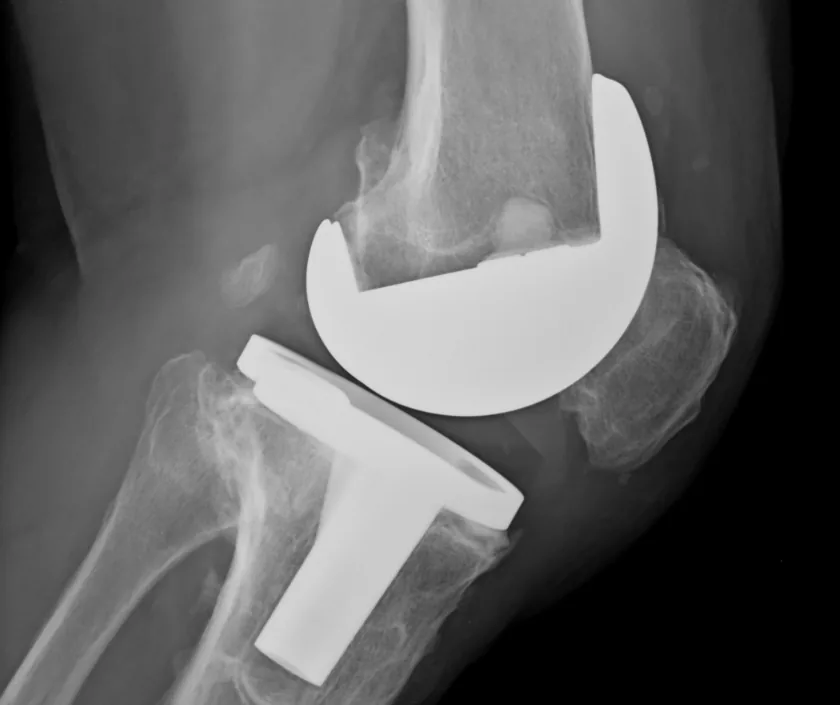
Infected prosthesis coverage is reconstructive surgery that seals an exposed or infected joint replacement with living tissue carrying its own blood supply. Skin over a knee or hip prosthesis is often thin, so once it breaks down bacteria reach the implant quickly. A muscle or fasciocutaneous flap fills the dead space and protects the joint, and it is combined with washout and a long antibiotic course planned with the orthopaedic team.
Timing shapes the whole plan. An exposed prosthesis is treated as urgent, because every day of exposure allows bacteria to settle on its surface. Assessment covers the state of the skin, the stability of the prosthesis on imaging, blood tests, and deep samples taken in theatre to identify the organism accurately.
Surgery begins with a thorough washout. Unhealthy skin edges and infected tissue are excised, the joint is irrigated with large volumes of fluid, and the orthopaedic team decides whether the components can stay. A flap is then raised, most commonly a muscle flap from the calf for the knee, or a local or free flap for other sites, and it is placed over the joint to fill dead space and seal it.
After surgery the flap is monitored closely, antibiotics continue for a prolonged course, and physiotherapy is introduced carefully so that movement returns without putting the repair at risk.
Flap cover suits people whose prosthesis is worth keeping and whose infection is still limited. The final judgement is shared with the orthopaedic surgeon and confirmed during surgery.
Skin, wound and joint are examined, imaging is reviewed for loosening, and blood tests are arranged. The orthopaedic surgeon and the reconstructive surgeon agree a shared plan before theatre.
Unhealthy skin edges and infected tissue are removed, the joint is irrigated thoroughly, and several deep samples are sent for culture. Any exchangeable components may be changed at this point.
The flap is chosen for the site and the size of the defect, most often a calf muscle flap for the knee. Blood supply, previous scars and the donor site are all considered before raising it.
The flap is moved over the joint, shaped to fill dead space and sutured without tension. A skin graft usually covers a muscle flap, and drains are placed to prevent fluid collecting.
A prolonged targeted antibiotic course is planned with the physician and orthopaedic team. Physiotherapy starts within the limits set by the flap, and range of movement is regained gradually.
The flap is checked at short intervals and the limb is rested in the position advised. Intravenous antibiotics continue and drains remain in place while output settles.
Drains come out and the skin graft over a muscle flap begins to take. Careful, limited joint movement usually starts under the physiotherapist's guidance.
The flap is generally stable and the wound healed. Walking and joint range improve steadily, though heavy activity is still avoided and antibiotics may continue.
Flap bulk reduces and the limb feels more natural in use. Joint function keeps improving with therapy, and review continues because deep infection can return quietly.
Success depends far more on the state of the prosthesis and the timing of surgery than on the flap itself. Many joints are kept when cover is done early and the implant is stable, while established deep infection often ends in removal and staged revision. The flap area stays firmer and different in colour, and some bulk usually remains. Joint movement improves with therapy, though stiffness after repeated operations is common.
Flap surgery around an infected joint carries significant risks, and these are set out clearly before consent.
The flap and the joint both need protection, and the two goals have to be balanced carefully.
Skin cannot grow over a foreign surface, and each day of exposure allows more bacteria to settle on the implant.
Not always. A stable prosthesis exposed recently can often be kept when washout and flap cover are done quickly.
Grafts need a well supplied bed and will not survive over metal or bare joint, so a flap with its own circulation is required.
Deep infection can reappear months later, so antibiotics are completed fully and the joint is reviewed for a long period.
Elegance Clinic in Surat plans prosthesis coverage jointly with the orthopaedic surgeon, so the joint and the soft tissue are treated as one problem. Families are given a realistic picture before surgery is arranged.

Cost is influenced by the flap chosen, the length of admission, whether joint components are exchanged, the number of theatre visits and the length of antibiotic treatment. Imaging, cultures and physiotherapy are counted separately. A written estimate is prepared after joint assessment with the orthopaedic team, and the surgical and medical parts are shown separately. If the plan changes to removal and staged revision, a revised estimate is explained before that stage is arranged.
These are the questions that come up most often in consultation. If yours is not here, send it on WhatsApp and the team will reply, usually the same day.
Ask your question →It is urgent. Skin cannot grow across an implant surface, and bacteria settle on it within days of exposure. Early washout and flap cover give the best chance of keeping the joint, so assessment is arranged without delay.
Often yes, when exposure is recent and the implant is still firmly fixed. A loose prosthesis, or one with a long discharging sinus, usually needs removal and staged revision, and that decision is made with the orthopaedic team.
Skin around a joint after several operations is thin and scarred, and stitching it under tension simply breaks down again. A flap brings tissue with its own blood supply, which seals the joint and fills the space beneath.
Cost depends on the flap, hospital stay, any exchange of components and the antibiotic course. A written estimate follows assessment, separating surgical and medical parts, and it is revised openly if the plan shifts towards staged revision.
Recovery can vary considerably. Flaps usually settle over roughly six weeks, while joint movement and walking improve over several months with therapy. Antibiotics often continue after discharge, guided by cultures and blood tests.
Movement usually improves with physiotherapy, though some stiffness is common after repeated operations and a period of rest. The main aim is a sealed, comfortable joint that supports walking, with range of movement improving steadily.
The wound and skin are examined, imaging and previous operation notes are reviewed, and blood tests are arranged. Options including flap cover and staged revision are discussed, along with a written estimate, before surgery is booked.
Each technique below has its own page explaining how it works and when it is chosen.
Seeing patients from across the city and beyond: read about the practice on the plastic surgeon in Surat page, or check what a written estimate covers on the costs and insurance page.
