Every traumatic wound carries dirt, dead tissue and bacteria into the body. Careful surgical cleaning, repeated when needed, decides whether the wound heals cleanly or turns into a long standing problem.
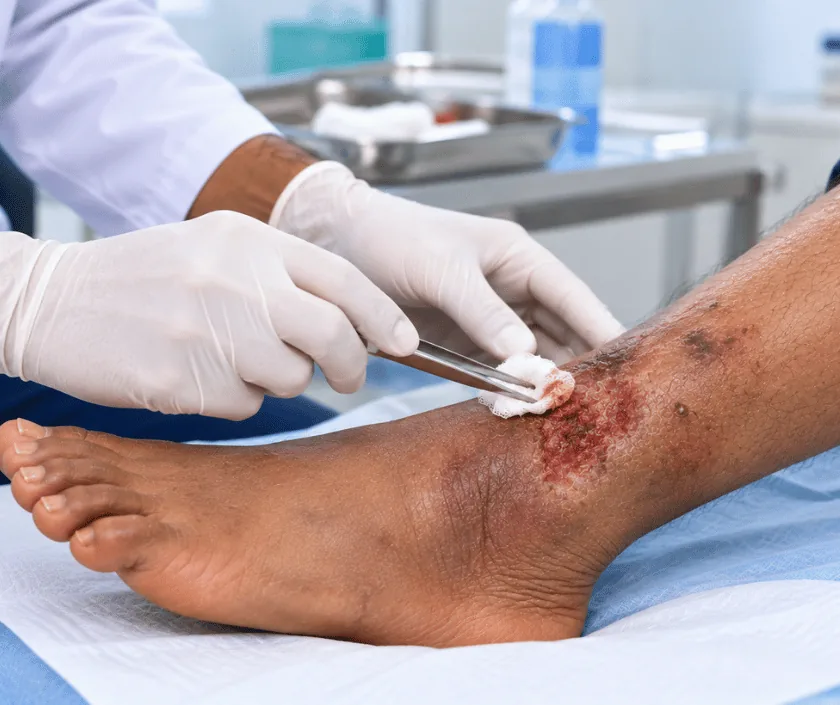
Post traumatic wound debridement is the surgical removal of dead tissue, dirt, grit and contaminated material from a wound caused by injury. It turns a dirty wound into a clean one that the body can heal. Timing matters, and heavily contaminated wounds often need repeat debridement over several days. Once the wound bed is clean, it may be closed directly or covered with a graft or flap.
Assessment starts with the whole patient rather than the wound. Bleeding, fractures, nerve and vessel injury and tetanus status are checked, and an X ray is taken when a fracture or a foreign body is suspected. Photographs help record the starting point, which is useful later when progress is being judged.
In theatre the wound is extended enough to see its full depth. Loose dirt, grit and clot are washed out with large volumes of fluid, and any embedded material is picked out carefully. Skin, fat, fascia and muscle that will not survive are cut back until healthy bleeding tissue is reached, while nerves, vessels and tendon are preserved wherever possible.
What happens next depends on how clean the wound looks. A tidy wound may be closed at once, while a contaminated or crushed wound is dressed and inspected again after a day or two. Once the bed is clean, cover is achieved by direct closure, a skin graft or a flap, according to what lies exposed.
Debridement is offered to anyone with a contaminated or crushed wound. What varies is the timing, how often it is repeated, and how the wound is finally closed.
Bleeding is controlled, circulation and nerve function are checked, and an X ray is taken where a fracture or foreign body is suspected. Tetanus protection and the first antibiotic dose are given without delay.
The wound is irrigated with large volumes of fluid to flush out loose dirt, clot and bacteria. Grit and tar embedded in the skin are lifted out early, since delay makes the marking harder to remove.
Skin, fat, fascia and muscle that does not bleed or contract is cut back to healthy tissue. Nerves, blood vessels and tendon are preserved wherever they can be, and samples are sent when infection is suspected.
Contaminated or crushed wounds are dressed and inspected again in theatre after a day or two. Any tissue that has since died is removed, and this repeats until the wound bed stays healthy.
A clean wound is closed directly, grafted, or covered with a flap where bone, tendon or implant lies exposed. Fracture fixation and reconstruction are coordinated with the orthopaedic team.
The limb is elevated and rested, and pain relief and antibiotics continue. Dressings are checked daily, and a second theatre visit is arranged when contamination was heavy.
Swelling reduces and the wound looks cleaner and pinker. Sutures, grafts or flaps are reviewed, and gentle movement of nearby joints usually begins.
Most wounds are healed or well grafted by now, and scars remain pink and firm. Physiotherapy continues, and lighter work is often possible depending on the site.
Scars soften, flatten and fade slowly. Stiffness and altered sensation may persist, and scar treatment or a small revision can be discussed at this stage.
Healing follows the severity of the injury more than anything done afterwards. A well cleaned wound usually closes without infection, though a scar always remains and its width reflects the original damage. Crushed or degloved areas may need more than one procedure, and colour and texture in grafted skin stay different. Stiffness, numbness and weather related aching can persist for months, and scar treatment can be considered later.
Debridement is a necessary operation, and its risks are mainly those of the injury itself.
Once home, protection and steady movement do most of the work.
Closing a contaminated wound traps bacteria inside, which is why dirty wounds are cleaned, left open and closed once healthy.
Surface antiseptic does not reach grit and dead tissue deep in a wound, and only proper surgical cleaning removes them.
Drugs cannot penetrate dead tissue or dirt, so antibiotics support surgery rather than replace it.
Crushed and heavily contaminated wounds need repeat inspection, because tissue damaged in the injury declares itself over the following days.
Elegance Clinic in Surat treats wound cleaning as the foundation of the whole reconstruction rather than a minor first step. Patients are told at the outset when more than one procedure is likely.

Cost depends on the size and depth of the wound, whether treatment is possible in day care or needs admission, the number of theatre visits and the way the wound is finally closed. Dressings, imaging and any fracture fixation are itemised separately. A written estimate is given after assessment, and it lists each planned stage so families can see what a second look or a later graft would add. Emergency and accident related admissions are often covered by insurance, and the team helps with the paperwork.
These are the questions that come up most often in consultation. If yours is not here, send it on WhatsApp and the team will reply, usually the same day.
Ask your question →Closing a wound that still holds dirt or dead tissue traps bacteria under the skin, and infection follows within days. Cleaning first and closing later gives a much more reliable result, even though it means waiting a little longer.
It depends on the injury. A tidy wound may need one operation, while crushed or heavily contaminated wounds are inspected again after a day or two and cleaned each time until the tissue stays healthy.
Cost reflects the size of the wound, whether admission is needed, the number of theatre visits and the final method of closure. A written estimate after assessment lists each planned stage so the family can plan ahead.
Small, superficial wounds can often be cleaned under local anaesthesia. Deeper or dirtier wounds need regional or general anaesthesia so that cleaning can be thorough, which lowers the chance of infection later.
Recovery can vary with the site and severity. Desk based work is often possible within a couple of weeks, while manual work usually waits until the wound is fully healed and strength has returned.
A scar always remains, and its width reflects the injury rather than the stitching alone. Scars soften and fade over many months, and treatment such as silicone, massage or a later revision can be discussed at review.
Expect examination of the wound, checks of circulation and nerve function, an X ray where needed, and confirmation of tetanus protection. The cleaning plan, likely number of stages and a written estimate are then explained.
Each technique below has its own page explaining how it works and when it is chosen.
Seeing patients from across the city and beyond: read about the practice on the plastic surgeon in Surat page, or check what a written estimate covers on the costs and insurance page.
