Printing turns a scan of your facial skeleton into something the surgeon can hold, or into an implant built layer by layer. It is a manufacturing method rather than a treatment in itself, and its value lies in the planning it allows.
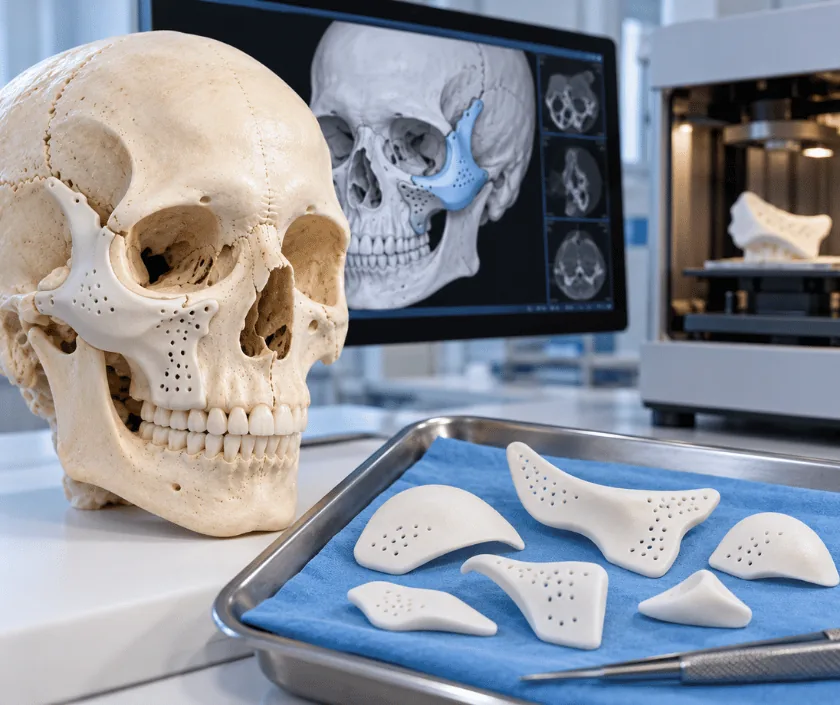
A 3D printed facial implant is built up in thin layers from a digital design based on your own CT scan. The same technology prints practice models of the skull and guides that show where to cut. Printing does not change what surgery can achieve on its own, yet it makes the plan easier to carry out accurately.
Three uses matter in facial work. First is a printed model of the skull, made from a CT scan, which the surgeon can hold, mark and use to bend plates before the operation. Next come cutting and drilling guides, small printed pieces that sit on the bone and show exactly where to work. Third is the implant itself, printed to the shape agreed during planning.
Titanium is printed by melting fine metal powder with a laser, layer upon layer, and the finished surface can be made porous so bone grows into it. Polymers used for skull and forehead reconstruction are printed or milled to a similar plan. Either way the piece is cleaned, sterilised and delivered ready for theatre.
What printing changes is accuracy and rehearsal time, not the biology of healing. A printed implant still has to be covered by healthy tissue, still carries a risk of infection, and still depends on careful surgery. Used sensibly, it shortens time under anaesthesia and helps the result match the plan.
Printing pays off when a shape is complex, one sided or hard to judge during surgery. For straightforward fractures it usually adds cost and delay without adding much else.
A fine cut CT scan is taken so the bone can be modelled accurately. Poor quality images limit everything that follows, which is why this step is never rushed.
That scan becomes a digital model. Surgeon and engineer agree the shape, the screw positions and any guides, then revise the design until it matches the plan.
Implant, model or guide is then printed, finished by hand where needed and sterilised. Delivery of every piece is confirmed before your surgery date is fixed.
Where a model has been printed, plates are bent and cuts marked on it beforehand. Such work happens outside theatre, so it adds nothing to your time asleep.
Under general anaesthesia the bone is exposed, guides are seated if they are used, and the implant is fixed with screws. Position is checked before closing.
Swelling and discomfort are greatest now. Pain relief, head elevation and rest matter most, and any drain usually comes out in this window.
Bruising settles and wounds are checked. Light activity is usually possible, although the area stays numb and tight for longer.
Most normal activity resumes and the new contour begins to show. Contact sport and heavy lifting still wait for clearance.
Swelling has gone and the shape is stable. Reviews confirm the implant has settled and the tissue over it is healthy.
Bone contour usually ends up close to the plan, and symmetry improves in most cases. Skin and muscle over the implant still swell, thin or thicken in their own way, so the visible outcome is a good improvement rather than an exact copy of the model. Judging the final shape takes several months. Printing does not shorten that wait, nor does it remove the risk of infection.
A printed implant is still a foreign material placed under living tissue, so the usual surgical risks apply and are discussed openly beforehand.
Early weeks at home decide how quietly the implant settles, and the instructions are simple enough.
Printing improves the accuracy of shape. Infection, wound healing and nerve injury remain exactly the same concerns as in any facial reconstruction.
Scanning, design, approval, printing and sterilisation together take weeks. Urgent injuries are treated with standard plates, and printed work is kept for planned reconstruction.
Parts printed in titanium are made to engineering standards and are used where load matters, such as the jaw. Material is decided by the site and the job.
Rehearsal often does save theatre time in complex cases. For simple fractures the extra steps add little, so a model is not printed as a matter of routine.
Digital planning at Elegance Clinic in Surat is used where it genuinely changes the operation, and the reasoning is explained so you can see why it is being suggested.

Charges fall into two halves. One is the digital work and the printed part itself, which depends on size, material and how many guides are needed. The other is the operation, driven by theatre time and length of stay. Because those details differ so much between patients, a written estimate follows assessment rather than being quoted upfront. Reconstruction after injury, infection or tumour is usually covered by mediclaim.
These are the questions that come up most often in consultation. If yours is not here, send it on WhatsApp and the team will reply, usually the same day.
Ask your question →Two elements make up the figure, the digital design with the printed part, and the surgery itself. Size, material and the number of guides all matter, as does theatre time. A written estimate is given after assessment so it reflects your own plan.
Reconstruction after injury, infection or tumour removal is usually covered, since it restores form and function. Cosmetic contouring generally is not. Insurers ask for scans, clinical notes and the planning documents, and the team helps put that file together.
Titanium and medical polymers used for printing have long records in surgery and are well tolerated. Infection and wound breakdown over the implant remain the main concerns, particularly where skin is thin. Any redness or discharge should be reviewed early.
Most people manage light work about two to three weeks after surgery, once swelling has settled and wounds are healing. Physical jobs and sport wait longer. Numbness around the site can persist for months while nerves recover. Recovery can vary.
Bone contour usually matches the plan closely. Soft tissue over it swells and settles in its own way, so the visible result is an improvement rather than an exact copy of the model. Several months pass before the shape can be judged.
Rarely. Design and printing take weeks, while most fractures need fixing within days if they are to heal in the right position. Standard plates are used at that stage, and printed work is kept for planned reconstruction later.
Bring any scans, discs or reports you already have, along with a list of your medicines and past operations. Photographs taken before the injury help as well. You will be examined, shown the imaging and given time to consider the plan.
Each technique below has its own page explaining how it works and when it is chosen.
Seeing patients from across the city and beyond: read about the practice on the plastic surgeon in Surat page, or check what a written estimate covers on the costs and insurance page.
