The back of the skull is round, hard and covered by skin that is only a few millimetres thick. In a patient who lies flat for days, that small contact point can break down long before anyone thinks to look there.
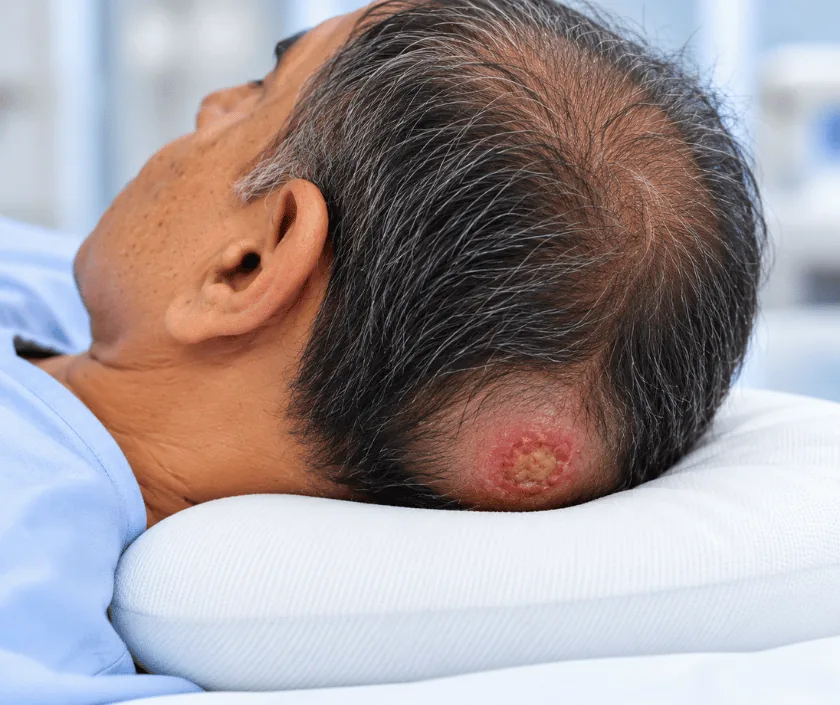
An occipital pressure sore develops on the back of the head, usually in someone kept flat in bed or in intensive care. Skin over the skull is thin with almost no fat beneath it, so damage reaches bone quickly. Treatment relieves pressure by repositioning the head, cleans the wound and uses a scalp flap or graft when bone is exposed.
Run your hand over the back of your head and you will feel bone almost straight away. The scalp there has a thin layer of skin and connective tissue and virtually no fat to cushion it. When a patient lies flat and cannot turn the head, the weight of the skull rests on one small curved area for hours at a stretch.
Intensive care units, prolonged ventilation, sedation and cervical collars after neck injury all remove the small unconscious movements that normally protect this spot. Infants are also at risk, since the head is heavy relative to the body and they may be nursed in one position. Long operations in which the head is fixed in place can cause it too.
The wound is easy to miss. Hair covers it, dressings on other parts of the body draw attention elsewhere, and there is often no complaint of pain from a sedated patient. By the time a damp patch or a smell is noticed, the sore may already reach the outer layer of the skull, which is why scalp checks belong in every daily nursing round.
Many occipital sores settle with repositioning and dressings alone. Surgery is discussed when tissue is dead, when the wound will not close or when the skull is exposed.
The head is repositioned at short regular intervals and a soft support or ring free padding is used. Collars are reviewed and padded so they no longer press on the sore.
Hair around the area is trimmed so the wound can be seen properly. Depth is checked, and imaging is arranged if the skull bone appears to be involved.
Dead tissue is removed and dressings are chosen to suit the wound bed. Swabs guide antibiotics when infection is present, and nutrition is reviewed at the same time.
If bone lies exposed, a local scalp flap is planned, since scalp tissue carries a strong blood supply. A skin graft may be used over healthy tissue in shallower wounds.
The scalp is checked at every dressing change and the positioning routine is taught to attendants, so the same spot does not take pressure again during healing.
Head position is changed frequently and the dressing is kept clean and dry. Pain relief is given and the surrounding scalp is watched for redness or swelling.
Stitches or dressings are reviewed on schedule. Hair begins to regrow around the treated area, and the patient is nursed so the repair takes no direct weight.
Most wounds treated with a flap have settled and the scalp feels less tender. Hair often covers a well healed scar, though a small bald patch can remain.
The area usually looks stable. Regular scalp checks continue for any patient who still spends long hours lying flat, since the risk does not disappear.
Shallow sores often heal with repositioning and dressings, leaving a small area where hair may be thinner. Deeper wounds that need a flap usually close well because the scalp has a rich blood supply. A scar line and a patch without hair can remain. Recovery can vary with the general condition of the patient, and any sore that reaches bone takes noticeably longer to settle.
Scalp procedures are generally well tolerated, though the position of this wound creates its own difficulties. These are explained before consent is taken.
Attention to the head is easy to forget once a patient is home and other wounds have healed. A short daily check keeps this area safe.
The back of the head is a genuine pressure point, and in patients kept flat it can break down before any other site.
A pillow helps, though the head still rests on one spot. Regular repositioning is what actually relieves the pressure.
Hair provides no cushioning at all and mainly hides an early sore from view, which delays treatment.
Shallow ones often do with pressure relief, while wounds reaching bone usually need cleaning and tissue cover.
Elegance Clinic in Surat sees occipital sores in patients who have come through long intensive care stays. Dr. Ashutosh Shah assesses the depth first, then chooses the simplest cover that will hold.

Some occipital sores need nothing more than repositioning and dressings, while others require cleaning under anaesthesia or a scalp flap. Because the range is wide, a written estimate is prepared after the wound has been examined and its depth assessed.
These are the questions that come up most often in consultation. If yours is not here, send it on WhatsApp and the team will reply, usually the same day.
Ask your question →The figure depends on whether the wound needs dressings alone, cleaning under anaesthesia or a scalp flap. A written estimate follows examination of the wound and an assessment of its depth, so the plan and the cost are clear together.
Fitness is assessed before anything is scheduled, including blood tests and a physician review. Many procedures on the scalp can be done under local anaesthesia. If a patient is not yet stable, dressings continue until surgery becomes safe.
Shallow wounds often settle in weeks once pressure is relieved. Deeper ones that expose bone take longer and usually need surgical cover. Recovery can vary with nutrition, general health and how consistently the head is repositioned.
Hair usually regrows around the wound, though a patch of scalp where skin was lost or where a scar sits may stay bare. Flap repairs often bring hair bearing scalp across, which improves the appearance.
To a large extent, yes. Frequent small changes of head position, padded supports, padding under collars and daily scalp inspection are the practical measures that reduce risk in patients who cannot move themselves.
No. Many close with pressure relief, suitable dressings and better nutrition. Surgery is advised when dead tissue must be removed or when the skull is exposed and needs living tissue to cover it.
As soon as a red patch that does not fade, unexplained hair loss or any open area is noticed on the back of the head. Early review usually keeps the problem shallow and simple to treat.
Each technique below has its own page explaining how it works and when it is chosen.
Seeing patients from across the city and beyond: read about the practice on the plastic surgeon in Surat page, or check what a written estimate covers on the costs and insurance page.
