Some defects lose more than skin alone. Composite tissue reconstruction rebuilds wounds involving several layers at once, moving tissue that carries skin, fat, muscle, cartilage or bone as a single unit so shape and function return together.
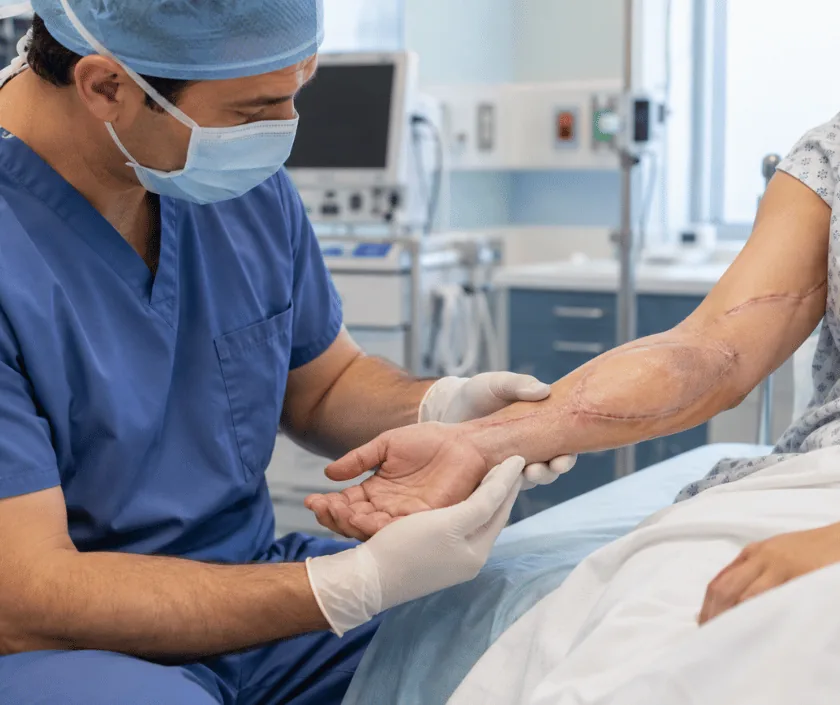
Composite tissue reconstruction rebuilds a defect that involves more than one type of tissue. Instead of covering the wound with skin alone, the surgeon moves a block that includes skin with fat, muscle, cartilage or bone, keeping its blood supply intact. This restores both the shape and the working structure beneath, which matters at the nose, ear, jaw, hand and lower limb.
Not every wound is a skin problem. Trauma, cancer surgery and infection can remove the framework underneath as well, leaving a defect that involves bone, cartilage, muscle or lining alongside the surface. Covering such a wound with skin alone leaves it flat, weak or collapsed. Composite reconstruction addresses the whole thickness by moving tissue that already contains the missing layers.
Tissue can come from nearby or from a distant site. A local flap rotates neighbouring tissue into the gap. A free flap is detached from its donor area and reconnected to blood vessels at the wound using microsurgery. Choice depends on the size of the defect, the layers needed, the state of the surrounding skin and the vessels available.
Planning takes time because these decisions interact. Imaging may be required, the donor site has to be assessed and the sequence of stages agreed. Patients are usually told from the outset that structure comes first and refinement follows, since chasing appearance too early can compromise the repair itself.
These are demanding operations, so fitness for anaesthesia and the state of the tissues both matter. Assessment usually involves more than one visit.
The defect is mapped and the tissues around it examined. Imaging of bone or blood vessels may be arranged, and donor options are discussed with their own scars and recovery explained.
Local, regional and free flap options are compared against what the defect actually needs. That decision balances tissue match, donor cost, vessel quality and how long surgery will take.
Under general anaesthesia the wound is cleaned and prepared, the flap is raised with its blood supply and set into the defect. In free flap work, vessels are joined under a microscope.
Your flap is watched closely in the first days, with colour, warmth and refill checked regularly. Early problems with the blood supply are treated urgently, sometimes by returning to theatre.
Once healing has settled, thinning, scar revision or contour adjustment can be planned. This later stage is about appearance, and it follows rather than competes with structure.
You stay in hospital while the flap is monitored closely. Pain relief, fluids and positioning are managed by the team, and movement is limited at first.
Dressings are changed and drains removed as the wound settles. Physiotherapy often starts here, especially for hand and limb reconstruction.
Wounds are usually healed and rehabilitation is well under way. Many people return to light work, with limits set by the site involved.
Swelling settles, scars soften and function continues to improve. Refinement surgery, if planned, is generally considered from this point.
Composite reconstruction restores structure and cover, and in good cases the shape comes close to what was lost. Scars remain at both the repair and the donor site, and rebuilt tissue rarely matches the original in texture or sensation. Bulk sometimes needs thinning later. Improvement continues across many months, and outcomes are best assessed once swelling has fully settled and rehabilitation has done its work.
These are major operations and the risks deserve careful explanation before consent is given.
A flap needs steady blood flow and protection, so discharge advice is mostly about avoiding anything that threatens either.
A graft needs a healthy bed and provides cover only. Where bone, cartilage or metalwork is exposed, tissue with its own blood supply is required.
Structure is restored first and refinement follows. Planning several stages is normal rather than a sign that something has gone wrong.
Sensation is usually reduced and texture differs. Function and protection are the realistic goals, with appearance improved as far as the tissue allows.
Fitness matters more than the number. Assessment looks at the heart, lungs, blood vessels and diabetes control rather than age by itself.
Elegance Clinic in Surat plans complex reconstruction as a full pathway, from imaging and donor choice through to rehabilitation and later refinement, with each stage explained before it begins.

Cost for composite reconstruction reflects the length of surgery, the type of flap, the hospital stay and any imaging needed beforehand. Free flap work with microsurgery costs more than a local flap because of the time and equipment involved. After assessment we give a written estimate that lists theatre, anaesthesia, stay, implants and review visits. Insurance frequently contributes when surgery follows trauma, infection or cancer treatment.
These are the questions that come up most often in consultation. If yours is not here, send it on WhatsApp and the team will reply, usually the same day.
Ask your question →The figure depends on the type of flap, how long surgery takes, the hospital stay and any imaging beforehand. Microsurgical free flaps sit higher than local flaps. A written estimate covering theatre, stay and reviews is given after assessment, and insurance often contributes.
These are major operations. Main concerns include flap failure, bleeding, clotting and infection, along with the general risks of a long anaesthetic. Fitness is assessed carefully beforehand, and the flap is monitored closely in the first days.
A stay of several days is usual so the flap can be watched. Light activity often resumes around six weeks, though limb and hand reconstruction take longer because rehabilitation forms part of the recovery.
Shape can be restored closely, yet texture, colour and sensation rarely match the original tissue. Scars remain at the repair and the donor site. Refinement surgery later can improve contour once healing is complete.
Fitness for a long anaesthetic, blood vessel quality, diabetes control and smoking status all matter. Age alone is not the deciding factor. Assessment sometimes needs a physician review and imaging before the plan is confirmed.
Timing depends on infection, tissue viability and your general condition. Some wounds are reconstructed early, while others need dressings and cleaning first. Rushing a repair into unhealthy tissue raises the chance of failure, so the decision is made at review.
The defect is examined and photographed, donor options are explained with their scars and recovery, and imaging is arranged if needed. You leave knowing the likely stages, the expected stay and a written estimate.
Each technique below has its own page explaining how it works and when it is chosen.
Seeing patients from across the city and beyond: read about the practice on the plastic surgeon in Surat page, or check what a written estimate covers on the costs and insurance page.
