Vitiligo surgery moves pigment producing cells from normal skin into patches that have lost colour. It is offered only when the vitiligo has been stable for a period, because active disease tends to undo the result.
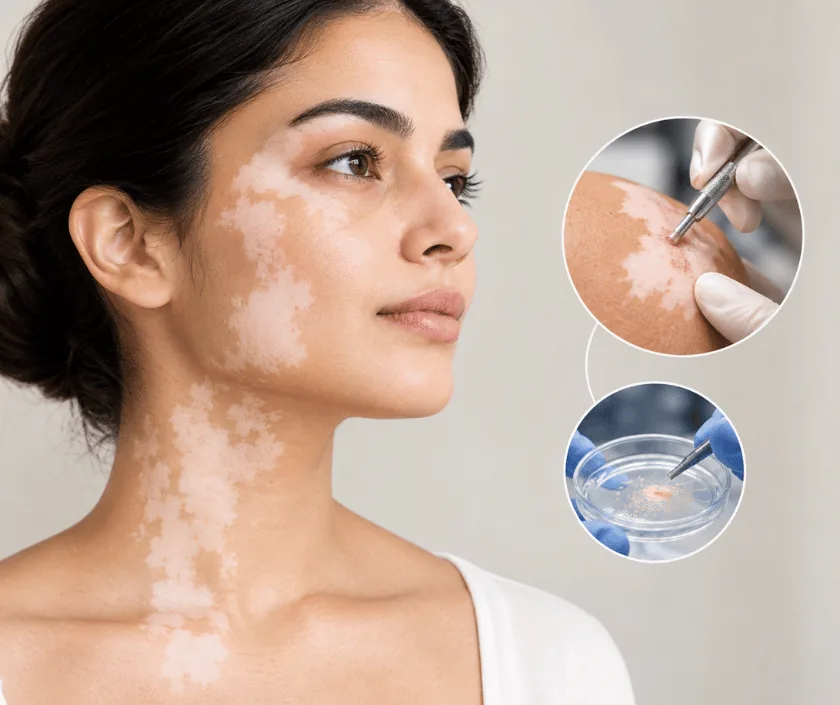
Vitiligo surgery treats patches that have stopped spreading by transferring pigment producing cells, called melanocytes, from your own normal skin. Methods include thin skin grafts, blister grafts and cell suspension transfer. Colour returns gradually over months as the transplanted cells spread across the treated area. Stability of the vitiligo for a period beforehand is the single most important condition.
Vitiligo appears when pigment producing cells are lost from patches of skin, leaving pale areas that stand out most on exposed sites and in deeper skin tones. Creams, light therapy and other medical treatment are the starting point, and many patches repigment with those alone. Surgery enters the picture only for areas that have stopped responding.
The principle is straightforward. Healthy skin carrying melanocytes is taken from a hidden donor area, usually the thigh or buttock, and transferred to the patch after its surface has been prepared. Techniques vary. Very thin grafts, small blister grafts, punch grafts and suspensions of separated cells are all used, chosen according to size, site and the texture of the area.
Stability governs everything here. If patches are still enlarging or new ones are appearing, transplanted cells are likely to be lost in the same way as the originals. Surgeons therefore ask for a period without change before operating, and they check the history carefully. Assessment also covers whether new patches have followed minor injuries, since that pattern suggests activity.
Stability is the first question, and everything else follows from it. A careful history and examination, sometimes with photographs taken over time, decide whether surgery is appropriate.
History, examination and photographs are used to judge whether the vitiligo has been quiet. Where doubt exists, a period of watching is advised before any surgery is planned.
Patch size, site and skin texture guide the choice between thin grafts, blister grafts, punch grafts or a suspension of separated cells. Each has its own advantages.
Under local anaesthesia the surface of the patch is prepared so it can receive the transferred cells. Your donor skin comes from a site usually hidden by clothing.
Cells or graft pieces are placed onto the prepared area and held with a careful dressing. That dressing stays undisturbed for the period advised, since movement can displace the graft.
Dressings are removed at review and light therapy is often added afterwards to encourage the cells to spread. Colour then develops slowly across the following months.
Dressings stay in place and the treated area is kept still. The donor site feels like a graze and is dressed separately.
Dressings are removed at review. The treated area may look pink or uneven, which is expected this early on.
Early pigment often becomes visible, sometimes in spots that gradually join. Light therapy may be started or continued at this stage.
Colour continues to fill in and even out. The result is fairly judged from here, and a touch up procedure can be considered for gaps.
Repigmentation develops slowly, often over several months, and the new colour may sit slightly lighter or darker than surrounding skin. Some areas fill in fully while others stay patchy and need a second procedure. Sites such as fingertips, lips and bony areas respond less predictably. Should the vitiligo become active again, treated areas can lose colour once more, which is why stability is judged so carefully beforehand.
Most risks relate to the graft, the donor site and the future behaviour of the vitiligo itself.
The first week protects the graft, and the following months are about supporting the transferred cells.
Active disease undoes the result. Surgery is offered only after a period without new or enlarging patches.
It is not. Vitiligo results from loss of pigment cells and cannot pass from one person to another by contact.
Surgery treats selected patches. Widespread vitiligo is generally managed medically, with surgery reserved for specific stable areas.
Transferred pigment usually blends well but can sit lighter or darker. Improvement rather than an exact match is the honest expectation.
Elegance Clinic in Surat assesses stability carefully before offering vitiligo surgery, and will advise waiting when the pattern suggests the disease is still active.

Cost depends on the technique used and the total area treated, since a small blister graft and a cell suspension for a large patch differ considerably. Light therapy afterwards is charged separately and often forms part of the plan. After assessing stability and the patches themselves we share a written estimate, including what a second sitting would cost if gaps remain.
These are the questions that come up most often in consultation. If yours is not here, send it on WhatsApp and the team will reply, usually the same day.
Ask your question →Cost varies with the technique and the size of the area treated, since a small blister graft differs greatly from a cell suspension over a wide patch. Light therapy afterwards is charged separately. A written estimate is shared once the patches have been assessed.
It is a day care procedure under local anaesthesia in most cases, using your own skin. Risks include patchy colour, mismatch, texture change at the graft or donor site, and infection. People prone to thickened scars need particular caution.
Dressings stay undisturbed for several days and the area is rested. The donor site heals like a graze over one to two weeks. Colour then develops slowly across months, so patience matters more than downtime here.
Often close, though the treated area can sit slightly lighter or darker than surrounding skin. Some patches fill in evenly while others remain speckled and need a second sitting. Fingertips, lips and bony areas respond least predictably.
Anyone whose patches are still spreading, who develops new patches after minor injuries, or who forms thickened scars easily. Very widespread disease is usually managed medically instead, with surgery reserved for selected stable areas.
A defined period without new patches, enlargement or colour loss at injury sites is required, and the exact length is judged at assessment. Photographs taken over time help confirm this before any procedure is planned.
The patches are examined and photographed, your history of spread is discussed and previous treatments are reviewed. If stability is confirmed, techniques are explained with their advantages and drawbacks, followed by a written estimate.
Seeing patients from across the city and beyond: read about the practice on the plastic surgeon in Surat page, or check what a written estimate covers on the costs and insurance page.
