A TRAM flap rebuilds the breast using skin, fat and part of the straight tummy muscle from below the navel. Because muscle is taken, the abdominal wall needs careful repair and recovery asks a good deal of you.
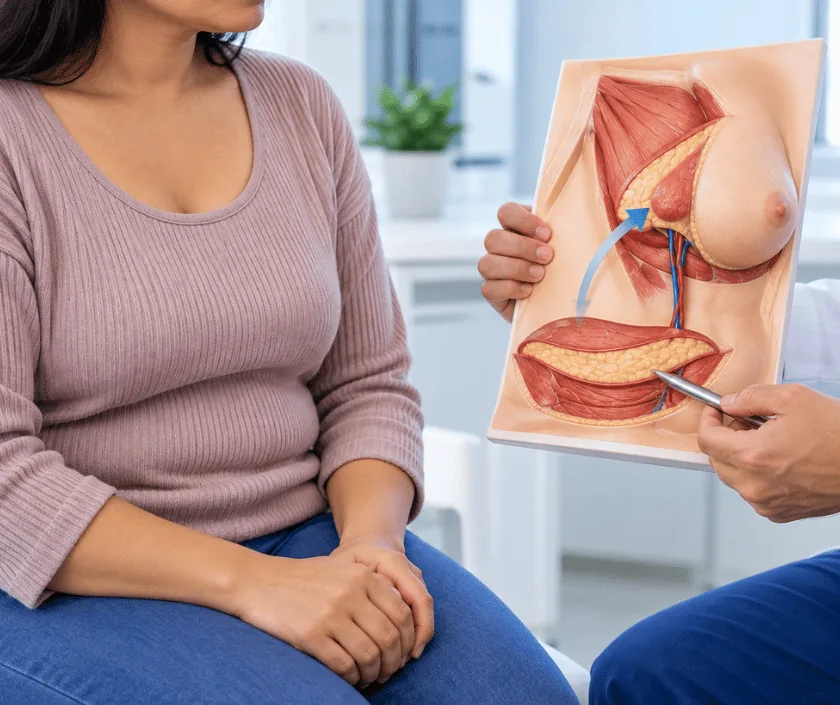
A TRAM flap uses skin, fat and some of the rectus abdominis muscle from the lower tummy to rebuild the breast. The donor area is the abdomen, so you gain a flatter tummy and a long low scar. Taking muscle can weaken the abdominal wall, which is why mesh repair is often used and why DIEP is sometimes preferred.
The rectus abdominis muscles are the two straight bands running down the front of the tummy. A TRAM flap takes lower abdominal skin and fat along with part of one of those muscles, because the muscle carries the blood vessels that keep the tissue alive. That is the essential difference from a DIEP flap, which leaves the muscle in place.
There are two forms. In a pedicled TRAM the tissue stays attached to the muscle and is tunnelled up under the skin to the chest. In a free TRAM the flap is fully detached and its vessels are rejoined with microsurgery. Your surgeon will explain which form suits your anatomy, your previous operations and your cancer plan.
Whichever form is used, the tummy wall is left with a gap where muscle was removed. Surgeons usually reinforce that area with mesh or a careful layered repair. You gain a flatter abdomen and a long low scar, and you lose some core strength, particularly for sitting straight up from lying flat.
A TRAM flap gives a natural feeling breast but asks more of the abdominal wall than other methods, so honest discussion about strength and lifestyle comes first.
Your abdomen, chest and previous scars are examined, and the flap is marked while you stand. Fitness tests are arranged and a written estimate is given before admission.
Under general anaesthesia the lower abdominal skin, fat and part of the rectus muscle are lifted with the blood supply protected. This stage takes several hours.
A pedicled flap is tunnelled under the skin to the chest, while a free flap is detached and its vessels rejoined near the ribs with microsurgery.
Tissue is trimmed and folded into a breast mound, then compared with the other side for size, position and projection while you lie on the table.
The tummy wall is repaired, often with mesh support, the skin is closed low across the hips and the navel is repositioned. Drains are placed at both sites.
The abdomen feels tight and sore. Nurses help you sit and take short walks, and the flap is checked regularly for colour and warmth.
Drains come out as fluid settles. Walking slightly bent forward at first is expected. Coughing and laughing may need a supporting hand over the tummy.
Standing upright is usually comfortable. Light activity resumes, while lifting, core work and driving wait until the abdominal repair is judged sound.
The breast softens and settles. Abdominal strength continues to improve with physiotherapy. Any refinement or nipple reconstruction is planned from this point.
The reconstructed breast usually feels natural and settles into a soft shape over months. It will not be identical to the other side, and the skin patch on the chest often differs a little in colour and texture. Sensation is reduced. On the abdomen you keep a long low scar, a moved navel and, for many women, some lasting loss of core strength. Refinement at a second sitting is common.
Because muscle is taken, this method carries abdominal risks on top of the usual ones, and all of them are discussed before you decide.
The abdominal repair sets the pace of recovery, so protecting it is the main job in the early weeks.
Both use lower abdominal tissue, but a TRAM takes muscle while a DIEP leaves it in place, which changes abdominal strength afterwards.
A flatter abdomen is a by product. The purpose is rebuilding the breast after cancer surgery.
Many women do very well, yet some lasting weakness in strong core movements is possible and is worth expecting as part of the trade.
A TRAM flap can be done years after mastectomy. Waiting until cancer treatment is behind you is a reasonable and common choice.
Elegance Clinic in Surat plans flap reconstruction around your cancer treatment and your daily demands, so the choice between methods is made with full information rather than in haste.

Flap reconstruction using abdominal tissue is priced case by case, because theatre time, hospital stay, mesh reinforcement and any second stage all vary between women. After assessment you receive a written estimate covering surgeon and anaesthesia fees, theatre, ward stay, drains, dressings and follow up visits. Reconstruction after cancer surgery is covered by many insurance policies in India, and the team will help you lodge the request before admission.
These are the questions that come up most often in consultation. If yours is not here, send it on WhatsApp and the team will reply, usually the same day.
Ask your question →Both take skin and fat from the lower tummy. A TRAM flap also takes part of the straight abdominal muscle, whereas a DIEP flap dissects the feeding vessels out and leaves the muscle behind. That usually means less abdominal weakness after a DIEP.
Bulging or hernia is one of the recognised risks, since muscle is removed from the tummy wall. Mesh reinforcement and careful repair reduce the chance. Avoiding heavy lifting during recovery and following the physiotherapy programme both help protect the repair.
The abdomen sets the pace. Most women walk bent forward for a while, straighten up over several weeks and return to light work after that. Heavy lifting and core exercise wait considerably longer. Recovery can vary, so timing is agreed as you progress.
Yes. The flap is your own fat and skin, so it behaves like the rest of your body. Gaining or losing weight will change the size of the reconstructed breast, which is one reason a stable weight before surgery is encouraged.
A written estimate follows your assessment, since theatre time, hospital stay, mesh if used and any second stage all affect the figure. Reconstruction after cancer surgery is covered by many insurers in India, so share the estimate with your insurer early.
Often yes, since a low caesarean scar usually sits within the tissue that would be removed anyway. Other abdominal operations can be more of a problem if they have divided the blood vessels, and a scan may be used to check.
No. Many women complete cancer treatment first and come back to the question later, sometimes years later. The abdominal tissue remains available. Taking time to think, or deciding against reconstruction altogether, is entirely reasonable.
Each technique below has its own page explaining how it works and when it is chosen.
Seeing patients from across the city and beyond: read about the practice on the plastic surgeon in Surat page, or check what a written estimate covers on the costs and insurance page.
