Plain gauze sticks to a burn and has to come off often, which hurts and disturbs healing. Advanced dressings are engineered to hold the right moisture, hold germ numbers down, and stay in place for longer between changes.
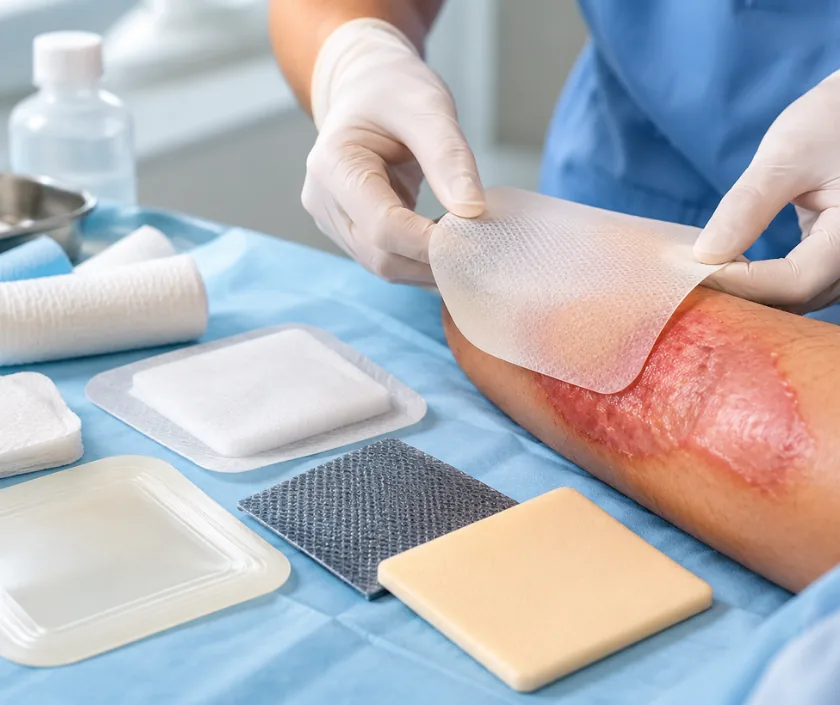
Advanced burn dressings are modern wound coverings that do more than absorb fluid. Depending on the type, they keep the wound surface moist, soak up heavy discharge, release silver or another antimicrobial, or sit against the wound without sticking to it. Because many stay in place for several days, changes are fewer, less painful and less disruptive to new tissue.
For a long time burns were dressed with gauze and an ointment, changed daily. That approach works, but it has costs. Gauze dries onto the surface, so removal pulls away the fragile new cells that were forming, and each change is painful enough that children often need sedation. Modern dressings were developed to solve those problems.
Several families of product are used. Foam and hydrofibre dressings absorb heavy discharge while holding a moist layer at the wound surface. Silver dressings release small amounts of silver to keep bacterial numbers down over several days. Silicone contact layers sit gently on the wound and release without tearing new tissue. Hydrocolloids suit small, shallow, low discharge burns. Biological dressings and skin substitutes are used to cover large areas temporarily or to prepare a bed for grafting.
Choice depends on depth, position, how much the wound is discharging, whether infection is suspected and how easily the patient can attend for changes. The same burn often needs different dressings at different stages, and the plan is reviewed at each visit rather than fixed at the start.
Advanced dressings help most in wounds expected to heal on their own, and in areas where comfort and fewer changes make a real difference.
The wound is examined for depth, discharge and any sign of infection, then cleaned gently with a saline or antiseptic solution. Loose dead skin is trimmed so the dressing can sit against living tissue.
Medication is given before the dressing begins, not afterwards. For large areas, or for children, light sedation or a short anaesthetic may be arranged so the change can be done calmly.
A product is selected for the wound at this stage, then applied with a contact layer against the surface and an absorbent layer over it. Padding and a bandage hold everything in position.
The nurse notes when the dressing is next due, based on the product and the amount of discharge. Families are shown what strike through looks like and told when to come in sooner.
At each change the wound is reassessed and the dressing may be switched. If a wound is not healing on schedule, surgical options such as grafting are discussed rather than continuing indefinitely.
The first dressing is applied and left undisturbed unless there is a problem. Elevation and pain relief matter as much as the dressing itself.
Shallow burns often show new skin forming. Dressings are changed at set intervals, and the product may be stepped down as discharge reduces.
Most superficial wounds are closed. Attention moves to moisturising, itch control and protecting fragile new skin from friction and sun.
Scar management continues with massage and pressure garments where advised, and colour differences slowly become less noticeable.
Shallow burns treated with suitable dressings often heal well and with limited scarring. Depth remains the main factor, so a deep burn will still need surgery no matter which product is used. Healing time can vary between people with similar looking wounds, and pigment changes in new skin are common for many months. Dressings support healing rather than replacing the body own repair.
Modern dressings are generally well tolerated, though they are not free of problems and they cannot do everything.
Most of the time between changes is spent at home, so a few habits protect both the dressing and the wound.
Depth decides healing. A deep burn needs dead tissue removed and a skin graft, and no dressing changes that fact however advanced it is.
Unnecessary changes strip away the new cell layer and cause pain. Many modern dressings are designed to stay in place for several days for exactly that reason.
Wounds heal better in a controlled moist environment. Exposure dries the surface, deepens the injury and invites contamination.
Silver reduces bacteria on the wound surface only. Infection that has spread into the body still needs antibiotics chosen on the basis of test results.
Elegance Clinic in Surat matches the dressing to the wound and to the family circumstances, so treatment is practical as well as clinically sound.

Dressing costs vary widely because the products themselves differ in price and because the number of changes depends on the wound. A small burn dressed with a silicone layer costs very little compared with a large area needing silver dressings and sedation for each change.
We give a written estimate after assessing the wound, including the likely number of changes, and we discuss alternatives when a cheaper product would work equally well. Dressings during an inpatient stay are usually covered by mediclaim.
These are the questions that come up most often in consultation. If yours is not here, send it on WhatsApp and the team will reply, usually the same day.
Ask your question →A written estimate is given after the wound is assessed, because price depends on the area covered, the product chosen and how many changes are likely. Where a less expensive dressing would serve equally well, that option is offered and explained.
Dressings used during an inpatient admission are generally included in covered treatment under mediclaim policies. Outpatient dressing visits after discharge are handled differently by different policies, so it helps to confirm the terms before a long course begins.
Most products are widely used in children, and reducing the number of painful changes is a particular benefit at that age. Some materials are avoided in very young infants, so selection is made individually after examining the wound.
It depends on the product and how much the wound is discharging. Certain dressings are designed to stay in place for several days, while heavily discharging wounds need more frequent attention. Your nurse will give you a specific return date.
Indirectly they can help, because faster healing with less infection tends to leave a better scar. Depth still matters most. Wounds that take a long time to close are more likely to scar noticeably whatever dressing is used.
Usually not. Deep burns have lost the cells that regrow skin, so they need dead tissue removed and a skin graft. Continuing dressings for weeks in that situation delays healing and increases the infection risk.
Ask which product is being used and why, when the next change is due, what warning signs to watch for at home, and what the materials will cost across the expected course. Written instructions are provided to take away.
Each technique below has its own page explaining how it works and when it is chosen.
Seeing patients from across the city and beyond: read about the practice on the plastic surgeon in Surat page, or check what a written estimate covers on the costs and insurance page.
