Healed burn skin tightens as it matures, and movement is what keeps it from pulling a joint out of shape. This page explains how physiotherapy and splinting work together in Surat, what families do at home and what the plan costs.
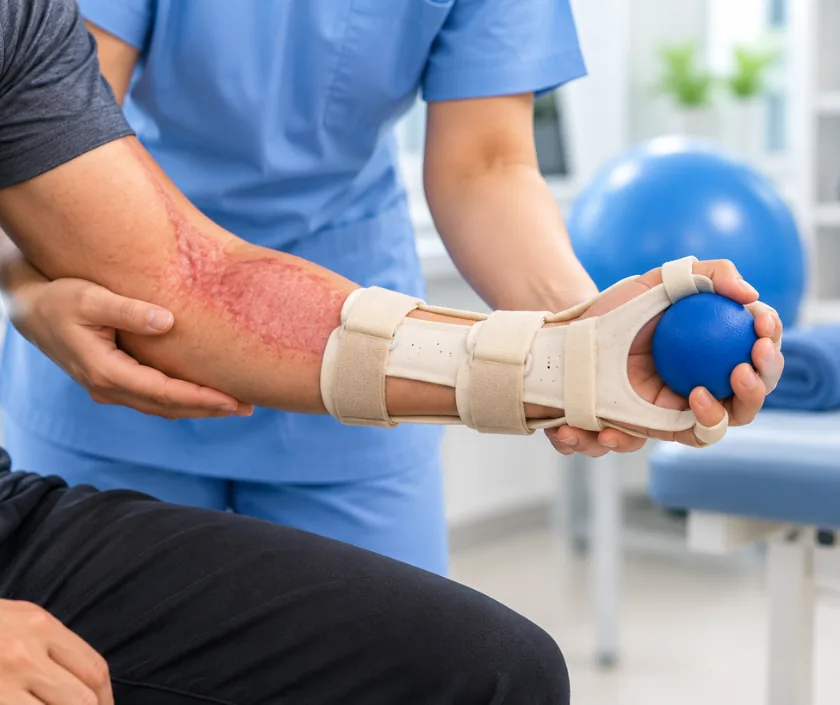
Burn physiotherapy and splinting keep healed skin long and joints moving while a scar matures. Therapists teach stretches, positioning and daily activity, and a splint holds a hand, elbow or neck in a safe position between sessions. Work usually continues for many months, because scar tissue keeps contracting until it settles. Commitment at home decides much of the result.
Skin that heals after a deep burn is not the same as the skin it replaces. New scar tissue is thick, it holds less water and it shrinks steadily for months while it remodels. Across a joint that shrinkage pulls, so an elbow slowly bends, a neck tips forward or fingers curl into the palm. Therapy exists to fight that pull every single day.
A therapist assesses how far each joint moves, then teaches stretches that take the scar to its full length and hold it there. Exercise is paired with ordinary activity, because using a hand to eat or dress does more than a set of repetitions alone. Positioning is taught too, so the neck stays extended and the shoulder stays open during rest.
Splints carry the plan through the hours nobody is exercising. Made from moulded thermoplastic or fitted from soft material, a splint keeps the joint at the end of its range while the patient sleeps or rests. Wearing schedules change as the scar softens, and splints are remade when a child grows or the shape of the scar shifts.
Almost everyone recovering from a deep burn needs some therapy, though the intensity and the use of splints vary a great deal.
Each affected joint is measured for how far it bends and straightens, and the scar is examined for thickness and tightness. Grip, daily tasks and any pain during movement are recorded as a starting point.
You are taught stretches that take the scar to its full length and hold it steadily, without bouncing. Sessions are short and repeated through the day rather than done once, since scar tissue responds to regular gentle load.
Thermoplastic is warmed, moulded directly on the limb and trimmed so the joint rests at the end of its range. Straps are adjusted, pressure points are checked and the wearing time is written down for you.
A parent or partner is shown how to stretch, how to put the splint on and how to check the skin underneath. Practising in front of the therapist first makes the routine far easier at home.
Movement is measured again at each visit and the splint is reheated or remade as the scar changes. Growth in children, and softening of the scar in adults, both call for regular adjustment.
Sessions start gently while new skin is still fragile. Stretches are brief, splints are worn for longer periods, and the skin under every strap is inspected each time the splint comes off.
Scar activity is at its highest now, so this is the period that decides most of the final range. Stretching happens several times a day and splint hours are usually longest.
Many patients regain a working range by this stage. Splint wear often shifts to night only, while daytime movement comes from ordinary tasks and work.
The scar gradually flattens and softens, and pull reduces. Therapy tapers rather than stops, and children return for reassessment because growth can tighten a scar again.
Therapy protects movement, but it does not remove a scar or make skin look normal. Many patients regain a range that lets them work and care for themselves, while a few still need surgery for a band that will not stretch. Progress is slow and easy to lose, so weeks of missed practice usually show at the next measurement. Recovery can vary widely with the depth and site of the burn.
Therapy is safe when it is supervised, though a splint that fits badly or a stretch pushed too hard can cause harm.
Most of this treatment happens in your own house, so a simple routine matters more than a complicated one.
Closure is the start of scar maturation, and the tightening that follows lasts many months.
Splints hold a position, while movement keeps the joint healthy. Both are needed together.
A firm pulling feeling is expected, but sharp pain means the stretch is too strong and skin may split.
Growing limbs outpace scar tissue, so children often need therapy repeated for years.
Burn care at Elegance Clinic in Surat treats therapy as part of the surgical plan rather than an afterthought. Dr. Ashutosh Shah and the team set out the rehabilitation schedule at the same visit as the operation.

Cost depends on how many joints are involved, how many sessions are needed each week, whether custom splints have to be made and remade, and how long the programme runs. Children usually need splints replaced as they grow, which adds to the total across a year. After your assessment you receive a written estimate covering therapy sessions and any splints, so there is no surprise later.
These are the questions that come up most often in consultation. If yours is not here, send it on WhatsApp and the team will reply, usually the same day.
Ask your question →Charges depend on the number of joints treated, how often you attend and whether custom splints are made. Since every burn is different, a written estimate is prepared after the first assessment. Ask about insurance cover at that visit, because policies treat rehabilitation differently.
Supervised stretching is safe once the skin has closed and the therapist has judged it strong enough. A pulling sensation is normal, while sharp pain, blistering or splitting is not. Report those signs, because the programme can be adjusted rather than stopped.
Wearing time is highest while the scar is active and reduces as it softens. Many patients move to night time wear after a few months, then stop when measurements stay steady. Your therapist writes the schedule down and changes it at review.
No treatment removes a burn scar. Therapy protects movement and helps the scar settle flatter and softer, and it lowers the chance of needing a release operation. Appearance improves slowly over many months, but healed burn skin keeps a different texture.
Late referral is common and still worth acting on. Old scars respond less to stretching than fresh ones, so a mature tight band may need surgical release before therapy can restore range. An assessment will show which situation applies.
Positioning and gentle movement usually start while the patient is still in hospital, long before the wound is fully closed. Full stretching waits until the skin has healed or a graft has taken. Starting early gives the best chance of keeping range.
Each joint is measured, the scar is examined and your daily difficulties are discussed. Photographs are often taken for comparison. You then learn the first set of stretches, and a splint is moulded the same day where one is needed.
Each technique below has its own page explaining how it works and when it is chosen.
Seeing patients from across the city and beyond: read about the practice on the plastic surgeon in Surat page, or check what a written estimate covers on the costs and insurance page.
