Fractional carbon dioxide laser softens tight, thick burn scars by making thousands of tiny channels that heal with more pliable tissue. This page explains how the treatment is given in Surat, what a course involves and what it cannot do.
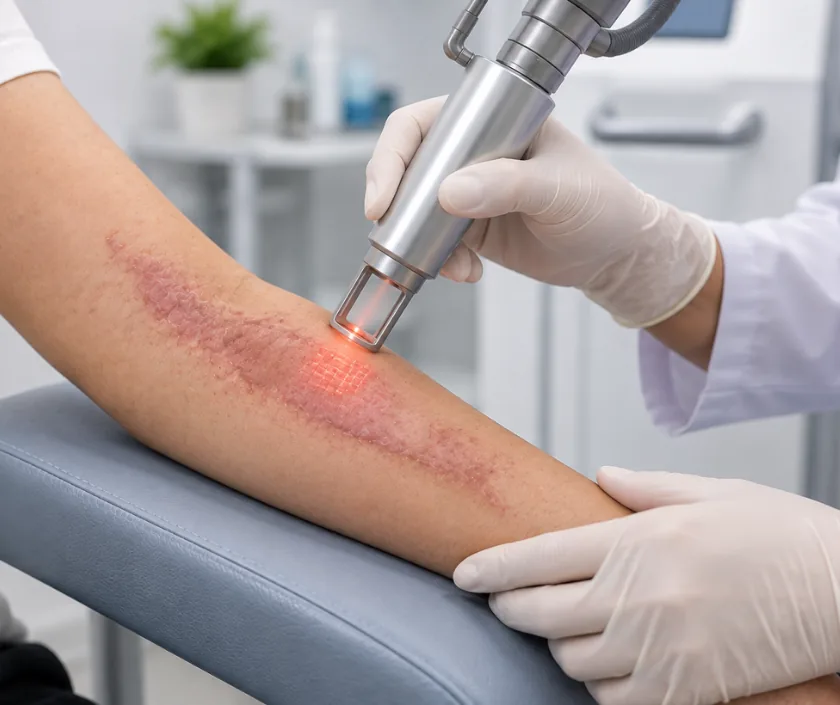
Fractional carbon dioxide laser treats burn scars by delivering microscopic columns of heat into the scar, leaving healthy skin between them to speed healing. Over a course of sessions the scar often becomes softer, smoother and less tight, and colour may even out. Treatment is repeated every few months, and it improves a scar rather than removing it.
Thick burn scars are made of dense collagen laid down in disorganised bundles, which is why they feel stiff and pull on the skin around them. A fractional carbon dioxide laser sends a grid of very fine beams into that tissue. Each beam creates a narrow column of controlled injury, while untouched skin between the columns supplies the cells that heal it.
Healing after each session appears to reorganise collagen, so the scar gradually becomes more pliable. Depth and density of the beams are chosen for the scar in front of the surgeon, since a tight band across a joint is treated differently from a flat discoloured patch. Numbing cream is often enough for a small area, while larger scars or children may need sedation or general anaesthesia.
One session is never the whole treatment. Sessions are spaced several months apart to let the scar remodel, and most people are advised to continue garments, silicone and stretching throughout the course. Improvement builds session by session and is judged with photographs rather than memory.
Laser suits people whose burn has healed but whose scar remains thick, tight or uneven despite months of garments and silicone.
Your scar is examined for thickness, colour and how it limits movement, and photographs are taken. Skin tone is considered carefully, because darker skin needs gentler settings to reduce the risk of pigment change.
Anaesthetic cream is applied and left for some time before treatment. Larger areas, children and very sensitive scars may be treated under sedation or general anaesthesia instead, which is discussed and planned in advance.
Eye protection is worn by everyone in the room. The handpiece is passed over the scar in a set pattern, and settings are adjusted between areas so a thick band receives deeper treatment than thin skin nearby.
Cold air or packs are used to settle the heat, then an ointment or light dressing goes on. Most people go home the same day with written instructions for washing, moisturising and sun protection.
Progress is reviewed against photographs after a few months, once the scar has had time to remodel. Settings for the following session are adjusted according to how the scar responded and how the skin healed.
The treated area feels hot and looks red and swollen, rather like sunburn. Cool packs and simple pain relief usually manage it, and ointment is applied as instructed to keep the surface moist.
Tiny crusts form and then lift on their own. Picking at them risks marks, so the area is washed gently and left alone. Many people return to work within this window.
Redness fades slowly and the skin can look darker than usual, particularly in Indian skin tones. Sun protection matters most during this stage, and stretching resumes once healing is complete.
Softening continues quietly in the background, and the change from one session is often modest. Assessment for the next session happens now, guided by photographs and by how the scar moves.
Laser improves a burn scar. It does not remove one, and anyone hoping for skin that looks untouched will be disappointed. Most people notice softer, more pliable tissue and a smoother surface across a course of sessions, with changes building slowly rather than appearing after the first treatment. Very thick bands across a joint may still need surgical release, and results can vary with skin tone and scar age.
Laser treatment on scarred skin carries real risks, and they are higher in the darker skin tones common in India, so settings are chosen cautiously.
What you do in the fortnight after each session affects the result as much as the session itself.
A course spread over months is standard, and each session adds a modest amount of improvement.
Treatment reorganises collagen so the scar softens and smooths, yet the scar remains visible.
Darker skin does carry a higher risk of pigment change, which is managed with gentler settings, test areas and strict sun protection.
Those treatments continue throughout, because laser works best as part of a whole plan.
Laser at Elegance Clinic in Surat is offered as one part of a burn scar plan rather than a standalone package. Dr. Ashutosh Shah assesses whether surgery, therapy or laser will help most before any course is booked.

Cost is worked out per session and depends on the area treated, the type of anaesthesia needed and how many sessions the scar is likely to require. Children treated under general anaesthesia carry theatre and anaesthetic charges as well. After assessment you receive a written estimate for a single session and for the expected course, so the whole commitment is clear before you start.
These are the questions that come up most often in consultation. If yours is not here, send it on WhatsApp and the team will reply, usually the same day.
Ask your question →Charges are set per session and depend on the area treated and whether numbing cream, sedation or general anaesthesia is used. Because a course is usually needed, the written estimate given after assessment covers both a single session and the expected total.
It can be used safely, though darker skin carries a higher chance of pigment change. Settings are kept gentler, a test area may be treated first and strict sun protection is advised afterwards. Discuss your history of pigmentation at the assessment.
Redness and swelling are worst in the first few days, and fine crusts usually lift within about a week. Many people return to work once the crusts have gone. Sun protection continues well beyond that, because treated skin darkens easily.
That depends on the thickness of the scar and how it responds. A course rather than a single treatment is the norm, with sessions spaced months apart so the scar can remodel. Progress is reviewed with photographs before each further session is booked.
Older scars can respond, although change is usually slower and more limited than in a scar that is still maturing. An assessment looks at thickness, colour and how far the scar restricts movement, then sets out what improvement is realistic for you.
The wound must be fully healed and the skin stable before any laser is used. Many surgeons begin once the scar is maturing, since tissue that is still remodelling tends to respond well. Your surgeon will judge readiness at examination.
Your scar is examined and photographed, movement is checked and your skin tone is assessed. Options including surgery, therapy and laser are compared honestly. If laser is suitable, you will hear how many sessions are likely and what the written estimate covers.
Seeing patients from across the city and beyond: read about the practice on the plastic surgeon in Surat page, or check what a written estimate covers on the costs and insurance page.
