Early excision and grafting means clearing dead burn tissue within the first days and covering the raw area in the same admission. This page explains the reasoning behind that timing, how sittings are planned and what recovery involves.
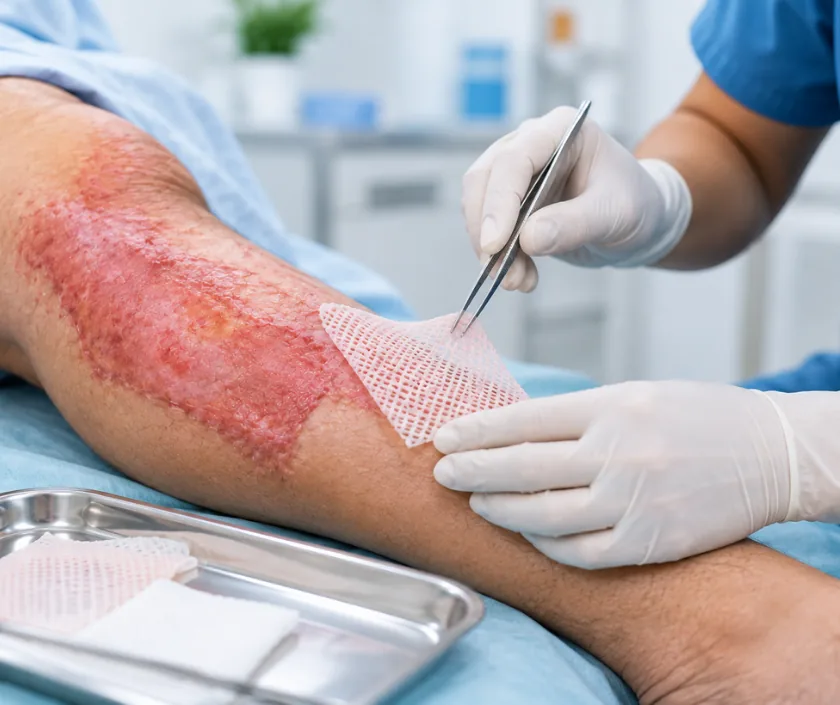
Early excision and grafting is a strategy rather than a single operation. Dead burn tissue is removed within the first days after injury, and the raw surface is covered with skin taken from an unburned area during the same admission. Closing the wound sooner reduces infection risk, limits fluid loss and helps patients start moving earlier.
An open burn is not a stable wound. Fluid, protein and heat leak from the surface every hour, and dead tissue on top gives bacteria a place to multiply. Older practice was to wait for that dead layer to separate on its own, which took weeks and left patients exposed the whole time.
Current practice moves in the other direction. Once resuscitation is settled and blood is arranged, the surgeon removes burned tissue and covers the raw bed with a graft in the same sitting. For a smaller burn that may be one operation. Larger burns are different, because the body cannot tolerate everything at once, so the team plans a series of sittings a few days apart, taking a defined area each time and returning when the patient has recovered.
Donor skin is the limiting factor in extensive burns. Thin sheets are taken from the thigh, back or scalp, meshed to stretch further, and the same donor area can be harvested again after it heals. Where donor skin runs short, temporary cover holds the wound until more becomes available.
The strategy suits burns that clearly will not heal on their own within a reasonable time. Suitability is judged from depth, area and how well the patient is holding up.
Fluids, warming, pain relief and wound assessment come first. Burn area and depth are mapped, blood is arranged and other injuries are ruled out before any operation is planned.
The team marks the areas to be excised in this sitting and estimates how much donor skin will be needed. Larger burns are divided deliberately so no single operation becomes too long.
Dead tissue is removed under general anaesthesia, shaving in layers or excising to a deeper plane where the burn is full thickness. Bleeding is controlled and the bed is checked before cover.
Thin sheets of skin are taken from an unburned area, meshed if needed and laid on the prepared bed. Staples, sutures or glue hold the graft while dressings and splints protect it.
Once the patient has recovered, the team returns for the next area. Donor sites are reused after healing, and the sequence continues until the wound is closed.
Care focuses on fluids, warmth, pain relief and nutrition. Grafts are left undisturbed and limbs are kept still. Blood counts are watched, since excision and harvesting both cause loss.
First inspection shows how much of the graft has taken. Small gaps are dressed and may close on their own. Physiotherapy begins gently, and feeding is pushed hard because healing needs protein.
Most grafted areas are closed and donor sites have usually healed. Pressure garments, silicone and moisturiser start. Splints continue at night where a joint is at risk of tightening.
Scars remain active for a long time, changing in colour, thickness and stiffness. Reviews continue, and any release of tight scar is planned only once the tissue has settled.
Wound closure is the first goal, and appearance comes second. Grafted skin stays different in colour and texture, meshed grafts leave a visible pattern, and donor sites heal with a mark of their own. Movement usually improves once therapy is underway. Many patients need further procedures later to release tightness or improve contour, and that is planned rather than a sign of failure.
These operations are done on patients under real physiological strain, so the risks are discussed frankly before consent is taken.
Discharge is a change of setting, not the end of treatment. The routine at home decides how well the result holds.
Waiting does make depth clearer, but it also leaves the body exposed for longer. Early closure is usually the safer choice.
Larger burns are closed over several planned sittings, and further work on scars is often needed later.
Grafts that take and stay are taken from the patient. Skin from another person can only cover temporarily.
Scar management, splinting and therapy run for many months and matter as much as the operation itself.
Acute burn care at Elegance Clinic in Surat is run as a planned sequence, with the family told at each stage what has been done and what comes next. Estimates are put in writing before admission wherever possible.

Cost follows the size of the burn more than anything else, because it drives the number of sittings, theatre time, transfusion needs, dressings and length of stay. Intensive care, nutrition support and physiotherapy add to the total where they are required. A written estimate is prepared after assessment, and the office checks what a policy or a government scheme will cover before admission.
These are the questions that come up most often in consultation. If yours is not here, send it on WhatsApp and the team will reply, usually the same day.
Ask your question →Total cost depends on burn size, the number of sittings, theatre and anaesthesia time, transfusion, dressings and how long the stay turns out to be. A written estimate is prepared after assessment, and insurance or scheme cover is verified before admission wherever possible.
An open burn keeps losing heat, fluid and protein while dead tissue feeds bacteria. Closing the surface earlier reduces those losses and lowers infection risk. Surgery still waits until resuscitation is settled and blood has been arranged, so timing is judged patient by patient.
Repeated anaesthesia carries added strain, which is why sittings are spaced and each one is limited in length. The anaesthetic team reviews blood counts, temperature control and breathing before every procedure. Staging exists precisely so that no single operation asks too much of the body.
Recovery varies widely with the size and depth of the burn. Grafted areas usually settle over the first weeks, donor sites heal in their own time, and therapy continues well beyond discharge. Scars stay active for many months, so reviews are spread across a long period.
Grafted skin heals paler, darker or shinier than surrounding skin, and meshed grafts leave a net like pattern. Appearance improves gradually with pressure garments, silicone and time. Closing the wound and restoring function come first, with contour and colour addressed later.
Superficial burns that are already healing need dressings, pain relief and time rather than theatre. Small deep patches sometimes settle with careful wound care. Depth is reassessed over several days, so a plan made on day one can reasonably change later.
Burn area and depth are mapped, photographs may be taken with consent, and blood tests are sent. Fitness for anaesthesia is reviewed and blood is arranged. The staged plan, the likely number of sittings and the estimate are explained to the family before consent.
Each technique below has its own page explaining how it works and when it is chosen.
Seeing patients from across the city and beyond: read about the practice on the plastic surgeon in Surat page, or check what a written estimate covers on the costs and insurance page.
