Burn scar across the front of the neck shortens as it heals and slowly draws the chin down towards the chest. Neck contracture release divides that band and resurfaces the gap, so the head can lift, turn and rest naturally again.
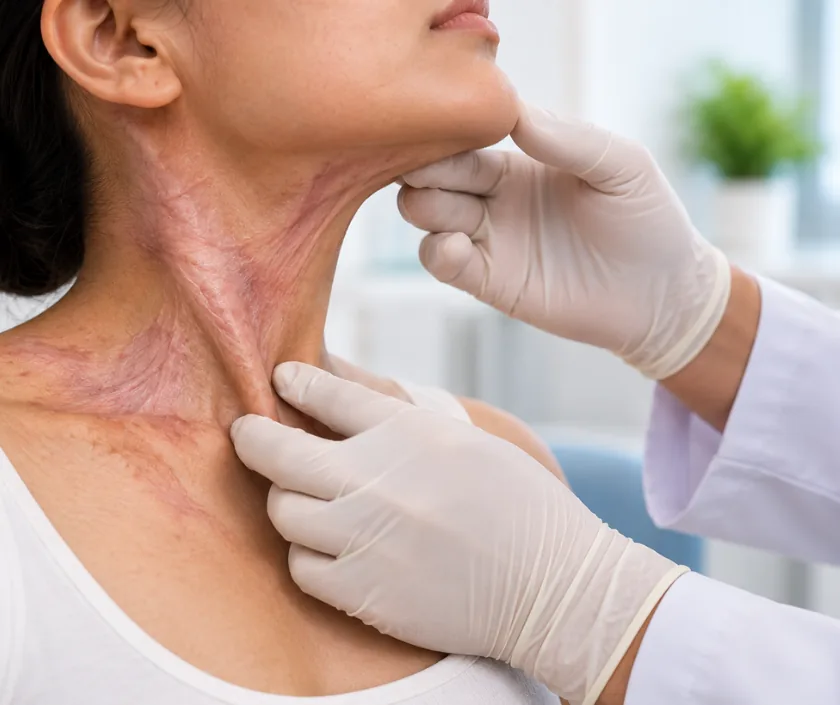
Neck contracture release is surgery that cuts the tight burn scar band pulling the chin towards the chest, then covers the raw area with a skin graft or a flap. Because that same scar limits mouth opening and head tilt, the anaesthetic is planned with extra care. A soft collar and daily therapy afterwards hold the length that has been gained.
Scar on the front of the neck behaves differently from scar elsewhere. There is little spare skin here, the area moves with every swallow and every turn of the head, and the scar lies directly over structures that matter. As it matures and shortens, it takes the chin along with it. Many people first notice that looking up at a fan or a ceiling is no longer possible, then that shaving, wearing a collar or fastening a chain has become awkward.
A tight neck rarely stays a neck problem. The pull travels upward and can drag the lower lip and chin downward, so the mouth no longer closes fully. Saliva escapes, eating turns messy and speech changes. Sleep suffers too, because the head cannot rest flat. Children may develop a stooped posture and, over years, changes in the jaw and the bite.
Surgery restores length. Once the band is divided across and the neck extends, the gap that opens is resurfaced with a thick skin graft or with a flap of healthy skin from the chest or shoulder. Holding the neck extended afterwards is what preserves the result.
Release is considered once the burn has healed and the neck scar has settled into a firm band that limits movement or mouth closure. Timing in children follows growth rather than the calendar.
Since a tight neck limits mouth opening and head tilt, the anaesthetist plans the airway before anything else. A flexible scope, an awake technique or dividing part of the band under local anaesthesia may all be considered.
With the head turned and extended as far as it will go, the tightest cords stand out and are marked. Photographs, a record of mouth opening and a therapy review help decide between a graft and a flap.
Under anaesthesia the band is cut across so that the chin lifts and the neck lengthens. Deeper structures are protected throughout, and the true size of the raw area becomes clear only once the head extends.
Narrow bands can be lengthened by rearranging local skin as Z shaped flaps. Broader raw areas need a thick skin graft, while a heavily scarred neck may be resurfaced with a flap raised from the chest or shoulder.
Before waking, the neck is settled in an extended position and supported with a collar or a moulded splint. That position protects the new cover and stops the scar folding back on itself as it heals.
The head stays extended and slightly raised, swallowing is checked, pain is controlled with medicine, and the first dressing is usually left undisturbed unless there is a concern.
Dressings are changed and graft take is assessed. Gentle neck movement begins under guidance, and most people go home wearing a collar with clear instructions on when it may come off.
Stretching becomes more active, neck extension and mouth opening are measured again, and scar care with massage, silicone or pressure often starts around this stage.
Scar softens slowly and movement is reviewed at follow up. Collar wear at night may continue for a long while, and growing children are watched closely for tightening.
Neck movement usually improves a great deal, and mouth closure often improves along with it. Even so, the neck will not look like skin that was never burned. Grafted areas commonly keep a different colour and texture, and a scar line remains at the edges. How much length is held depends heavily on collar wear and daily stretching at home. Gradual tightening is common as the scar matures, and a further smaller release is sometimes needed, above all in a child who is still growing.
Neck scar surgery carries the usual risks of an operation plus a few specific to this area, and they are worth talking through before a date is fixed.
What happens at home over the following months decides how much of the new length is kept, so plan for it before discharge.
Healed neck scar shortens instead of stretching. Without release and therapy, the pull on the chin usually increases over the first year after the burn.
Release provides the length, though the collar and daily stretching are what hold it. Stopping them early is the commonest reason the chin drops down again.
Growth makes it worse, because scar does not lengthen with the child. Neck contractures in childhood often need review and sometimes further surgery as height increases.
Tight neck skin limits mouth opening and head tilt, which makes airway management harder. That is planned in detail beforehand and is one reason the surgery belongs in hospital.
Neck burn reconstruction at Elegance Clinic in Surat is planned with the anaesthetist and the therapist from the first consultation, so the airway plan, the collar and the stretching programme are agreed before a date is fixed.

A neck contracture release counts as reconstructive surgery in India, so most health insurance policies and many government schemes cover it once the loss of function is documented. The final figure depends on how wide the raw area turns out to be, whether a graft or a flap is used, the length of stay and the collar and therapy that follow. You will be given a written estimate before admission.
These are the questions that come up most often in consultation. If yours is not here, send it on WhatsApp and the team will reply, usually the same day.
Ask your question →Cost usually falls in a band of Rs 45,000 to Rs 1.6L, depending on how wide the raw area proves to be, whether a graft or a flap is used and how long you stay in hospital. A written estimate is given before admission.
Releasing a neck contracture restores movement and mouth closure rather than changing appearance, so mediclaim policies and government schemes generally allow it. Approval needs photographs, a note on the movement lost and the treating team paperwork. Policy waiting periods and room limits still apply.
Tight neck skin limits mouth opening and head tilt, which makes reaching the airway harder. That is why the anaesthetist assesses you beforehand and plans a technique such as a flexible scope. Managed in a hospital with the right equipment, this is handled routinely.
Most people go home within a few days, once the dressing has settled and swallowing feels comfortable. Gentle movement starts in the first weeks, and stronger stretching follows as the graft matures. Collar wear at night and home exercises often continue for many months.
Movement usually improves markedly, though the skin will still look grafted. Colour and texture differ from the surrounding neck, and a scar line remains at the edges. Scar care, sun protection and time all help the appearance settle, yet the burn history stays visible.
Surgery is usually planned once the burn has healed and the scar has matured, because tissue handles better then. Children are treated earlier when the pull affects jaw growth, posture or school life. An open or infected wound must settle before a release is booked.
Neck extension and mouth opening are measured, the scar band is examined with the head turned, and photographs are taken for records and insurance. Graft and flap options are explained, along with the airway plan, the collar and therapy. You leave with a written plan and estimate.
Each technique below has its own page explaining how it works and when it is chosen.
Seeing patients from across the city and beyond: read about the practice on the plastic surgeon in Surat page, or check what a written estimate covers on the costs and insurance page.
