A sealed foam dressing joined to a small pump can do something an ordinary bandage cannot. Gentle continuous suction pulls excess fluid away, holds a skin graft steadily against its bed, and encourages the wound surface to fill in.
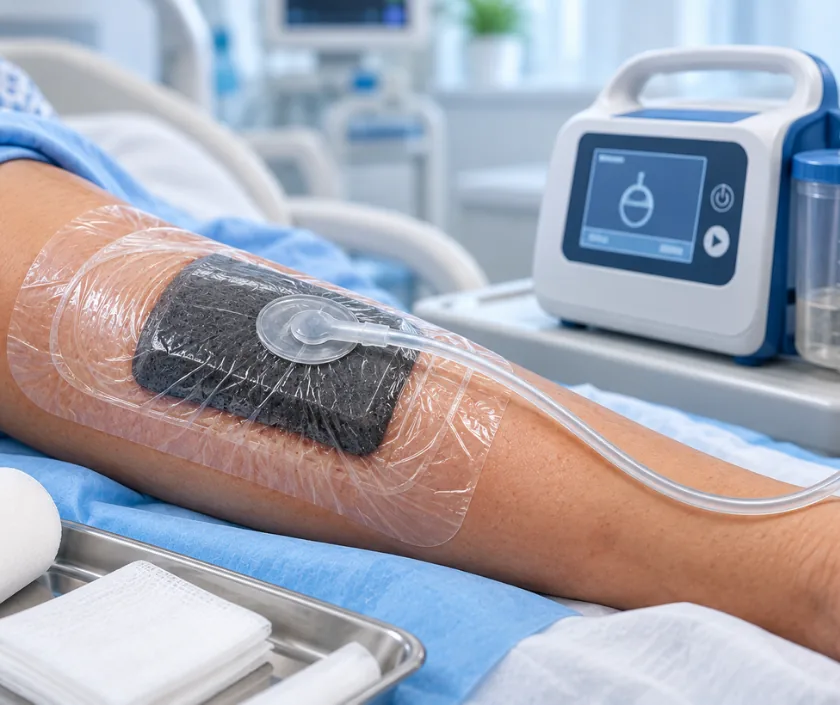
NPWT stands for negative pressure wound therapy, commonly called a vacuum dressing. A foam sponge is laid into the wound, sealed under a clear film and connected by tubing to a pump that applies gentle suction. Fluid drains into a canister, swelling reduces, and the wound edges are drawn together. In burns it is used mainly over skin grafts and open wounds.
The idea behind negative pressure is simple. A piece of open cell foam is cut to the shape of the wound and laid in. Clear adhesive film seals it, a small port is fixed on top, and tubing runs to a pump. When the pump starts, gentle suction is spread evenly across the whole wound surface, and fluid drains into a collection canister.
Several useful things follow. Excess fluid and swelling are drawn away, which improves blood flow in the surrounding tissue. Wound edges are pulled slightly inward. The sealed film keeps the environment moist and stops outside contamination reaching the surface. Over a fresh skin graft the foam works as an even splint, holding the graft in contact with its bed so that new blood vessels can grow into it, which is especially valuable over an awkward curve such as a shoulder or the back of a hand.
Application is normally done in theatre at the time of grafting, or in the dressing room under sedation. The dressing then stays undisturbed for a few days. Because there is no daily unwrapping, patients are more comfortable and new tissue is left alone to do its work.
A vacuum dressing helps in specific situations rather than as a routine covering for every burn wound.
Dead tissue is removed first, because suction over dead tissue achieves little. The wound is cleaned and any bleeding is controlled, and the surrounding skin is dried carefully so that the film will stick.
Foam is cut to fit the wound exactly and laid in without overlapping healthy skin. Over a fresh graft a non adherent contact layer is placed first, so the foam never rests directly on the new graft.
Clear film is applied over the foam and a margin of surrounding skin, a small hole is made and the port is stuck on. Tubing connects to the pump, which is set to the pressure and mode chosen.
The foam visibly collapses when suction begins, which confirms a good seal. Nurses record canister output, check for leaks and monitor pain and circulation. Alarms are attended to promptly so therapy is not interrupted.
The dressing is changed every few days, usually with pain relief and sometimes sedation. Once the graft has taken or the wound bed is healthy, the therapy is stopped and conventional dressings continue.
The dressing stays sealed and undisturbed. You may feel a mild pulling sensation. Output in the canister is measured and the limb is kept elevated.
The first change reveals whether a graft has taken. Foam is replaced or the therapy is stopped in favour of ordinary dressings.
Most wounds are closed or healing steadily. Moisturising, itch control and gentle movement of nearby joints become the priorities.
Scar treatment continues with massage and pressure garments where advised, and grafted skin gradually softens and settles in colour.
Used in the right wound, a vacuum dressing improves graft take and keeps swelling under control. It does not shorten the healing of a deep burn on its own, and it cannot rescue a wound that still contains dead tissue or untreated infection. Some grafts still fail in part and need a second procedure. Comfort between changes is usually better than with conventional dressings.
The therapy is widely used and generally well tolerated, but there are real limitations worth understanding before starting.
The pump is portable, so ordinary life continues around it with a few sensible precautions.
Suction removes fluid, not established infection. Infected tissue still needs surgical removal, and infection in the body needs antibiotics guided by test results.
Most people describe a mild pulling feeling that settles quickly. Discomfort is usually greatest at dressing changes, and pain relief is given beforehand.
It is often chosen for practical reasons, such as holding a graft on a shoulder or reducing how often a dressing needs changing.
Therapy works through continuous suction. Long periods with the pump off allow fluid to build up and can loosen a graft, so gaps are avoided.
Elegance Clinic in Surat uses vacuum dressings where they genuinely add something, and explains the reasoning and the cost before starting rather than afterwards.

Cost depends on the size of the wound, how many foam kits are used, how long the therapy runs and whether application happens in theatre. Because those factors are only clear after the wound is assessed, we quote a written estimate rather than a fixed package.
When the therapy is used during an inpatient admission it is usually included in covered treatment under mediclaim, subject to your policy terms. Our team files the preauthorisation and keeps you updated on the running account.
These are the questions that come up most often in consultation. If yours is not here, send it on WhatsApp and the team will reply, usually the same day.
Ask your question →A written estimate follows assessment of the wound, since the figure depends on wound size, the number of foam kits used, how long therapy continues and whether it is applied in theatre. Alternatives are discussed when a simpler dressing would work.
Used during an inpatient admission, this therapy is generally treated as part of covered treatment under mediclaim policies, subject to sum insured and policy terms. Preauthorisation is filed early so that any limits are known before therapy begins.
Most people feel a mild pulling sensation for the first few minutes and then stop noticing it. The uncomfortable moment is the dressing change, so pain relief is given beforehand and sedation is arranged when needed.
It varies with the wound. Over a fresh skin graft it often runs until the first planned change, while a deep open wound may need it for longer. The plan is reviewed at every change rather than fixed at the beginning.
Usually yes. The pumps are portable and run on battery between charges, so walking and physiotherapy are encouraged. You will be shown how to carry the unit and how to keep the tubing free from kinks.
It helps in situations where an ordinary dressing struggles to hold a graft still, such as over a shoulder, a joint or the back of a hand. Graft take also depends on a clean wound bed and good general health.
Contact the team promptly. A leaking dressing stops delivering therapy and the wound can start to soak. Do not try to patch it yourself with tape, as trapped fluid under a poor seal raises the infection risk.
Each technique below has its own page explaining how it works and when it is chosen.
Seeing patients from across the city and beyond: read about the practice on the plastic surgeon in Surat page, or check what a written estimate covers on the costs and insurance page.
