A venous leg ulcer forms when the valves inside leg veins stop working and blood pools around the ankle. Compression is the mainstay of treatment, and surgery is aimed at the faulty veins or at resurfacing a stubborn ulcer.
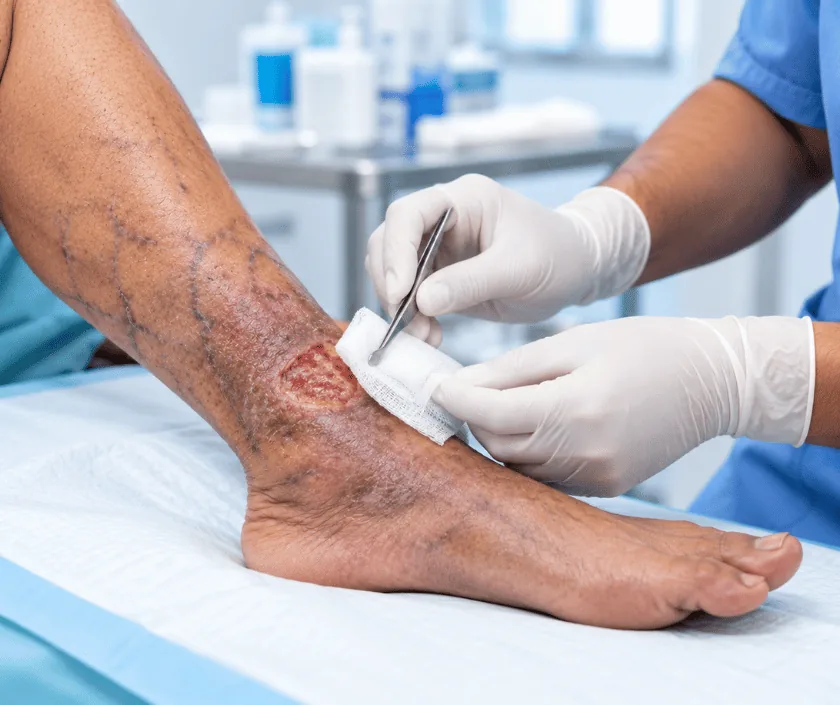
A venous leg ulcer is an open wound near the ankle caused by valves inside the leg veins failing, which lets blood pool and pressure build in the skin. Compression bandaging or stockings remain the mainstay of treatment. Surgery is added to correct the faulty veins, or to resurface an ulcer that will not close on its own.
Leg veins carry blood upwards against gravity. Small valves inside them stop it falling back between heartbeats, and the calf muscle acts as a pump each time you walk. When those valves fail, blood slips downwards and pressure rises in the smallest vessels of the skin around the ankle.
Skin under that pressure changes slowly. It darkens, thickens and itches, and the ankle may swell by evening. Eventually a knock or a scratch opens it, and the wound stays open because the pressure that caused it is still there. Dressings alone treat the surface while the cause continues underneath, which is why so many of these ulcers drag on for months.
Effective treatment reverses that pressure. Firm graduated compression, applied once arterial flow has been checked, supports the veins and lets the calf pump work again. Where scans show veins leaking backwards, a procedure to close or remove them lowers pressure at its source. A stubborn ulcer that has been cleaned and compressed may then be resurfaced with a skin graft.
Almost everyone with a venous ulcer needs compression. Whether vein surgery or grafting is added depends on the scan and on how the ulcer behaves.
The leg is examined, the ulcer is measured and photographed, and pulses are checked. A pressure comparison between arm and ankle plus a scan of the veins guide everything that follows.
Once arterial flow is confirmed as adequate, graduated compression is applied. Technique matters here, so it is applied and reviewed by trained staff rather than left to chance.
Dead tissue and hard skin at the edges are removed, and a simple dressing sits underneath the compression. Elaborate dressings add little while compression is doing the work.
If the scan shows leaking veins, they are closed or removed. These procedures are usually done in day care, and walking is encouraged straight afterwards.
A clean ulcer that stays open despite good compression may be resurfaced with a thin skin graft, which is then protected by compression while it takes.
Compression feels firm at first and the leg may ache as swelling reduces. Walking is encouraged, since the calf pump only works when you move.
Bandages are changed at planned visits and the ulcer is measured each time. Many patients notice less discharge and a tidier wound edge by the second visit.
A good number of ulcers have shrunk considerably by now. Those that have not are reassessed, and vein treatment or grafting is then discussed.
Once healed, stockings continue for the long term. Reviews check the skin and the veins, because return of the ulcer is the main risk after closure.
Many venous ulcers close with consistent compression, and closure is the main goal. Even so, the vein problem underneath does not disappear, so stockings are usually needed afterwards and ulcers can return if those are abandoned. Skin near the ankle often stays darker and firmer than elsewhere. Healing times can vary widely with the size of the ulcer and how long it has been open.
Compression and vein procedures are both generally well tolerated, though there are drawbacks worth understanding first.
Compression and movement do the heavy lifting here, and most of that happens at home rather than in clinic.
Compression heals venous ulcers. Dressings keep the surface comfortable while the pressure problem is corrected.
The faulty valves are still there, so stopping compression is the commonest reason an ulcer comes back.
Elevation helps, yet walking is what drives the calf pump, so movement is encouraged alongside rest.
Vein treatment reduces pressure and lowers recurrence, but compression and wound care are still needed for closure.
Elegance Clinic in Surat treats the ulcer and the veins as one problem, so the scan, the compression and any procedure are planned in a single conversation rather than across scattered visits.

Cost depends on how long compression is needed, whether a vein procedure is added and whether the ulcer is finally grafted. Compression bandaging is charged per visit, while vein procedures and grafting are estimated as day care procedures. A written estimate is prepared after the scan, so you can see what each part contributes. Insurance cover differs for vein procedures and for dressing visits, so your policy is checked before treatment begins.
These are the questions that come up most often in consultation. If yours is not here, send it on WhatsApp and the team will reply, usually the same day.
Ask your question →Cost depends on how many compression visits are needed, whether the veins are treated and whether a graft is used. A written estimate is prepared after the scan, and compression visits, procedures and grafting are listed separately so the total is clear.
No, and that is why arterial flow is checked first. Firm compression on a leg with poor arterial supply can damage the skin. Where arterial disease is found, lighter compression or vascular treatment is arranged instead.
Healing can vary widely with the size of the ulcer and how long it has been open. Many improve steadily over weeks of consistent compression. Progress is measured at every visit so the plan can change if nothing moves.
It can, especially if stockings are stopped. Wearing compression daily and treating the faulty veins both reduce that risk considerably, which is why review continues after the wound has closed.
Not everyone does. A scan shows whether veins are leaking and whether closing them would help. Vein treatment mainly reduces the chance of recurrence, while compression remains the treatment that closes the ulcer.
Usually when a clean, well compressed ulcer is large and has stopped shrinking. Grafting can shorten the time to closure, though compression must continue afterwards or the graft is unlikely to survive.
The leg is examined, the ulcer measured and photographed, and pulses checked with a pressure comparison between arm and ankle. A vein scan is arranged. Compression is usually started at that visit once it has been confirmed as safe.
Each technique below has its own page explaining how it works and when it is chosen.
Seeing patients from across the city and beyond: read about the practice on the plastic surgeon in Surat page, or check what a written estimate covers on the costs and insurance page.
