Children with a cleft through the gum need bone placed in that gap before the adult teeth arrive. This page explains how alveolar bone grafting is timed in Surat, what the operation involves and what it costs.
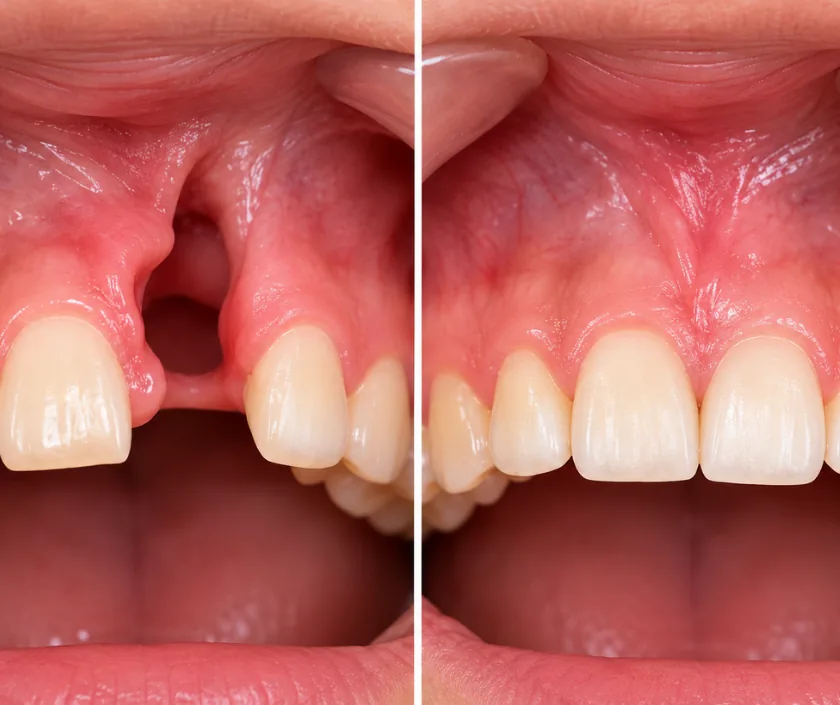
Alveolar bone grafting fills the gap in the bony gum ridge left by a cleft. Bone is taken from the hip and packed into the cleft after the gum is closed on both the mouth and nose sides. Timing is guided by the dental age of the child, usually before the canine tooth comes through.
In a full cleft the split runs through the gum ridge that carries the teeth, not only the lip and palate. That ridge is called the alveolus. Without bone across the gap, adult teeth near the cleft have nowhere to erupt, the arch stays unstable and food or air can pass between the mouth and the nose.
Grafting closes that gap with bone from the child. Spongy bone is taken from the crest of the hip, which refills over the following months. The gum is closed in layers first, so the graft sits in a sealed pocket, and the nose floor on that side gains support at the same time.
Timing follows tooth development rather than birthdays. An orthodontist watches the roots of the canine on X ray films and advises the window when the graft will best serve the erupting tooth. Braces often start before the graft and continue afterwards, so the two teams work to one plan.
The right moment is chosen from dental X rays and a joint examination by the surgeon and the orthodontist. It is a narrow window, which is why reviews are scheduled closely at this age.
Braces are often used first to widen and line up the upper arch. Films are taken so the roots of nearby teeth are seen clearly and the right window for surgery is chosen.
Under general anaesthesia the gum is lifted on both the mouth side and the nose side of the cleft. Each layer is stitched so the future graft lies in a sealed pocket.
Spongy bone is collected through a small cut over the crest of the hip. The outer shell is left in place and the site refills with new bone over the following months.
The bone is packed firmly into the cleft, up to the floor of the nose. Careful filling supports the nasal base and gives the canine a path to travel along.
The gum is closed over the graft and the hip wound is stitched and dressed. Soft diet, gentle mouth care and pain relief are arranged before your child goes home.
Your child stays a night for pain relief and fluids. The hip is usually sorer than the mouth. Walking starts gently on the first day, and only liquids or soft food are allowed.
Mouth swelling settles and the hip becomes comfortable. Most children go back to school in this period. Soft diet continues and brushing near the graft follows the advice given.
A film is taken to see how the bone has taken. Normal diet is usually allowed again. Orthodontic treatment restarts once healing has been confirmed.
The canine is watched as it moves into the grafted bone. Braces guide it into place, and a missing tooth can be replaced later if one never appears.
Most grafts take well and the canine comes through into the new bone over the following months, usually with braces guiding it. Some of the grafted bone is absorbed as it settles, which is expected and planned for. A small number of children need a second graft if too little bone remains. The hip stays sore for a week or two before walking returns to normal. The result is judged on X rays as well as on how the mouth looks.
Bone grafting for a cleft is a well established step in cleft care and most children heal without trouble. A few problems are worth knowing about before the day.
Most of the care is about food, mouth hygiene and keeping pressure off the new bone while it joins.
Timing follows the adult canine on X ray. Waiting too long can mean losing the chance to guide that tooth into place.
Only the outer layer of the hip rim is used, and children return to normal activity once the soreness settles.
Bone taken from the child is still the usual choice, because it carries living cells that help the graft join.
The graft creates bone. Teeth still need guiding into position afterwards.
This is one stage in a long cleft journey, and families value having the whole path explained rather than just the next appointment.

Cost depends on whether one or both sides are grafted, the anaesthetic time, the length of stay and any dental work done in the same sitting. Films and orthodontic treatment are usually billed separately by the dental team. Many children are treated under PM JAY, and staff help with scheme paperwork before admission. A written estimate is shared after assessment.
These are the questions that come up most often in consultation. If yours is not here, send it on WhatsApp and the team will reply, usually the same day.
Ask your question →The published band runs from about Rs 60,000 to Rs 1.1L. Grafting both sides, longer anaesthetic time and a longer stay push the figure up. Many children are covered under PM JAY, so ask about scheme eligibility at the first visit.
Only spongy bone from inside the hip crest is taken, and the outer shell is left in place. The site refills over the following months. Children walk within a day or two, though the hip stays sore for a short while.
Most children stay one night and return to school within one to two weeks. Soft food is used while the gum heals, and a film at about six to twelve weeks shows how well the bone has taken.
When timing is right, the canine usually erupts into the new bone and braces guide it into the arch. Some grafts take less well and need repeating. If a tooth is missing altogether, an implant or bridge can be considered later.
The window is set by tooth development rather than by age alone, generally in the mixed dentition years before the canine erupts. An orthodontist reviews films and advises when the moment has come. Earlier or later grafting is sometimes appropriate.
Grafting after the canine has already erupted is still worthwhile for arch stability, for closing an opening to the nose and for supporting the nasal base. Options for the tooth itself narrow, so an orthodontic review is worth booking as soon as the question arises.
The cleft in the gum is examined, films are reviewed with the dental team and the state of the arch is checked. You will hear whether braces come first, when the window is likely to open and what the estimate and scheme cover would be.
Each technique below has its own page explaining how it works and when it is chosen.
Seeing patients from across the city and beyond: read about the practice on the plastic surgeon in Surat page, or check what a written estimate covers on the costs and insurance page.
