Some children are born with a named syndrome that affects the skull, the eye sockets, the cheeks and the jaws together. This page explains how craniofacial syndromes are assessed in Surat and how care is staged through childhood.
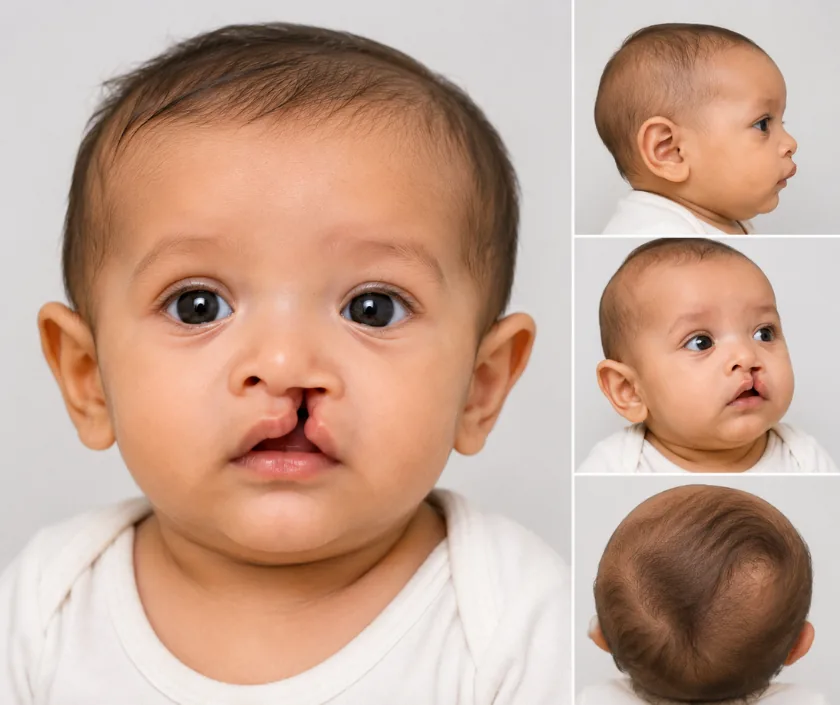
Craniofacial syndromes are named conditions in which several parts of the skull and face are affected together, such as the eye sockets, cheekbones, jaws and ears. Care is shared by a team and staged across childhood, beginning with breathing, feeding, hearing and vision, then moving to skull, midface and jaw surgery as growth allows.
A syndrome means a set of features that occur together for one underlying reason. In craniofacial syndromes the skull seams, the middle of the face, the jaws, the ears and sometimes the hands are all involved. Names such as Apert, Crouzon and Treacher Collins describe recognised patterns, and each has its own likely course.
Because so many structures are affected, no single operation answers everything. Breathing can be difficult when the middle of the face is set back, hearing may be reduced, the eyes can sit shallow in their sockets and the bite is often uneven. Each of these needs its own assessment, and priorities are set in that order rather than by appearance.
Care is therefore a long partnership rather than one admission. A team that includes paediatrics, ear and eye specialists, dentistry, speech therapy, genetics and surgery meets the family repeatedly. Operations are timed to growth and to school life, and the roadmap is revised at each stage.
Rather than one operation, this is an ongoing plan. Which steps a child needs depends on the diagnosis and on what is causing difficulty at the time.
Breathing, feeding, hearing, vision and development are each reviewed. Genetic testing may be offered. The findings are brought together so priorities are agreed before any surgery is discussed.
Airway support and eye protection come first when needed. Sleep studies, ointments, lid surgery or airway procedures are arranged early, because these affect daily wellbeing more than shape does.
Where several seams have fused, skull expansion is planned with a neurosurgical team. Making room for the brain and easing pressure take priority over the outline of the head.
As the child grows, the middle of the face can be brought forward to improve breathing and eye protection. Planning uses scans and models, and the move is often made gradually.
Bite correction, ear reconstruction and refinements to the eyelids or nose are planned in the teenage years, once growth is well advanced and the child can share in the decision.
Recovery follows the stage carried out. Monitored care is used after major skull or midface surgery. Swelling is heavy at first and eases steadily, with pain relief given regularly.
Swelling settles and wounds heal. School restarts once the team agrees it is safe. Any device or fixation in place is reviewed and adjusted at planned visits.
The change in shape and in breathing becomes clearer. Hearing, vision and speech are reassessed, and dental treatment continues alongside.
Growth alters what is needed, so the roadmap is revisited every year or two. Later stages are timed around school, examinations and what the young person wants.
Children usually breathe, hear, eat and speak better than they would without a coordinated plan, and facial shape improves through the steps that are carried out. Surgery does not remove the underlying condition, so features of the diagnosis remain. Growth changes what is needed, so plans are revised as a child gets older and some operations are repeated at a later stage. Progress is judged over years rather than from any single result.
Each stage carries its own risks, which are explained again before that operation. Anaesthesia can be more demanding in these children, so airway planning is part of every discussion.
Between operations, the work at home is mostly watching, recording and keeping appointments.
Some steps do wait for growth, but breathing, hearing, vision and feeding are treated as soon as they need attention.
These conditions arise from how the bones form very early. Genetic advice can explain more for your own family.
Care is a sequence of planned steps across childhood, each one timed for growth and for what is troubling the child.
Dentists, eye, hearing and speech specialists and psychologists all shape the plan, which is why care is given by a team.
Families come to us for care organised as one long plan, with the different specialist opinions brought together instead of collected one by one.

Cost cannot be reduced to one band, because these children need several operations over many years. Each stage is priced on its own, taking in operating time, the team involved, implants or distraction devices, intensive care and the length of stay. Scheme and insurance cover is checked stage by stage, and staff help with pre authorisation. A written estimate is given after assessment.
These are the questions that come up most often in consultation. If yours is not here, send it on WhatsApp and the team will reply, usually the same day.
Ask your question →It cannot be reduced to one band, because several operations are spread over years. Each stage is priced on its own, taking in operating time, implants or devices, intensive care and length of stay. A written estimate is issued for each step after assessment.
Anaesthesia can be more demanding, particularly where the airway is narrow, so planning involves the anaesthetic team from the start. Blood loss, infection and healing problems are discussed for each stage. Care in a hospital with paediatric intensive support reduces these risks.
Skull and midface operations usually mean several nights in hospital, some in monitored care, with heavy swelling in the first week. School restarts once the team agrees. Each stage comes with its own written timeline rather than a single rule.
Staged treatment can ease breathing, protect the eyes, improve hearing, correct the bite and give a much more balanced face. Features of the syndrome do not disappear, so aims are set for each stage and reviewed honestly with the family.
Function comes first, so airway and eye problems are handled in the early years. Skull expansion follows when indicated, midface surgery in later childhood and jaw work once growth is well advanced. Timing is set by need and growth, not by age alone.
Some syndromes run in families and others appear for the first time in one child. Genetic testing and counselling give a clearer answer for your family. That conversation is offered as part of assessment rather than left for you to seek out.
Breathing, feeding, hearing, vision and development are reviewed and photographs and any scans are studied. Genetic testing may be offered. You will leave with a staged roadmap, an idea of what comes first and a written estimate for that step.
Yes. The priorities are the airway and hearing first, then staged reconstruction of the cheekbones, jaw and ears through growth. It is a long programme rather than a single operation, and the sequence is planned around the child rather than a fixed timetable.
One side of the face grows less than the other, affecting the jaw, ear and soft tissue. Treatment is staged over years and may involve lengthening the jaw, reconstructing the ear and adding contour with fat grafting. Treating early where growth can be influenced makes a real difference.
Seeing patients from across the city and beyond: read about the practice on the plastic surgeon in Surat page, or check what a written estimate covers on the costs and insurance page.
