Epispadias is a rare condition, present at birth, in which the urinary opening lies on the upper surface rather than at the tip. This page explains how it is assessed in children and what repair aims to achieve.
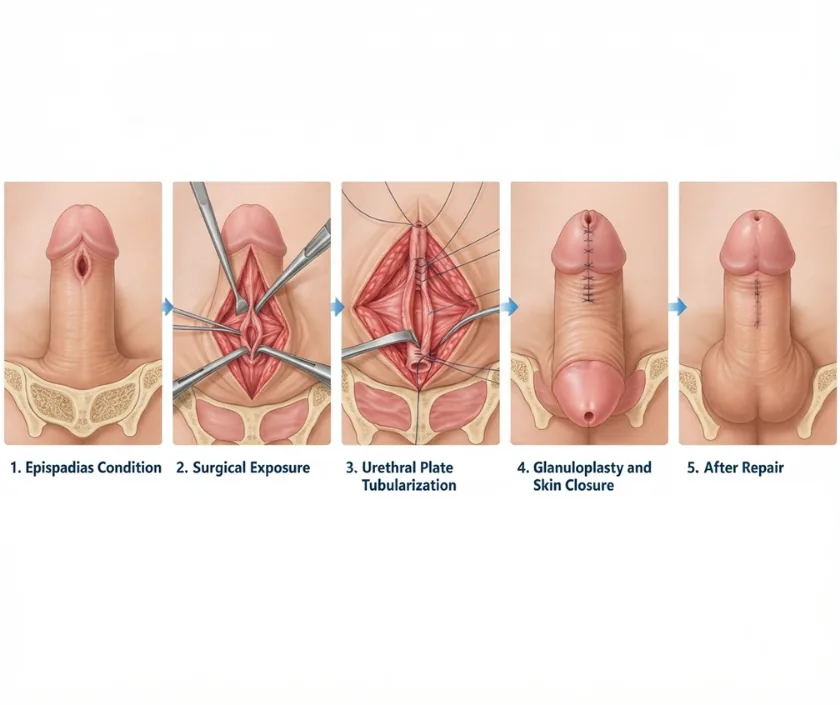
Epispadias is a rare difference in how the urinary passage forms before birth, so the opening lies on the upper surface. It can affect boys and girls, and it sometimes occurs with a wider bladder condition. Repair aims to give a stream a child can direct, reliable bladder control and a natural appearance, often in more than one stage.
In epispadias the urinary passage, called the urethra, does not close along its upper surface as the body forms before birth, so the opening sits higher than usual. It is rare, is present from birth and is not caused by anything a parent did. Both boys and girls can be affected, though it is seen more often in boys.
Epispadias sits at one end of a group of conditions that also includes bladder exstrophy, where the bladder itself is open. For that reason the first step is a full assessment of the bladder and kidneys, not only of the outward appearance. Scans and a review by a paediatric urologist are usually part of that work.
Repair has three aims: a stream your child can direct, bladder control that allows dry days at school, and a structure that will serve well into adult life. Reaching all three often takes more than one operation, spaced around growth. Because every child is different, the plan and its timing are agreed with the family and with the wider team rather than fixed in advance.
Every child is assessed individually. The plan depends on how the bladder stores and empties urine, not only on outward appearance.
Scans check the kidneys, the bladder and the way urine drains. Continence is discussed with a paediatric urologist. Surgery is planned only once this wider picture is clear.
The number of operations and their timing are agreed with the family. Some children have a single repair, while others have the passage repaired first and bladder control addressed later.
Under general anaesthesia the surgeon reconstructs the urinary passage as a tube, brings it to a normal position and corrects any upward curvature at the same sitting.
Where urine still leaks after a good repair, a separate operation tightens the bladder neck. This is planned once your child is old enough to take part in bladder training.
A fine catheter drains urine while the repair heals, and dressings protect the area. Both are removed at a planned review rather than at home.
Your child stays in hospital while pain relief, antibiotics and the catheter are managed. Nappies or loose clothing are used, and the area is kept clean and dry.
The catheter is removed at a planned visit and the stream is checked. Swelling and bruising settle. School or playgroup usually restarts once your child is comfortable.
Healing is reviewed and the stream is watched again. Bathing and normal play are usually back to usual by now, and stitches have dissolved.
Reviews continue through childhood, covering urine control, infections and growth. Further staged surgery, where it was planned, is timed around school and development.
Most children improve, but improvement is not the same for everyone. Urinary control usually develops gradually over months and sometimes needs a second operation or extra treatment. A small number of children continue to leak and need further help. Scars settle but do not disappear. Regular reviews through childhood and into the teenage years are part of the treatment rather than a sign that something has gone wrong.
Epispadias repair is detailed surgery on a small area, and problems are not rare. Being told about them in advance makes them easier to manage if they do happen.
Most of the recovery happens at home, and small steady habits matter more than anything dramatic.
Epispadias is often treated in planned stages, so a further operation is expected care rather than a failure.
Many children gain useful urinary control, though the timing varies and some need extra help along the way.
It forms very early in pregnancy for reasons that are still not fully understood, and it is not caused by anything a parent did.
Timing is judged child by child, and delay can allow bladder problems and social worries to build up.
Families usually come to us wanting a plain explanation of what is different, what can be done about it and what happens next.

The estimate depends on how many stages are planned, on the complexity of the repair, on whether bladder neck surgery is included, on the length of hospital stay and on the imaging needed beforehand. Reviews and any catheter care afterwards are counted too. Because plans are so individual, the figure is written after assessment, and scheme or policy cover is checked at the same time.
These are the questions that come up most often in consultation. If yours is not here, send it on WhatsApp and the team will reply, usually the same day.
Ask your question →There is no single published band, because the number of stages and the complexity differ from child to child. A written estimate is prepared after assessment and imaging, and it sets out hospital stay, surgery and review costs separately.
Surgery is planned with a paediatric anaesthetic team once your child is growing well and the kidneys and bladder have been assessed. Monitoring is close afterwards. Splitting the work into stages keeps each operation shorter and easier to recover from.
Most children stay in hospital for a few days, with a fine catheter draining urine. The catheter comes out at a planned visit within two to four weeks. Comfort returns before the tissue has fully settled, so gentle play is advised at first.
Many children achieve dry days, though some need a further operation at the bladder neck and a period of bladder training. Control is judged over years rather than weeks, and honest expectations are set at the start.
Repair is often started in early childhood, with later stages timed around growth and schooling. No single age suits every child. Weight, general health and the state of the bladder all influence when a date is fixed.
Older children and adults are still treated, and repair can improve the stream, the appearance and comfort. Tissue that has been operated on before makes the work harder, so an assessment comes first to see what is realistic.
The examination is brief and respectful, and a parent stays with the child throughout. Earlier scans and operation notes are reviewed. You will hear what the stages would involve, what each one aims to achieve, and the cost in writing.
Seeing patients from across the city and beyond: read about the practice on the plastic surgeon in Surat page, or check what a written estimate covers on the costs and insurance page.
