Labial reconstruction repairs differences of the outer genital tissue that a girl is born with, or damage that follows infection, injury or earlier surgery. This page explains who it helps, how it is planned, what recovery involves and what it may cost.
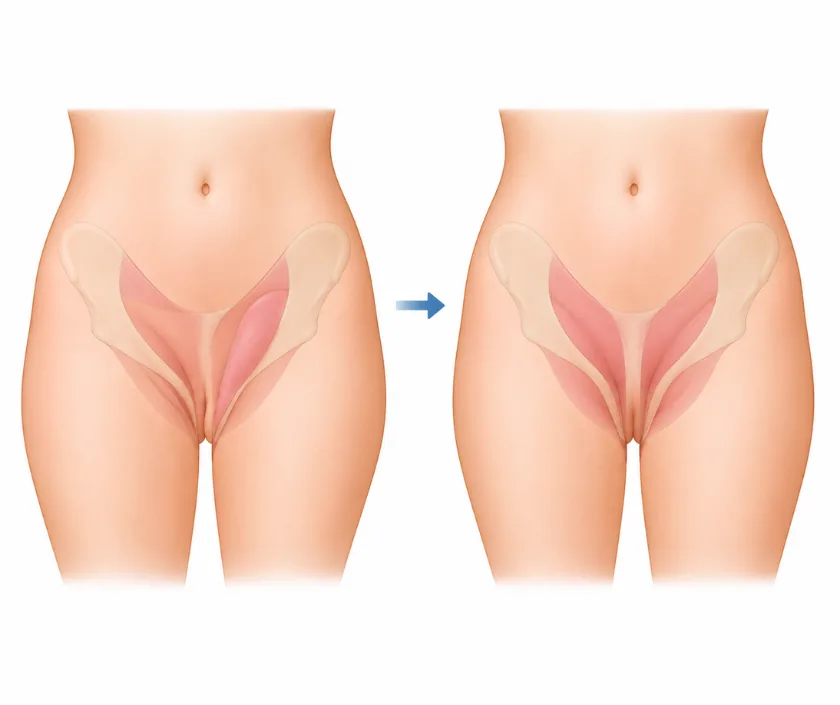
Labial reconstruction restores the shape and cover of the outer genital tissue when it is absent, fused, uneven or damaged. It is a reconstructive operation, planned for function and comfort rather than appearance alone. In young children many minor problems settle with simple measures, so surgery is offered only after assessment and often once growth is further along.
The labia are the folds of tissue that cover and protect the entrance of the vagina. They can be affected in several ways. A child may be born with tissue that is joined, missing on one side or clearly uneven. Tissue can also be lost through infection, burns, injury or an earlier operation.
Assessment always comes first. In young girls, thin adhesions between the labia are common and often settle with simple measures and time, so an operation is not the first answer. For older girls and women, the reasons to operate are usually practical ones, such as difficulty passing urine, repeated soreness, hygiene problems or discomfort with clothing and activity.
When surgery is advised, the plan is tailored to the tissue available. Fused tissue may simply be separated. Missing cover can be rebuilt with local flaps, which move nearby skin into place, or with grafts. Growth matters, so timing is discussed rather than assumed, and staged operations are sometimes safer than one large procedure.
Only a minority of girls need an operation. Most are managed with creams, hygiene advice and time, and surgery is kept for genuine symptoms.
The area is examined gently and in private, with a parent present for a child. Symptoms, hygiene, urine flow and any earlier surgery are discussed. Photographs may be taken for the medical record with consent.
For thin adhesions in young girls, careful hygiene and a prescribed cream are often enough, and many separate without an operation. Surgery is kept for tissue that does not settle or that causes real difficulty.
The surgeon explains what tissue is available and which technique fits. Timing takes growth into account. For larger repairs the plan may be staged, and the reasons for that are set out clearly.
Under general anaesthesia the fused or damaged tissue is released or removed, and cover is rebuilt using nearby skin flaps or a graft. Fine dissolving stitches are used and a soft dressing is applied.
Passing urine is checked before discharge. Pain relief, washing advice and activity limits are explained, and a review date is given so that healing can be watched.
Swelling and soreness are expected. Simple pain relief, loose clothing and gentle washing help. Most patients go home the same day or after one night.
Sitting, walking and school become comfortable again for most. Cycling, swimming and sport are held back so stitches and flaps are not pulled.
A review checks that the wounds have healed and that urine passes freely. Normal activity is usually allowed by now when healing has gone well.
Scars keep softening for many months. Further review is arranged if growth changes the shape, since a second smaller procedure is sometimes needed.
Symptoms usually settle once the tissues are separated or rebuilt, and most girls return to normal activity within a week or two. Tissues can join again while a girl is young, so a barrier ointment is used for a period afterwards. Scars are generally well hidden, though one side may look slightly different from the other. Where a wider condition is present, this operation deals with one part of it and other steps may follow.
Most repairs heal well. It still helps to understand what can go wrong, so that any problem is treated early.
The ointment routine after surgery is not optional. It is the part that keeps the result.
Joined tissue in young girls is common, often causes no harm and frequently settles with cream and time.
Most girls are treated without an operation, and surgery is reserved for symptoms that do not settle.
The tissues can join again while a girl is young, which is why an ointment is used for a period afterwards.
Parents value being told when an operation is not needed, and being given a plan they can carry out at home instead.

The figure depends on how much tissue needs rebuilding, whether flaps or grafts are used, theatre and anaesthetic time, whether the work is done in one sitting or in stages, and how long the stay is. Dressings and review visits add to the total. Because no two repairs are the same, a written estimate is prepared after assessment rather than quoted over the phone.
These are the questions that come up most often in consultation. If yours is not here, send it on WhatsApp and the team will reply, usually the same day.
Ask your question →There is no single published band, because the work varies from a simple release to a staged flap repair. Theatre time, hospital stay and dressings all affect the total. A written estimate follows assessment, and insurance cover is checked when the reason for surgery is medical.
Surgery is planned only when a child is well and the anaesthetic team is satisfied. Fine stitches that dissolve are used, and passing urine is checked before going home. Bleeding, infection and delayed healing are the main risks, and they are usually manageable.
Soreness and swelling settle over one to two weeks for most. School often restarts within a week, while sport, swimming and cycling wait around six weeks. Scars keep softening for several months after that.
The aim is comfortable, protected tissue that works normally and looks natural. Symmetry improves but is rarely exact, and scars remain visible on close inspection. Your surgeon will describe what is realistic for the tissue available before you decide.
No. In young girls, thin adhesions frequently separate with hygiene measures and a prescribed cream, and many resolve as hormone levels change. An operation is reserved for tissue that is truly missing or damaged, or for problems that keep coming back.
Timing depends on growth, symptoms and the child rather than on a fixed age. Urgent repair is needed when urine will not pass or when skin keeps breaking down. Otherwise waiting until tissue is more developed often gives a steadier result.
Your concerns are heard in private, and a gentle examination is offered with a chaperone present. Urine flow, hygiene and past surgery are reviewed. You will hear which options fit, what recovery involves and the estimated cost, in writing, before any date is fixed.
Seeing patients from across the city and beyond: read about the practice on the plastic surgeon in Surat page, or check what a written estimate covers on the costs and insurance page.
