Vaginal agenesis means a girl is born with a vagina that is absent or only partly formed. This page explains how the condition is assessed in Surat, which treatments are used, what recovery involves and what it may cost.
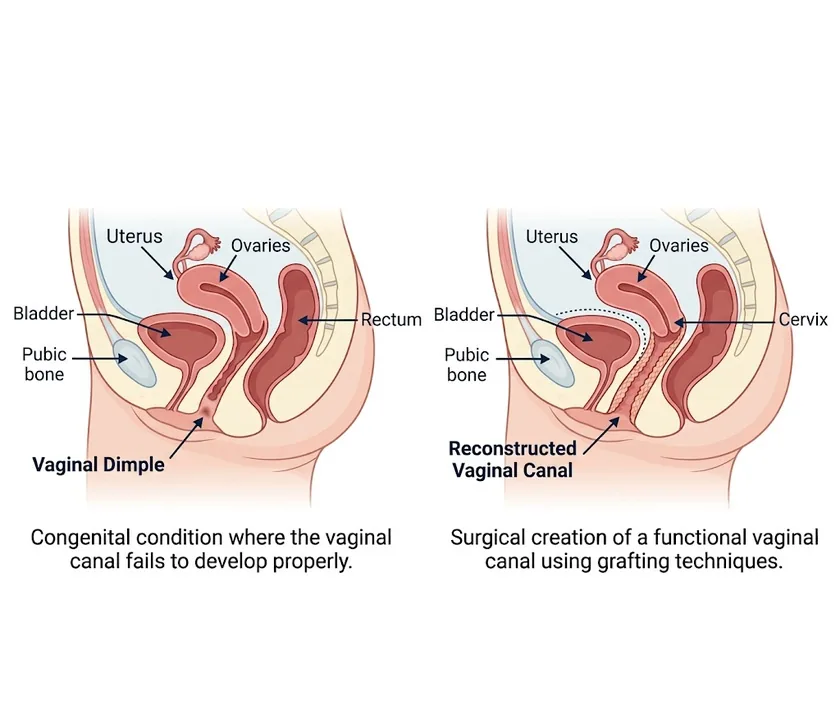
Vaginal agenesis is a congenital condition in which the vagina does not form fully before birth. It is often found in the teenage years when periods do not start. Care begins with tests and counselling. Many young women are treated first with guided dilation, and surgery to create a vaginal passage is offered when dilation is not suitable or does not work.
Vaginal agenesis is present from birth, although it is usually noticed later. In many girls the first sign is that periods have not started by the middle teenage years, even though breast development and body shape have progressed normally. The womb may be small or absent, and the ovaries usually work as they should.
Assessment comes before any treatment. It includes a gentle examination, an ultrasound scan and often an MRI scan, blood tests for hormones and, in some cases, genetic testing. The kidneys and spine are checked too, because they can be affected at the same time. A counsellor or psychologist is part of the team from the start.
Treatment is planned with the young woman herself. Guided dilation, taught and supervised by the team, is often tried first and works for many. When it is not suitable, an operation can create a passage using tissue such as lining from the abdomen, a skin graft or a segment of bowel. Whichever route is chosen, regular use of dilators afterwards keeps the result open.
Treatment is offered when the young woman herself is ready, not at a fixed age. Both dilator therapy and surgery need her active involvement to work.
Examination, an ultrasound scan and often an MRI scan show what is present. Hormone and genetic tests may be added, and the kidneys are checked. Time is given for questions before anything is decided.
Where the anatomy allows, the team teaches a dilation programme and supervises it at regular visits. Many young women achieve a comfortable passage this way, without an operation, over several months.
If dilation is not suitable or has not worked, the surgeon explains the options. The choice depends on the tissue available, any previous surgery, and what matters most to the young woman.
Under general anaesthesia a space is created between the bladder and the back passage and lined with the chosen tissue. A soft mould is usually left in place while healing begins.
A dilation routine continues after healing, guided by the team, because the new passage can narrow if it is not used. Review visits check comfort, healing and emotional well being.
Time is spent in hospital while pain relief, fluids and wound care are given. A mould or pack may stay in place, and walking starts gently once you feel able.
Most daily activity returns slowly. Heavy lifting and sport are avoided. The team explains how and when the dilation routine begins, and checks it at each visit.
A review looks at healing and comfort. School, college or work is usually possible by now, and the dilation routine continues under guidance.
Reviews carry on for longer, because the passage can narrow if dilation stops. Counselling remains available, and fertility questions are discussed when you are ready.
Dilator therapy succeeds for many young women when it is done consistently, though it takes months and requires patience. Surgery is a reasonable option when it does not. Either way, regular dilator use or intercourse is needed afterwards to maintain the result, since the canal narrows without it. Reconstruction does not create a uterus, so carrying a pregnancy is not possible, although those with working ovaries may have options through assisted reproduction. Sensation and lubrication vary between individuals.
Treatment is planned carefully and most young women do well. Even so, you should know what can go wrong so that problems are picked up early.
The routine after treatment is straightforward but it needs to be kept up. Your specialist nurse will go through each step privately.
Chromosomes, ovaries and hormones are typically female. One part of the reproductive tract did not form, and this does not change identity.
A dilator programme works for many young women and is usually tried first, because it avoids an operation altogether.
Kidneys, the spine and hearing form at a similar stage, so scans and checks are part of the assessment.
There is no medical urgency. Treatment works best when the young woman feels ready and has had time and counselling.
This diagnosis is as much an emotional matter as a surgical one, and we treat it with privacy, patience and full information.

The figure depends on which treatment is chosen, how long the operation takes, whether tissue is taken from another site, the length of hospital stay and the scans and tests needed beforehand. A supervised dilation programme costs far less than an operation. Review visits and dilators also form part of the plan. A written estimate is given after assessment, so the family knows what to expect before admission.
These are the questions that come up most often in consultation. If yours is not here, send it on WhatsApp and the team will reply, usually the same day.
Ask your question →There is no fixed price band for this treatment. Cost depends on whether dilation or surgery is used, the operating time, hospital stay and the scans needed first. A written estimate is shared after assessment. Ask about insurance cover, since some policies contribute when the reason is medical.
The operation is carried out under general anaesthesia by a team used to this work, and fitness is checked beforehand. Bleeding, infection and injury to nearby structures are possible, so recovery is monitored closely. Risks are explained in detail before you agree to a date.
Most young women stay in hospital for a few days and feel much better within two to four weeks. Sport and heavy lifting wait longer. A dilation routine then continues for months, since the new passage can narrow without it.
Many young women go on to have comfortable intimate relationships after treatment. Results vary with the method used and with how closely the dilation routine is followed. Your team will explain what is realistic for your own anatomy rather than quoting a general figure.
Dilation suits many young women who have a small dimple of tissue to work with and who feel ready to follow the routine. It avoids an operation. When dilation is not possible, or has not worked after a fair trial, surgery is discussed.
There is no rush on the day of diagnosis. Assessment and counselling come first, and treatment usually starts when the young woman is emotionally ready and wishes to proceed. Urgent care is needed only when trapped blood is causing pain or blocking urine.
The history is taken privately, a gentle examination is offered, and scans are arranged. Kidney and spine checks may be added. You will hear the options, the likely recovery and the estimated cost in writing, and counselling support is offered at the same visit.
Each technique below has its own page explaining how it works and when it is chosen.
Seeing patients from across the city and beyond: read about the practice on the plastic surgeon in Surat page, or check what a written estimate covers on the costs and insurance page.
