Microtia means a child is born with a small or incompletely formed outer ear. This page explains how microtia reconstruction is planned in Surat, what the stages involve, how recovery goes and what the surgery is likely to cost.
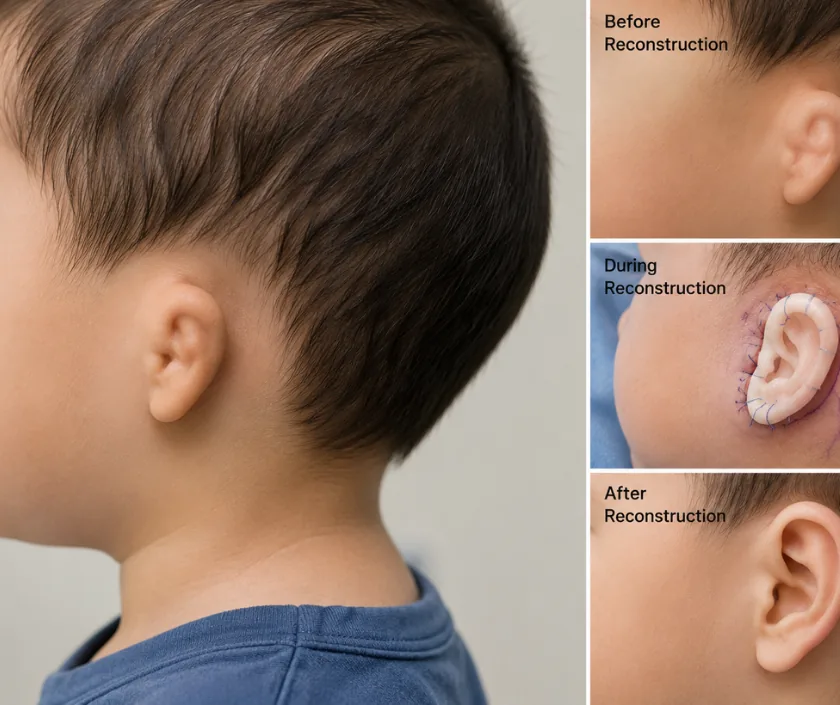
Microtia reconstruction builds a new outer ear for a child born with a small or missing one. The usual method carves a framework from the child own rib cartilage and places it under skin at the matched position, then lifts the ear away from the head at a second stage. Work is staged over months, often from about school age.
Microtia covers a wide range, from an ear that is simply small to one that is only a little tag of skin. The ear canal is often narrow or absent on the same side, so hearing on that ear is usually reduced. Most children hear normally on the other side and develop speech well, yet hearing is always tested formally.
Reconstruction rebuilds the shape of the outer ear. In the rib cartilage method, cartilage is taken from the lower chest, carved into a framework that copies the folds of an ear, and placed under a pocket of skin at the matched position. Once that has settled, a second stage lifts the ear away from the scalp and adds skin behind it.
Hearing is handled separately by an ear specialist. Surgery for the canal, or a hearing device, is planned alongside the reconstruction so that one treatment does not spoil the other.
The right route depends on age, the size of the rib cartilage, hearing on both sides and what the child actually wants.
The other ear is measured and a template is made, so the new ear matches in size and position. Hearing tests and a check of the chest wall may be arranged before a date is set.
Cartilage is taken through a short cut low on the chest. The chest wall is closed carefully and pain relief is planned, since this area is often the sorest part in the early days.
The cartilage is shaped into a framework that copies the ridges and hollows of an ear. Fine sutures hold the pieces together while the surgeon checks the shape against the template.
A pocket is raised under the skin at the marked site and the framework is slid into it. Gentle suction draws the skin into the folds, so the shape shows through clearly.
Several months later a second operation raises the ear away from the head. A skin graft and a small cartilage wedge hold the new angle, so the ear stands out naturally.
The child stays in hospital for pain relief and chest care. Breathing exercises are encouraged early. A protective dressing sits over the ear, and light suction drains may be in place.
Dressings are changed at the clinic and the chest becomes much easier. Sleeping on the operated side is avoided, and a soft head band may be advised at night.
School usually restarts. Contact sports, swimming and helmets are kept aside, so the framework is not pressed or knocked while healing continues underneath.
The shape settles and the plan for the next stage is discussed. Small refinements to the lobe or the groove behind the ear are sometimes added later.
A reconstructed ear reads clearly as an ear at conversational distance and sits in the right place, but it will not match the other side in every fold. Two or more stages are usually needed, leaving scars on the chest and behind the ear. Sensation on the new ear is reduced. Occasionally thin skin over a cartilage edge or a framework problem needs a further procedure. Hearing is assessed and managed separately by an ear specialist.
This is a staged reconstruction on a growing child, so the plan is discussed in detail beforehand. Most children heal well, though a few need extra procedures.
The chest is often sorer than the ear in the first week, and the ear needs protecting for far longer.
It rebuilds the shape of the outer ear. Hearing is assessed and treated separately by an ear specialist.
The rib cartilage has to be big enough, which is why this surgery is usually planned from around school age.
A prosthesis avoids chest surgery but needs ongoing care and replacement, so each route has its own trade offs.
The ear is usually built in stages, and lifting it away from the head is often a separate step.
Parents value having hearing, timing and the choice between reconstruction and a prosthesis discussed before any date is set.

Cost depends on the number of stages planned, the amount of cartilage needed, whether a skin graft is used at the second stage, theatre and anaesthetic time, and the nights spent in hospital. Reconstruction after a burn or an injury may need extra tissue and takes longer. Because every ear is different, the estimate is given in writing after the child is examined and the stages are agreed.
These are the questions that come up most often in consultation. If yours is not here, send it on WhatsApp and the team will reply, usually the same day.
Ask your question →The published band runs from about Rs 1.4L to Rs 2.8L for the reconstruction. That figure depends on how many stages are planned, theatre time and hospital nights. Congenital ear surgery is often assessed case by case for insurance, so bring policy papers to the first visit.
Cartilage is taken from the lower chest through a short cut, and the chest wall is closed carefully. Soreness in that area is common for a week or so, and is managed with pain relief and breathing exercises. Surgery waits until the ribs are big enough.
Children usually spend two to three nights in hospital. The chest settles over one to two weeks, dressings are changed at the clinic, and school restarts at around three weeks. Contact sports and helmets wait longer, so the framework stays protected.
A carved framework can reproduce the main folds and give a shape that sits well under hair and behind glasses. Close comparison with the other side will still show differences. Refinements to the lobe or the groove behind the ear are sometimes added later.
Reconstruction using rib cartilage usually waits until the chest has grown enough to give a good framework, often around school age. Waiting also lets the child share in the decision. An examination and a chest assessment guide the exact timing.
Hearing is tested early, because speech development matters more than appearance in the first years. An ear specialist advises on a hearing device or canal surgery, and the order of treatment is agreed jointly, so neither plan spoils the other.
Both ears are measured and photographed, hearing reports are reviewed and the chest is examined. You will hear which method suits your child, how many stages are likely, what each stage involves and what the written estimate covers.
Each technique below has its own page explaining how it works and when it is chosen.
Seeing patients from across the city and beyond: read about the practice on the plastic surgeon in Surat page, or check what a written estimate covers on the costs and insurance page.
