Years of diabetes can shorten the calf muscles and the Achilles tendon, so the heel lifts too early with every step. All that weight then lands on the ball of the foot, where ulcers form and refuse to close.
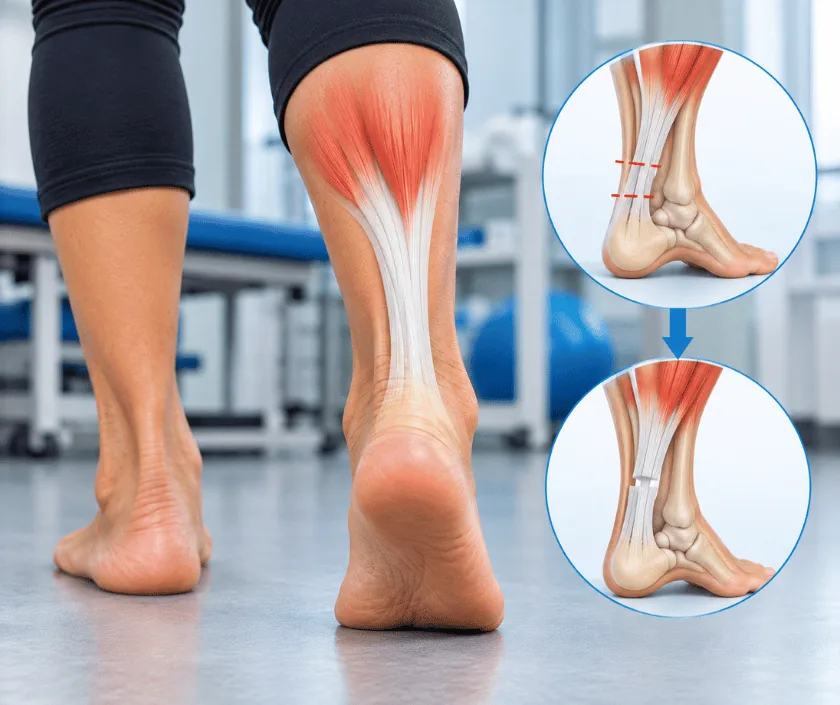
Achilles tendon lengthening is a short operation that releases a tight calf so the ankle can bend upward again. With the tendon lengthened, the heel stays down longer during each step and pressure under the ball of the foot drops. That change often allows a stubborn forefoot ulcer to heal.
Walking depends on the ankle bending upward as the body passes over the foot. When the calf and the Achilles tendon shorten, that movement is blocked. The heel lifts sooner than it should, and the forefoot is pressed into the ground for longer and with more force. Repeat that a few thousand times a day and the skin under the ball of the foot has little chance.
Diabetes encourages the tightening. Sugar binds to proteins in tendon and connective tissue over the years, leaving them stiffer and less elastic. Since the nerves are damaged too, nothing feels tight or uncomfortable, and the change goes unnoticed until an ulcer appears. Testing is simple, because the ankle is bent upward with the knee straight and then bent, to see how much movement remains.
Lengthening restores that movement. Either the tendon is released in a controlled way through small cuts, or the muscle above it is released higher in the calf. Which one suits you depends on where the tightness sits and how severe it is, and the aim is always the smallest change that lowers forefoot pressure.
Lengthening suits a person whose forefoot problem is clearly linked to limited ankle movement, and whose circulation is good enough to heal a small wound.
Ankle movement is measured with the knee straight and then bent, which shows whether the tight structure is the tendon itself or the muscle higher up in the calf.
A lengthening through tiny cuts suits many people, while a release higher in the calf is preferred when the tightness comes mainly from the muscle rather than the tendon.
Under regional anaesthesia the tendon or muscle is lengthened in measured steps, with the ankle moved gently until the intended range is reached and no further than that.
A cast or boot holds the ankle in its new position while healing begins. Such protection is essential, since an unprotected repair can stretch or even tear.
Weight is reintroduced gradually and physiotherapy rebuilds calf strength. Insoles and footwear are then reviewed against the new pressure pattern under the foot.
The leg is elevated and the cast or boot stays on. Discomfort is usually mild, and moving about happens with crutches or a walker as advised.
Small wounds are checked and the cast may be changed. Any forefoot ulcer is reviewed at this point, since pressure on it should already be lower.
Protection is usually removed around now and physiotherapy begins in earnest. Calf strength returns slowly, while walking distance builds in stages.
Push off strength keeps improving through the year. Foot pressure is reassessed and tightness rechecked at reviews, because a calf can gradually shorten again.
Most people notice that the foot rolls through the step more evenly and that callus under the forefoot builds more slowly. Wounds that had stalled often begin to close. Calf power feels reduced for some months while strength rebuilds, so stairs and slopes can seem harder during that time. Tightness may return over the years, and pressure can move towards the heel, which is why reviews continue.
This is a small operation with a real effect on how you walk, so the trade offs are explained fully before you decide.
The tendon is at its most vulnerable in the first weeks, and protection is what keeps the correction intact.
The tendon is lengthened rather than removed, and most people walk normally once strength returns.
Nerve damage removes that sensation, so tightness is usually found on examination instead of being reported.
Skin breaks down where force concentrates, and a tight calf is often the reason that force is there.
Tissue can stiffen again over the years, which is why ankle movement is rechecked at every review.
Elegance Clinic in Surat tests ankle movement at every diabetic foot assessment, because tightness is easy to miss and straightforward to correct. Dr. Ashutosh Shah lengthens only as much as the measurements justify.

Lengthening is a short procedure, so the estimate is usually modest and the stay is brief. Cost changes with the technique used, the anaesthesia chosen and whether an ulcer is being treated during the same admission. A written estimate is prepared after assessment, and insurance cover is checked before a date is booked.
These are the questions that come up most often in consultation. If yours is not here, send it on WhatsApp and the team will reply, usually the same day.
Ask your question →It is a short procedure, so the estimate sits at the lower end for foot surgery. The figure depends on the technique, the anaesthesia and whether an ulcer is being managed in the same admission. A written estimate is provided after assessment.
The incisions are tiny and the operating time is short, which suits a foot that heals slowly. Circulation and infection are checked beforehand. The main safety issue is not the wound but releasing too much, so the amount is carefully measured.
A cast or boot is generally worn for around six weeks while the tendon heals in its new length. Weight bearing rules differ between people. Recovery can vary depending on the technique used and the state of the skin.
Push off does feel weaker for some months while the calf rebuilds its strength, and stairs or slopes may feel harder at first. Physiotherapy addresses this steadily. Most people return to their usual walking without difficulty.
It is not appropriate when ankle movement is already normal, when the heel has an ulcer that extra pressure would worsen, or when the calf is very weak. Poor circulation must be assessed and improved before any surgery is planned.
It is usually considered once a forefoot ulcer has failed to close with casting and dressings, or keeps returning after healing. Doing it before infection reaches bone keeps treatment simpler and the recovery shorter.
Ankle movement is measured with the knee both straight and bent, callus is mapped, and pulses and sensation are tested. Imaging is arranged when needed. Findings, the planned release and a written estimate are then explained to you.
No. Lengthening is a planned procedure to take pressure off the forefoot in a diabetic foot. A rupture is a sudden injury, felt as a snap with difficulty pushing off, and is treated either in a cast or by surgical repair depending on the gap between the ends, the delay since injury and the patient.
Seeing patients from across the city and beyond: read about the practice on the plastic surgeon in Surat page, or check what a written estimate covers on the costs and insurance page.
