A cross facial nerve graft borrows a spare branch from the healthy side of the face and carries its signal across to the paralysed side. It is the option most likely to give a smile that appears on its own.
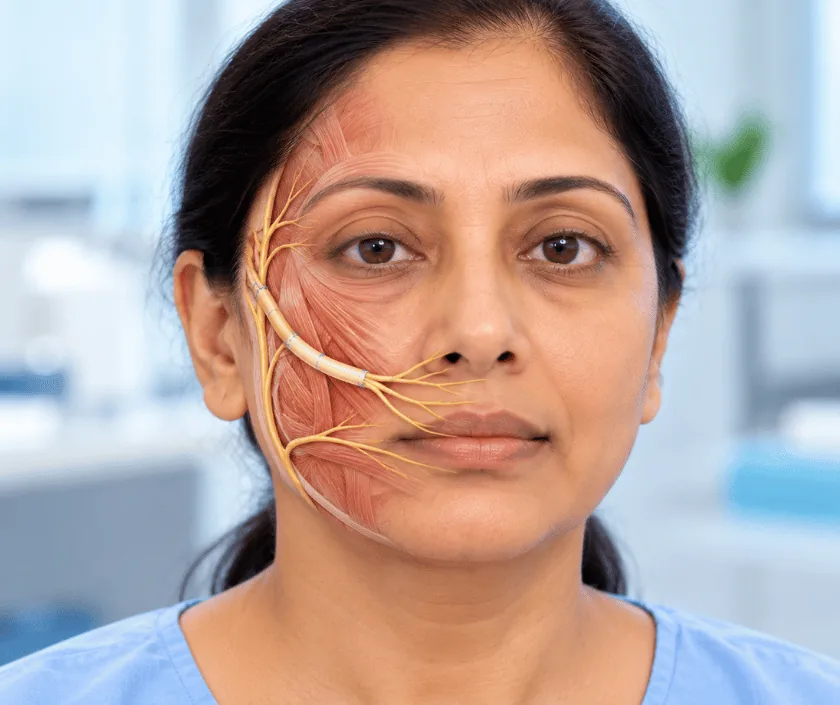
A cross facial nerve graft takes a thin nerve from the leg, usually the sural nerve, and tunnels it across the upper lip. One end is joined to a spare smile branch on the healthy side. Fibres then grow along the graft over many months, and a second stage links them to muscle on the weak side.
On the working side of the face, the facial nerve divides into several branches that all help the smile. One of those branches can usually be spared without changing movement on that side. The surgeon finds it, tests it with a nerve stimulator, then joins it to a thin donor nerve taken from the lower leg.
That donor nerve is tunnelled under the skin of the upper lip and parked near the corner of the mouth on the paralysed side. Nothing moves at this point. Over the following months the healthy nerve grows fibres along the graft, a slow process that can be followed at reviews by tapping over the graft and asking where a tingling sensation is felt.
A second stage completes the circuit. If the facial muscle on the weak side is still healthy, the grown graft is joined to it directly. If the muscle has wasted, the graft is instead used to power a transferred gracilis muscle. Because the signal starts on the healthy side, the smile that follows is linked to genuine emotion rather than to a deliberate effort.
This graft rewards patience, so it suits people who can wait for a result that builds over more than a year.
Through a small incision in front of the ear on the working side, branches of the facial nerve are identified and stimulated. A branch that can be spared without weakening the smile is then selected.
The sural nerve is harvested from the lower leg through one or more short incisions. This nerve mainly supplies sensation to the outer foot, so its loss leaves numbness rather than weakness.
The graft is passed under the skin of the upper lip to the paralysed side and marked so it can be found later. Nerve joins are made under magnification with very fine sutures.
No movement appears at first. Fibres travel along the graft slowly, and progress is checked at reviews by tapping along its course to see how far the tingling has reached.
Once the graft has grown, it is joined either to facial muscle or to a transferred gracilis muscle. Movement then begins to appear over the following months with therapy.
Facial swelling and a sore leg are usual. Gentle walking is encouraged early, while the leg wound is kept dry and raised during rest.
Stitches are reviewed and most people manage light tasks at home. Facial swelling begins to settle and the lip feels less tight.
Wounds have healed and the leg is comfortable again. Nothing has changed in the face yet, and that is exactly as expected at this stage.
Fibres reach the far end of the graft and the second stage is planned. Movement then builds slowly, guided by facial therapy.
The smile produced through a cross facial graft is usually gentler than the healthy side, because only part of the original signal reaches the other cheek. Some patients gain an easy, confident smile, while others gain a softer lift that reads well in conversation but less so in a wide grin. Progress is measured in months rather than weeks, and the face can keep improving well beyond the first year.
Most people heal without trouble, although the particular risks of nerve grafting deserve attention before you agree.
Two areas need care, the face and the leg, and both settle faster with a little planning.
Only a spare branch is used, and the remaining branches carry on supplying the smile on that side.
Fibres have to grow along the whole graft first, which is why a wait of several months is built into the plan.
The sural nerve carries sensation rather than movement, so walking is unaffected. A patch of numbness on the foot is the usual trade off.
It relies on facial muscle that is still viable, so longstanding paralysis usually needs a muscle transfer instead.
At Elegance Clinic in Surat, Dr. Ashutosh Shah plans nerve grafting alongside eye protection and therapy, so the smile is one part of a written plan you can take home and read.

A cross facial nerve graft is usually planned as two operations, so the estimate covers both stages. Theatre time, anaesthesia, hospital stay, microsurgical work and follow up all influence the figure. You receive a written estimate after assessment, and it is explained line by line before admission. Where the paralysis followed tumour surgery or an injury, insurance may contribute, and the team can help with the paperwork.
These are the questions that come up most often in consultation. If yours is not here, send it on WhatsApp and the team will reply, usually the same day.
Ask your question →Not for several months, and often longer. Fibres grow along the graft slowly, and only after the second stage does movement begin. Early flickers usually strengthen over the following year, especially when facial therapy is followed steadily.
The donor nerve carries sensation from the outer part of the foot, not movement, so walking is not affected. A numb patch on the foot is expected and usually stays. Protect that area from very hot water and tight shoes.
The graft has to grow before it can carry a useful signal. Joining it to muscle too early would connect a nerve that is not yet working. Waiting allows fibres to reach the far end, and the second stage then completes the circuit.
A written estimate is prepared after assessment and covers both stages, theatre time, anaesthesia, hospital charges and follow up. There is no fixed price, because the plan varies. Insurance sometimes contributes when paralysis followed surgery or injury.
They do different jobs. A graft from the other side tends to give a smile that appears with emotion, while a chewing nerve gives more power and earlier movement. Sometimes both are used together, and the choice is discussed at assessment.
Usually not on its own. Facial muscle that has been still for years loses the ability to respond. In that situation a new muscle is transferred instead, and the graft may then be used to supply that muscle.
Expect an unhurried examination of the face at rest and in motion, photographs or video, and questions about how the weakness began. The eye is checked carefully. You then receive an explanation of the options and a written estimate.
Each technique below has its own page explaining how it works and when it is chosen.
Seeing patients from across the city and beyond: read about the practice on the plastic surgeon in Surat page, or check what a written estimate covers on the costs and insurance page.
