When a face has been paralysed for years, the original smile muscles waste away and no nerve repair can revive them. A slim muscle from the inner thigh is then transferred into the cheek and given its own blood and nerve supply.
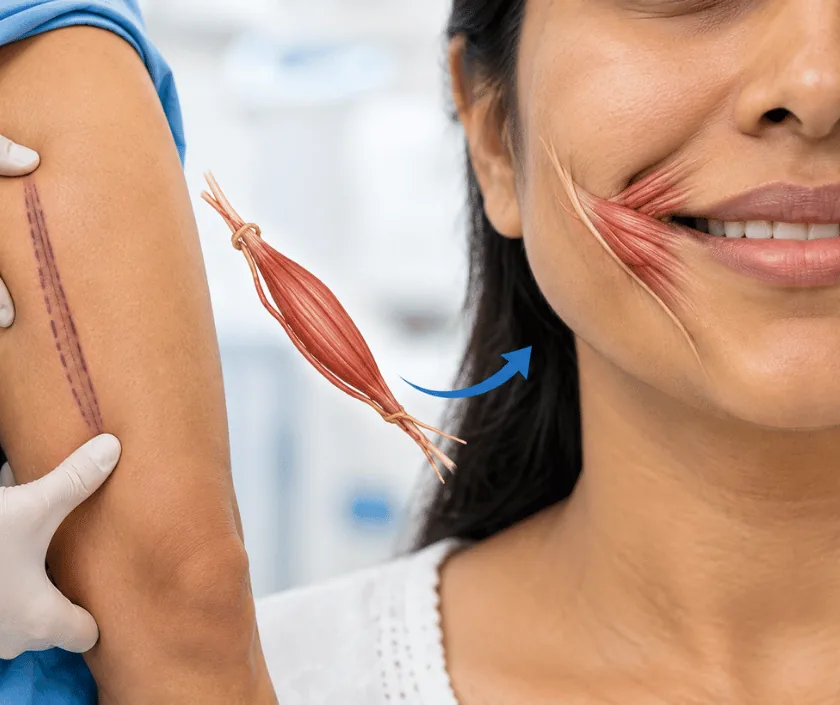
Free gracilis smile reconstruction moves a thin strip of muscle from the inner thigh into the cheek. Its artery and vein are joined to vessels in the face under a microscope, and its nerve is connected to a donor nerve. Months later that muscle contracts and lifts the corner of the mouth into a smile.
Facial muscles depend on a working nerve. Once that supply has been missing for a long time, usually more than about two years, the muscle fibres shrink and stop responding even if a new nerve is delivered to them. At that stage the sensible answer is not to repair the old muscle but to bring in a fresh one.
The gracilis lies along the inner thigh and is a common choice, because a narrow strip can be taken without leaving weakness. That strip arrives with its own artery, vein and nerve. In the face, an incision similar to a facelift incision lifts the skin, and the muscle is anchored to the corner of the mouth at one end and to firm tissue near the cheekbone at the other.
Vessels are then joined to facial vessels under a microscope, so the muscle has a blood supply straight away. The nerve is connected to whichever donor has been planned, most often a cross facial graft placed at an earlier operation, a masseteric branch, or both together. Nothing moves at first. Fibres grow into the muscle over months, and therapy then teaches you to use it.
Gracilis transfer is a longer operation than nerve surgery, so fitness and motivation matter as much as the state of the face.
Assessment decides whether a cross facial graft is needed first. When it is, the graft is placed several months earlier so that fibres have already grown before the muscle arrives.
A strip of gracilis is taken through an incision on the inner thigh, along with its artery, vein and nerve. The remaining muscle and the other thigh muscles keep the leg working normally.
An incision in front of the ear, similar to a facelift approach, exposes vessels in the cheek and the corner of the mouth. The nerve prepared at the earlier stage is located.
The muscle is anchored with the tension set carefully, then the artery and vein are joined under a microscope. Finally the nerve is stitched to the donor nerve with very fine sutures.
The flap is watched closely in the first days. Months later, once movement begins, a therapist teaches you how to trigger and control the new smile.
You stay in hospital while the flap is monitored. The face is swollen and the thigh is sore, and walking usually begins on the first or second day.
Swelling settles gradually and stitches are checked. The thigh becomes comfortable, though sitting for long periods can still ache.
Wounds have healed and you are back to most daily activities. The face is quiet, as expected, because the muscle has no working nerve supply yet.
Movement usually begins during this period as a small twitch, then strengthens. Therapy shapes the pull, and the smile keeps improving well into the second year.
A transferred muscle gives a smile, not the original smile. The pull is usually in one direction and lifts the corner of the mouth, while fine expression around the eye and nose stays limited. Bulk in the cheek may look full at first and settles over months. Some patients gain a broad, easy smile, others a modest lift that mostly helps symmetry. The result takes a year or more to judge fairly.
This is major microsurgery, so the risks are more substantial than with nerve procedures alone.
The first weeks protect the flap, and the months that follow build the smile through training.
A narrow strip is used and the surrounding muscles take over its work, so walking and climbing stairs are not affected.
Nerve fibres have to grow into the new muscle first, so several months without movement is the expected pattern.
This operation exists precisely for that situation, because it does not depend on the original facial muscles.
Many patients need a small adjustment later, for example thinning bulk or fine tuning the direction of pull.
Elegance Clinic in Surat carries out microsurgical reconstruction as a planned pathway, and Dr. Ashutosh Shah discusses staging, therapy and realistic outcomes before any date is offered.

Free muscle transfer is the most involved option on this pathway, so the estimate reflects a longer operation, microsurgical care, a hospital stay of a few nights and close monitoring afterwards. Where a cross facial nerve graft is done first, that stage is quoted as well, and the two are shown separately so the total is clear. A written estimate is issued after assessment. Reconstruction after tumour surgery, trauma or a condition present from birth often qualifies for insurance cover.
These are the questions that come up most often in consultation. If yours is not here, send it on WhatsApp and the team will reply, usually the same day.
Ask your question →Walking, climbing stairs and exercise are generally unaffected. Only a strip of one inner thigh muscle is used, and the neighbouring muscles do the same job. The thigh feels sore for a couple of weeks and then settles.
Usually several months, because nerve fibres must grow into the muscle before it can contract. The first sign is often a faint twitch. Strength then builds gradually, and the smile keeps improving into the second year.
When a spontaneous smile is the aim, a nerve graft is placed across the face first and left to grow. The muscle is transferred at a second operation and connected to that grown nerve, which is why the plan is staged.
There is no fixed price. A written estimate after assessment covers theatre time, microsurgical care, anaesthesia, hospital stay and follow up, with each stage shown separately. Insurance frequently contributes when the paralysis followed surgery, trauma or a condition present from birth.
It is major surgery and is carried out with full monitoring and a planned hospital stay. Fitness is checked beforehand. The main concern is the blood supply to the transferred muscle, which is watched closely in the first days.
The cheek often looks fuller at first because of swelling and the muscle itself. This settles over months. If bulk remains noticeable, a small thinning procedure can be discussed once the result has matured.
Age alone is not the deciding factor. General fitness, healing capacity and motivation for therapy matter more. When a long operation is unwise, a static sling may achieve worthwhile improvement at rest with far less strain.
Each technique below has its own page explaining how it works and when it is chosen.
Seeing patients from across the city and beyond: read about the practice on the plastic surgeon in Surat page, or check what a written estimate covers on the costs and insurance page.
