A gold weight is a thin, curved piece of high purity gold placed inside the upper eyelid. It adds just enough weight for gravity to bring the lid down when the muscle that closes the eye no longer works.
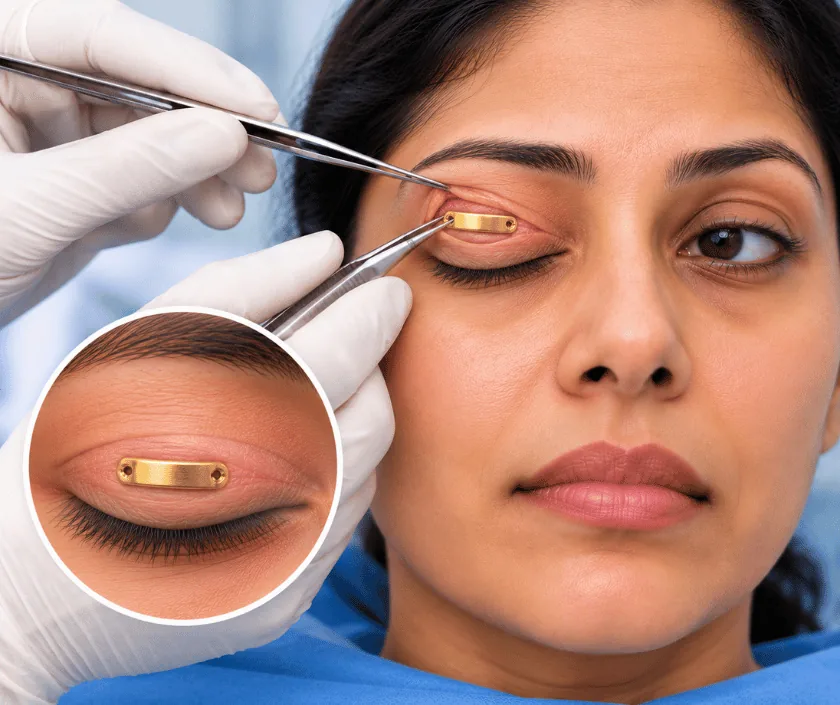
A gold weight implant treats an upper eyelid that cannot close after facial paralysis. The lid opens using a different nerve, which still works, so only closure is missing. Adding a small weight lets gravity finish the movement. Sizing is tested on the outside of the lid first, then the chosen weight is fixed to the tarsal plate through a hidden incision.
Two different nerves control the upper eyelid. One lifts it open and belongs to a nerve that facial paralysis does not affect. The other closes it and runs in the facial nerve, so it stops working when that nerve is damaged. The result is an eye that opens normally and then will not shut, which is why the surface dries out.
Adding weight to the lid restores the balance. When the lifting muscle relaxes, gravity pulls the lid down, and a correctly sized implant makes that descent complete rather than partial. Before surgery, trial weights are taped to the outside of the lid so you can blink with each one, and the smallest weight that achieves closure without making the lid droop is chosen.
Surgery is usually a day case under local anaesthesia. A short incision in the natural crease of the upper lid gives access to the tarsal plate, the firm strip that gives the lid its shape, and the implant is secured to it and covered by tissue. Most patients notice the difference immediately, though swelling can hide the final effect for a week or two.
A weight suits people whose upper lid will not close and who need dependable daily protection rather than more drops.
Closure is measured and corneal health checked. Trial weights are then taped to the outside of the lid so you can blink with each and see which size gives closure without heaviness.
The procedure is usually a day case. Blood thinning medicines are reviewed beforehand, and the eye is examined again on the day to confirm nothing has changed.
Local anaesthetic is given and a short incision is made in the natural crease of the upper lid, so the scar sits within an existing line.
The weight is secured to the tarsal plate with fine sutures and covered with tissue to reduce the chance of it showing. Closure is tested before the skin is closed.
You are seen within a week or two. If closure is still incomplete once swelling has settled, the weight can be exchanged for a slightly larger one.
The lid is bruised and swollen, and closure may look better than it truly is. Cold compresses and prescribed drops are used, with the head raised for sleep.
Stitches are removed or dissolve. Swelling falls and the true effect of the weight becomes clearer, often with a noticeable drop in the need for drops.
The lid crease has settled and the implant is usually not visible. Sizing is reviewed properly at this stage if closure remains incomplete.
Most patients are comfortable with far less lubricant. The implant can be removed later if facial nerve recovery makes it unnecessary.
A weight assists closure, so it improves protection without restoring a normal blink. Most patients still blink more slowly on that side and many continue with some lubricant, particularly in dry or windy conditions. Because gravity does the work, closure is best when upright and least reliable lying flat, which is why taping at night is sometimes still advised. The lid may sit a fraction lower than the other side.
Problems are uncommon, though they are worth knowing before you agree to an implant.
Care is straightforward, and the main job is keeping the eye lubricated while the lid settles.
The implant is thin, curved to the lid and placed under tissue, so in most patients it is not noticeable. Thin skin makes it more visible, and that is assessed beforehand.
It can be removed or exchanged. Many are taken out when facial nerve recovery makes them unnecessary.
It helps the lid close under gravity. Blinking stays slower on that side, since the muscle itself is still without a nerve supply.
Most patients need far less lubricant, yet some drops usually continue, especially in wind or air conditioning.
Elegance Clinic in Surat sizes eyelid weights with trial weights before surgery, and Dr. Ashutosh Shah reviews the lower lid and brow at the same visit so the eye is treated as a whole.

The estimate for an eyelid weight covers the procedure itself, local anaesthesia, the implant, dressings and follow up reviews. Because sizing is tested before surgery, the trial process is included rather than charged as an extra visit. If the lower lid also needs tightening or the brow needs lifting, those are itemised separately so the total is transparent. A written estimate is given after assessment, and insurance may contribute since the aim is to protect sight.
These are the questions that come up most often in consultation. If yours is not here, send it on WhatsApp and the team will reply, usually the same day.
Ask your question →In most patients it is not obvious, because the implant is thin, shaped to the curve of the lid and covered by tissue. People with very thin eyelid skin are more likely to see a slight fullness, and this is assessed before surgery.
Yes. If the facial nerve recovers and the lid closes on its own, the weight can be removed through the same crease. It can also be exchanged for a different size if closure turns out to be incomplete.
Less well, because the implant relies on gravity. Closure is most reliable when you are upright. Many patients are advised to continue taping the lid at night, at least until the eye is reviewed.
A written estimate is prepared after assessment and includes the procedure, anaesthesia, the implant and follow up. Sizing trials are part of the process. Insurance may contribute, because the treatment protects the surface of the eye rather than altering appearance.
Usually not. It is generally a day case under local anaesthesia, which also allows closure to be tested during the procedure. General anaesthesia may be used if it is combined with a larger operation on the face.
Many patients notice easier closure straight away, although swelling can mask the true effect for a week or two. The need for drops typically falls once bruising settles, and comfort keeps improving over the first month.
Most implants settle without incident. The problems that do occur include the weight becoming visible, shifting position, or working towards the surface. Reporting redness or thinning of the skin early makes these much easier to manage.
Seeing patients from across the city and beyond: read about the practice on the plastic surgeon in Surat page, or check what a written estimate covers on the costs and insurance page.
