When facial paralysis stops the eyelid from closing, the surface of the eye is left exposed. Correcting that is the first priority in facial palsy care, because sight can be lost while the rest of the face is still being planned.
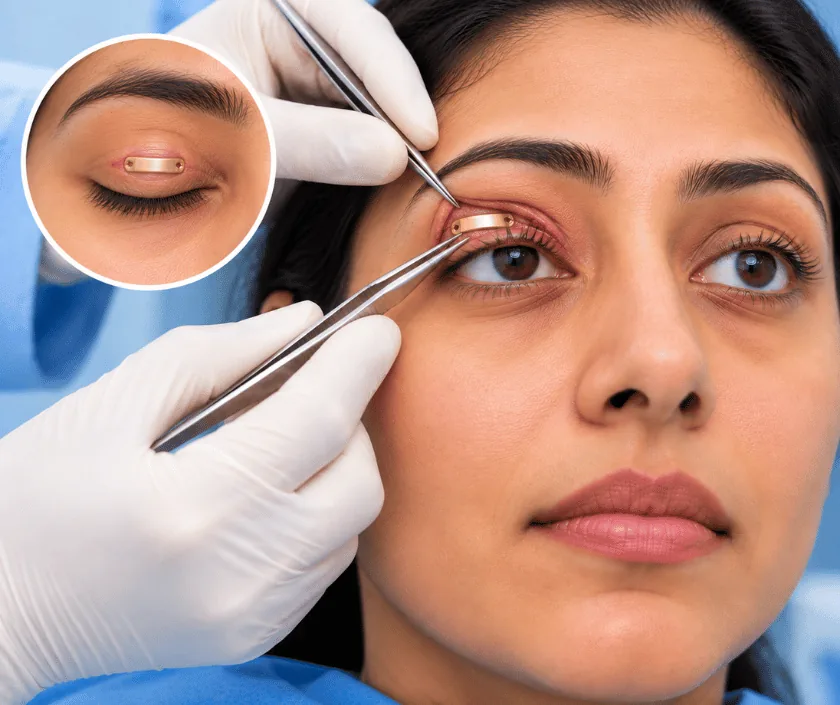
Lagophthalmos is the inability to close the eyelids fully. In facial paralysis it happens because the muscle that shuts the eye has lost its nerve supply. Treatment starts with drops, ointment and taping at night, and moves on to surgery such as an eyelid weight, lower lid tightening or a brow lift when closure remains incomplete.
Blinking does more than keep dust out. Each blink spreads a thin film of tears across the cornea, the clear window at the front of the eye, and that film keeps the surface healthy. In facial paralysis the muscle that closes the lids stops working, so blinking becomes weak or absent on one side. The tear film breaks up, the surface dries and small injuries appear.
Two extra problems often join it. The lower lid loses its tone and drifts away from the eyeball, so tears spill over the cheek instead of bathing the eye. The brow may also droop and hang over the upper lid. Some people are protected by a reflex that rolls the eye upwards during attempted closure, and others are not, which is why examination matters more than any general rule.
Correction is therefore tailored. Lubrication and night time taping come first and are sometimes enough while nerve recovery is awaited. If closure stays incomplete, an upper eyelid weight uses gravity to help the lid come down, lower lid tightening restores contact with the eyeball, and lifting the brow removes the extra load from above.
Almost everyone with facial paralysis needs some form of eye protection, though the level of intervention depends on how much closure is missing.
Closure, blink strength, tear production and corneal sensation are assessed, usually alongside an eye specialist. The lower lid is checked for laxity and the brow for drooping.
Lubricating drops during the day and ointment with taping at night are started straight away. This buys time safely while the longer plan is worked out.
Options are matched to the findings. An upper lid weight helps closure, lower lid tightening restores contact, and a brow lift removes weight from above. Several may be combined.
Most eyelid work is done as a day case under local anaesthesia, sometimes with sedation. Incisions sit within natural creases so that scars settle discreetly.
The eye is reviewed within days and again as swelling settles. Weights can be exchanged and tension adjusted if closure is still not complete.
Bruising and swelling of the lid are expected. Cold compresses, prescribed drops and sleeping with the head raised keep things comfortable.
Stitches are removed or dissolve, and most swelling settles. Vision is usually stable, though the lid may still feel tight or slightly heavy.
Scars are softening and closure can be judged properly. Any small adjustment is planned around this point rather than earlier.
The eye is generally comfortable with far less lubricant. Reviews continue if facial nerve recovery is still changing the picture.
The aim is a comfortable, protected eye rather than a blink that matches the other side. Most patients still need lubricating drops afterwards, simply fewer of them. Closure often becomes complete or very nearly so, and night time taping can sometimes be stopped. Blinking speed and spontaneity usually remain reduced, since these procedures assist closure rather than restore the muscle that produces it.
Eyelid procedures are generally well tolerated, yet a few specific problems deserve mention.
Diligent eye care at home does more to protect sight than any single operation.
Corneal sensation is often reduced, so serious damage can develop without pain. Regular checks matter more than how the eye feels.
Lubricants help, yet they cannot replace closure. When the lid still gapes at night, surgery protects the eye far more reliably.
The order is the other way round. Sight is at stake, so the eye is dealt with first.
It remains a simple and effective protection, and it is often the difference between a healthy cornea and an ulcer.
Elegance Clinic in Surat treats the eye as the first priority in every facial palsy plan, and Dr. Ashutosh Shah arranges eye assessment alongside surgical planning rather than afterwards.

Eyelid procedures are usually shorter than reconstruction of the smile, and most are day case operations, so the estimate is correspondingly smaller. It covers theatre time, anaesthesia, any implant used, dressings and follow up reviews. Where a lid weight, lower lid tightening and a brow lift are combined, each element is itemised so you can see what is included. A written estimate follows your assessment, and insurance may contribute since this treatment protects sight.
These are the questions that come up most often in consultation. If yours is not here, send it on WhatsApp and the team will reply, usually the same day.
Ask your question →Because sight is at risk. An eye that cannot close dries out, and the clear front surface can ulcerate within days. Smile surgery can wait a few months without harm, while an unprotected cornea cannot.
Sometimes, especially if closure is nearly complete and the eye still has normal sensation. When the lid gapes at night or sensation is reduced, drops are not enough on their own and a surgical option is safer.
A written estimate is prepared after assessment. It lists theatre time, anaesthesia, any implant, and follow up, with each combined procedure itemised. Insurance may contribute, because the treatment is carried out to protect sight rather than for appearance.
Most eyelid procedures are done as a day case under local anaesthesia, sometimes with sedation to keep you relaxed. General anaesthesia may be chosen if the work is combined with a larger operation on the face.
Bruising and swelling usually settle within one to two weeks, and many people return to desk work within that time. Closure can be judged properly at around six weeks, once the tissues have relaxed and stitches have healed.
These procedures assist closure rather than rebuild the blink itself. The eye becomes far more comfortable and protected, though blinking generally stays slower on that side unless the facial nerve recovers.
That is planned for. An eyelid weight can be removed if it is no longer needed, and lid tightening can be adjusted. Reviews continue while recovery is still changing how the eye behaves.
Seeing patients from across the city and beyond: read about the practice on the plastic surgeon in Surat page, or check what a written estimate covers on the costs and insurance page.
