A masseteric nerve transfer connects a branch of the chewing nerve to the facial nerve on the weak side. It gives a strong, reliable lift of the mouth, and movement usually appears sooner than with other nerve options.
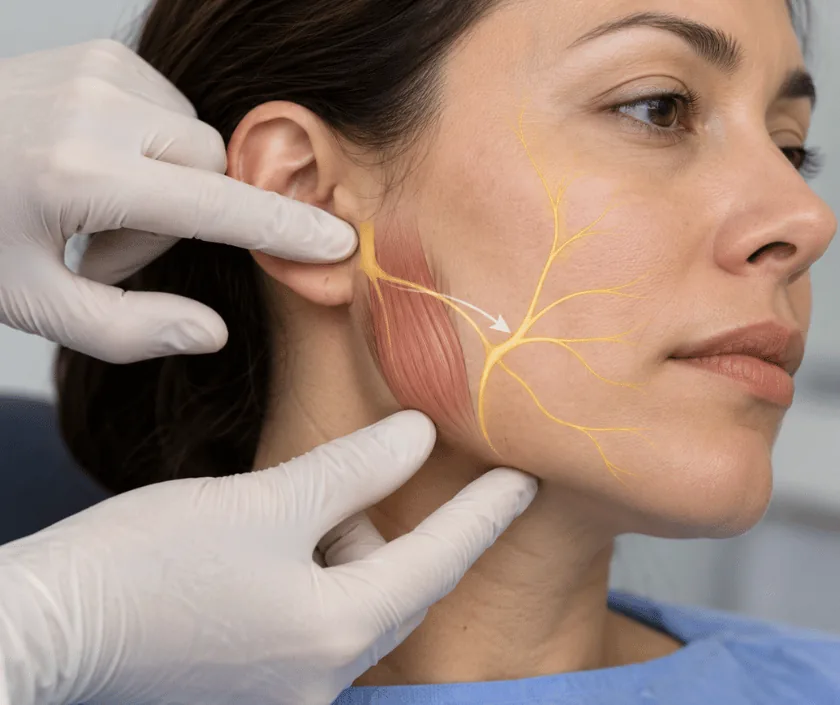
A masseteric nerve transfer borrows a branch of the nerve that drives the masseter, the muscle you clench with. That branch is joined directly to the facial nerve near the cheek. Biting then lifts the corner of the mouth. With therapy, many patients learn to trigger the smile without an obvious clench.
The masseter is one of the muscles you use to bite. Its nerve sits close to the facial nerve branches in the cheek, and it carries a large number of fibres. That combination makes it a useful donor when the facial nerve above has been lost but the smile muscles below are still healthy.
Through an incision in front of the ear, the surgeon exposes the facial nerve branch that supplies the smile and then finds the masseteric nerve deeper in the cheek. The two are joined directly under magnification, without needing a graft from the leg. Because the join is close to the muscle, fibres have only a short distance to travel, which is why movement returns comparatively early.
In the beginning the smile is driven by biting, so patients practise in front of a mirror with a therapist. Over time the brain often learns to fire the new pathway during conversation and laughter, although this varies from person to person. When a fully spontaneous smile is the goal, a cross facial nerve graft may be added so that two signals feed the same area.
This transfer suits people who want dependable movement and are ready to practise, since the smile begins as a learned action.
The face is examined in motion, and the strength of your bite is checked. Photographs and video record the starting point so that later reviews can be compared fairly.
An incision in front of the ear, similar to that used for parotid surgery, gives access. The branch that supplies the smile muscles is identified and tested with a stimulator.
The masseteric nerve is traced within the chewing muscle. Only one branch is taken, so biting strength is preserved through the branches that stay behind.
The two nerve ends are brought together and stitched under magnification with very fine sutures. No graft is usually needed, because the nerves lie close together.
Once healing allows, a therapist teaches you to bite gently while smiling. Practice gradually links the two actions, and many patients find the effort fades over months.
Swelling in front of the ear and a mildly sore jaw are usual. Soft food, cold packs and prescribed pain relief keep things comfortable.
The wound is reviewed and most patients return to desk work. Chewing feels a little tired at first and then settles.
The scar is maturing and jaw comfort is back to normal. Movement has usually not started yet, so therapy focuses on preparation.
Movement typically appears during this period and grows stronger with practice. Reviews continue while the smile becomes easier to trigger.
Expect a smile that works well and looks natural in most social situations, yet begins as a deliberate action. Early on you will bite gently to make the mouth lift, and mirror practice helps join the two. Many patients find the effort becomes automatic with time, while some always notice it slightly. The lift is usually strong, though the eye and cheek do not move in the same way as the healthy side.
Complications are uncommon, but they should be understood before consenting to surgery.
Recovery here is as much about training as about wound care, so daily practice matters.
Only one branch is used and the rest stay intact, so biting strength is kept. Some tiredness in the jaw early on is normal and settles.
It starts as a deliberate bite, yet many patients find the action becomes automatic during conversation as the brain adapts.
Therapy does much of the work here. Without regular practice the new pathway stays clumsy and the smile stays effortful.
Nerve fibres still have to reach the muscle, so a few months of nothing visible is expected rather than a sign of failure.
Elegance Clinic in Surat treats nerve transfer as one part of a wider plan, and Dr. Ashutosh Shah reviews eye protection, resting balance and the smile together before recommending anything.

Cost reflects theatre time, anaesthesia, the microsurgical work involved and the length of hospital stay, which is usually short. Facial therapy sessions and follow up reviews are listed separately so you can see what is included. A written estimate is prepared after assessment rather than quoted over the phone, because the plan depends on your examination. Where paralysis followed tumour surgery or trauma, insurance may cover part of the treatment.
These are the questions that come up most often in consultation. If yours is not here, send it on WhatsApp and the team will reply, usually the same day.
Ask your question →Biting strength is generally kept, because only one branch of the chewing nerve is used and the others remain. Many patients notice the jaw tires more easily for a few weeks, and that settles as healing progresses.
Usually within a few months, which is earlier than options relying on a long graft. The first movement is small. Strength then builds through the following year, and mirror practice with a therapist speeds the process.
At the start, yes. A gentle clench triggers the lift, and therapy teaches you to blend the two. Over time many patients find the smile appears during conversation without conscious effort, though this varies.
A written estimate is given after examination and covers theatre time, anaesthesia, hospital charges, the surgical fee and follow up. Therapy is listed separately. Insurance may contribute when the paralysis followed surgery or an injury.
Often not on its own, because the smile muscles waste when they have no nerve supply for a long time. In that case a muscle is transferred instead, and this nerve can be used to power it.
Yes. It is frequently paired with a cross facial nerve graft, so one signal supplies power and the other supplies spontaneity. Eyelid procedures and a brow lift may be planned in the same episode of care.
The face is examined at rest and in motion, bite strength is tested, and photographs or video are recorded. Eye closure is checked carefully. You then discuss suitable options and receive a written estimate before deciding.
Each technique below has its own page explaining how it works and when it is chosen.
Seeing patients from across the city and beyond: read about the practice on the plastic surgeon in Surat page, or check what a written estimate covers on the costs and insurance page.
