A static sling uses a strip of the patient's own tissue, or a graft material, to suspend the drooping corner of the mouth. It does not create movement, yet it can transform how the face looks and works at rest.
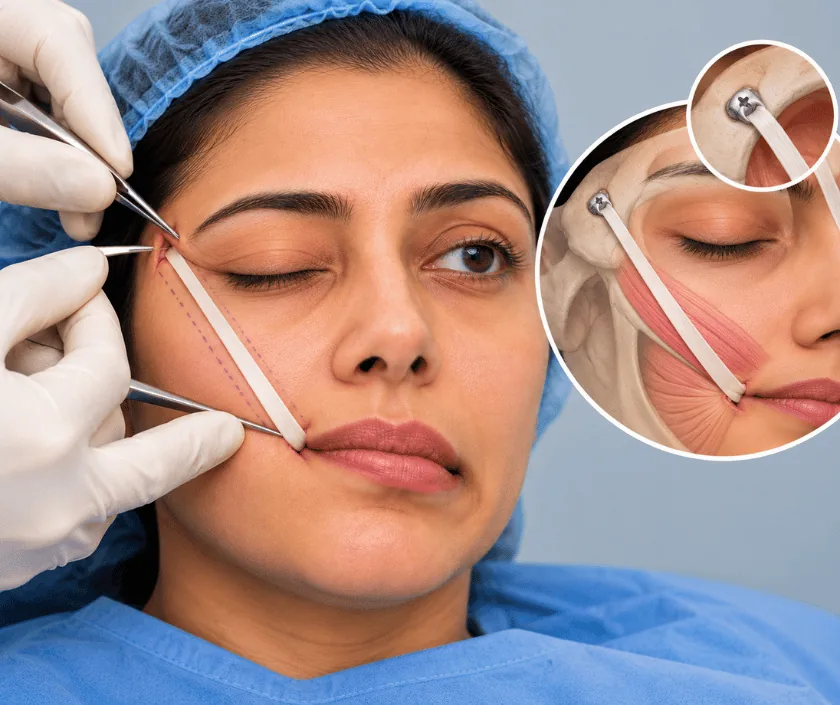
Static sling surgery suspends the sagging side of a paralysed face. A strip of fascia from the thigh, or a suitable graft, is passed from the corner of the mouth to firm tissue near the cheekbone and tightened. The face sits more evenly, the lips seal better, and drooling often improves, though the sling itself cannot move.
Not every patient with facial paralysis is a candidate for a long reconstruction. Someone in their seventies, someone with heart or lung disease, or someone who simply does not want months of therapy may still be troubled by a face that sags on one side. The corner of the mouth drops, food escapes, speech blurs and photographs feel difficult.
A static sling addresses those problems directly. Through an incision in front of the ear and a small one near the corner of the mouth, a strip of fascia lata from the outer thigh is tunnelled under the cheek skin. One end is anchored to the tissue around the mouth, the other to firm tissue near the cheekbone or temple, and the tension is set so that both sides match while you lie flat.
Because nothing is being reinnervated, there is no waiting period. The change is visible as soon as swelling settles. What the sling cannot do is smile, blink or add expression, and it is important to hold that distinction clearly in mind when choosing between options.
This is the practical choice when appearance and function at rest matter more than the prospect of movement.
The face is examined sitting and lying, because gravity changes the picture. Marks are made to show the direction of pull that will look most natural in an upright position.
A strip of fascia lata is harvested through a short incision on the outer thigh. This tough sheet of tissue holds tension well and comes from the patient's own body.
Through an incision in front of the ear and a small one near the mouth, a tunnel is made under the cheek skin so the strip can pass without kinking or bunching.
One end is fixed around the corner of the mouth and the upper lip, the other to firm tissue near the cheekbone. Tension is deliberately set a little tighter than the final aim, since slings relax over time.
Wounds are closed and a light dressing applied. Most patients go home the same day or the next morning, and the tension is reassessed at follow up visits.
The cheek feels tight and looks overcorrected, which is intentional. Swelling, bruising and a sore thigh are usual, and pain relief keeps things manageable.
Stitches are checked and swelling begins to fall. Most people return to desk work, though the face still looks pulled to one side.
The result is settling into its intended position and the thigh is comfortable. Scars are pink and will fade over the following months.
The face has reached a stable resting position. Slings can loosen with time, so tension is checked at reviews and can be adjusted if needed.
The change is limited to how the face sits, and that limitation is the whole point of the operation. At rest the two sides look far closer, yet when you smile the difference remains obvious because the sling cannot contract. Overcorrection early on is deliberate and settles within weeks. Over the years the tissue may stretch a little, so some patients choose a small tightening procedure later on.
This is a smaller operation than muscle transfer, although it carries its own set of problems.
The instructions are simple, and following them protects the tension you have paid for.
It holds the face in position and cannot contract, so a smile needs a nerve or muscle procedure instead.
Slight overcorrection early on is deliberate, because the tissue relaxes a little as healing settles.
Tissue stretches over the years, so some patients choose a small tightening procedure later. That is expected rather than a failure.
Lip seal, drooling and speech are practical daily problems, and improving them changes how comfortably people eat and talk.
Elegance Clinic in Surat offers static support as a considered choice rather than a fallback, and Dr. Ashutosh Shah explains plainly what a sling can and cannot do before you decide.

A static sling is usually a shorter operation than nerve or muscle surgery, and the estimate reflects that. It covers theatre time, anaesthesia, the graft harvest, a day case or single night stay and follow up reviews. Because slings can loosen over the years, the possibility of a later adjustment is explained at the same time rather than raised afterwards. You receive a written estimate after assessment, and insurance sometimes contributes when the paralysis followed surgery or an injury.
These are the questions that come up most often in consultation. If yours is not here, send it on WhatsApp and the team will reply, usually the same day.
Ask your question →No, and that is the honest limit of the operation. A sling holds tissue in a better position but cannot contract. It improves the face at rest, lip seal and drooling, while a smile requires a nerve or muscle procedure.
Many patients get years of useful support, though tissue naturally stretches with time and the face may settle lower. Tension is checked at reviews, and a small tightening procedure can be discussed if the change becomes noticeable.
A strip of fascia lata from the outer thigh is often preferred, since it is your own tissue and holds tension well. Other graft materials exist and may be chosen depending on your health and the plan agreed at assessment.
It frequently is. The procedure is shorter, the recovery quicker and the anaesthetic demand lower than a free muscle transfer, which makes it a sensible option when a long operation would be unwise.
A written estimate is prepared after assessment and covers theatre time, anaesthesia, the graft, the hospital stay and follow up. There is no set price, because the extent varies and eyelid procedures are sometimes done at the same time.
Many people return to desk based work within one to two weeks, once swelling has eased. Heavy physical work and exercise wait longer. Wide mouth opening and tough food are avoided in the early weeks to protect the tension.
Often yes, and a sling is sometimes used as support while a nerve procedure matures. The sequence depends on your age, health and goals, so it is worth discussing both paths at the first consultation.
Seeing patients from across the city and beyond: read about the practice on the plastic surgeon in Surat page, or check what a written estimate covers on the costs and insurance page.
