Numbness in the little finger with a weakening pinch sometimes comes from the wrist rather than the elbow. Guyon's canal syndrome is that wrist level trapping of the ulnar nerve, and releasing the canal gives the nerve room again.
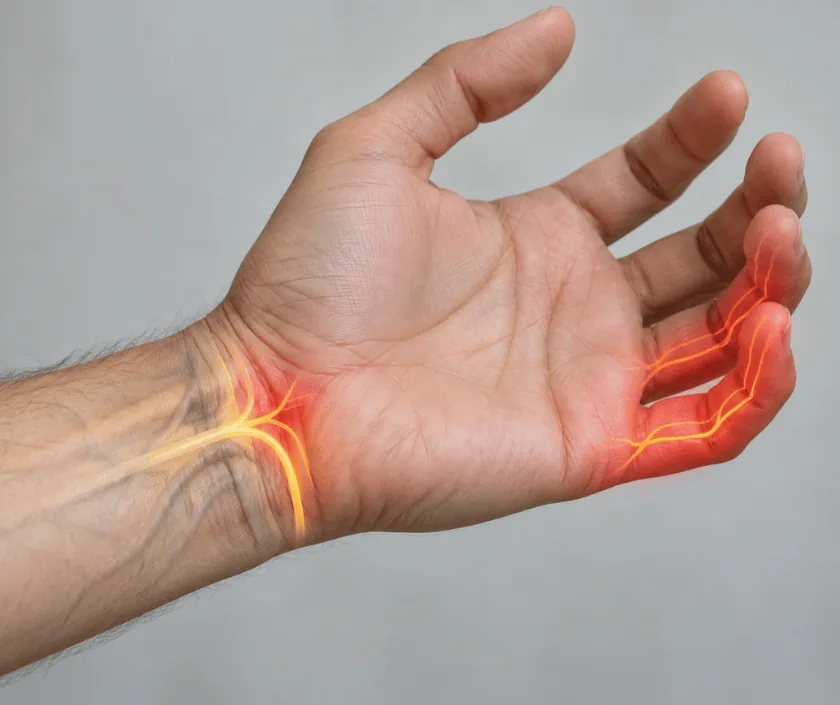
Guyon's canal syndrome happens when the ulnar nerve is squeezed at the wrist rather than the elbow. It causes numbness in the little and ring fingers, weak pinch, or both, depending on which branch is affected. Surgery opens the roof of the canal and removes whatever is pressing on the nerve, such as a ganglion or a thickened band.
Guyon's canal is a short passage on the little finger side of the wrist, bounded by two small bones and a band of tissue. The ulnar nerve travels through it and then divides. One branch carries sensation to the little and ring fingers, while the other powers most of the small muscles inside the hand. Pressure within this canal therefore produces numbness, weakness, or a mixture of the two.
Causes are usually mechanical. A ganglion arising from a nearby joint is among the commonest, and long periods of pressure through the heel of the hand, from cycling or from leaning on a tool, can irritate the nerve as well. Old fractures, thickened bands and swelling after an injury account for some cases.
Assessment first separates this from compression of the same nerve at the elbow, because the symptoms overlap closely. Examination and nerve studies usually settle the question. Surgery then opens the roof of the canal along its length and removes whatever is pressing, after which therapy rebuilds pinch and finger spread.
Release suits people whose nerve is being squeezed at the wrist and whose symptoms are not settling. Finding the cause first matters more here than in most nerve operations.
Sensation is mapped finger by finger and pinch is tested, since the pattern shows whether the nerve is pinched at the wrist or the elbow. Nerve studies and a scan for a ganglion are often arranged first.
Most releases are done under a regional block that numbs the arm, with sedation if you prefer. Your wrist is positioned so the little finger side of the palm is easily reached.
An incision over that side of the wrist exposes the roof of the canal, which is divided along its full length. Both branches of the nerve are then followed to be sure neither remains tight.
A ganglion arising from the joint is taken out along with its stalk, and any thickened band or scar tissue is released. The nerve is inspected once the pressure has been lifted.
The wound is closed with fine stitches and a light dressing applied. Finger movement starts straight away, and therapy for pinch and finger spread is arranged before you go home.
Keep the hand raised and the dressing dry. Move the fingers fully several times an hour, because stiffness sets in quickly when a sore hand is left still.
Stitches usually come out at the wound check. Therapy begins with gentle nerve gliding and light pinch work, and desk tasks are generally manageable.
Scar tenderness on the palm side of the wrist is settling. Strengthening for pinch, grip and finger spread increases, and most daily activities feel comfortable again.
Sensation usually improves ahead of strength, and muscle bulk returns slowly where wasting had begun. Recovery can vary and may continue for a year.
Tingling and pain often improve early, particularly when a ganglion was the cause and has been removed. Sensation returns over months, and strength follows behind, because muscle recovers more slowly than feeling. Where wasting between the thumb and index finger was already visible, pinch may improve only partly. Therapy for pinch, finger spread and grip does much of the work once the wound heals. Recovery can vary.
This is a delicate area where nerve, artery and tendons lie close together, so the possible problems are worth understanding.
Keeping the hand moving and keeping pressure off the wrist are the two habits that help most.
The same nerve can be squeezed at the wrist as well. Sparing of the back of the hand and a lump at the wrist are clues that point below the elbow instead.
A ganglion sitting in this canal presses directly on the nerve. Removing it is often what settles the numbness, which is why a scan is arranged before surgery.
Long rides put steady pressure through the heel of the hand onto this canal. Padded gloves, changing grip position and taking breaks reduce that load considerably.
Feeling usually recovers first. Muscle rebuilds slowly, and structured therapy for pinch and finger spread is what converts a decompressed nerve into a stronger hand.
Elegance Clinic in Surat looks along the whole nerve, from neck to wrist, before deciding where it is being pinched. Dr. Ashutosh Shah treats the cause found in the canal rather than releasing tissue blindly.

Cost depends on what has to be done inside the canal. Releasing the roof alone is simpler than removing a ganglion with its stalk from the joint beneath, and the anaesthesia chosen also affects the figure. Nerve studies, scans, dressings and therapy sessions are listed separately so you can see what is included. At Elegance Clinic the estimate is given in writing after examination.
Insurers generally accept nerve decompression when studies support the diagnosis, although day care limits and waiting periods differ between policies. Bring your papers to the consultation and the office will help you check.
These are the questions that come up most often in consultation. If yours is not here, send it on WhatsApp and the team will reply, usually the same day.
Ask your question →Cost depends on whether the canal simply needs opening or a ganglion has to be removed with its stalk, plus the anaesthesia used. Nerve studies and therapy are listed separately. You receive a written estimate after examination, and most insurers accept documented nerve compression.
It is a day care nerve decompression, usually done under a block that numbs the arm. Scar tenderness, temporary stiffness and slow recovery of strength are the usual concerns. Injury to a nerve branch or the nearby artery is uncommon, as both are seen directly.
The wound settles over the first two weeks, and light tasks are usually possible within days. Pinch and grip strength build over the following months with therapy. Manual work takes longer than desk work, and recovery can vary.
Feeling usually improves before strength does. When the small hand muscles have already wasted, pinch may recover only partly, because muscle rebuilds slowly. Starting treatment before wasting becomes visible gives the best chance of regaining power.
It is the same nerve trapped at a different level. Compression at the wrist tends to spare sensation over the back of the hand, and a lump at the wrist points there. Nerve studies confirm which level is affected.
Sometimes it can, particularly when steady pressure on the heel of the hand is the cause. Padded gloves, changing grip and avoiding leaning on the wrist help. Surgery is discussed when a ganglion is found or symptoms keep progressing.
Sensation is mapped, pinch and finger spread are tested, and the wrist is felt for a lump. The neck and elbow are checked as alternative sources. Nerve studies or a scan may follow, and you receive a written estimate.
Seeing patients from across the city and beyond: read about the practice on the plastic surgeon in Surat page, or check what a written estimate covers on the costs and insurance page.
