The condyle is the rounded head of the lower jaw that sits in the joint just in front of the ear. A break here is common, easy to miss, and treated quite differently from fractures in the rest of the jaw.
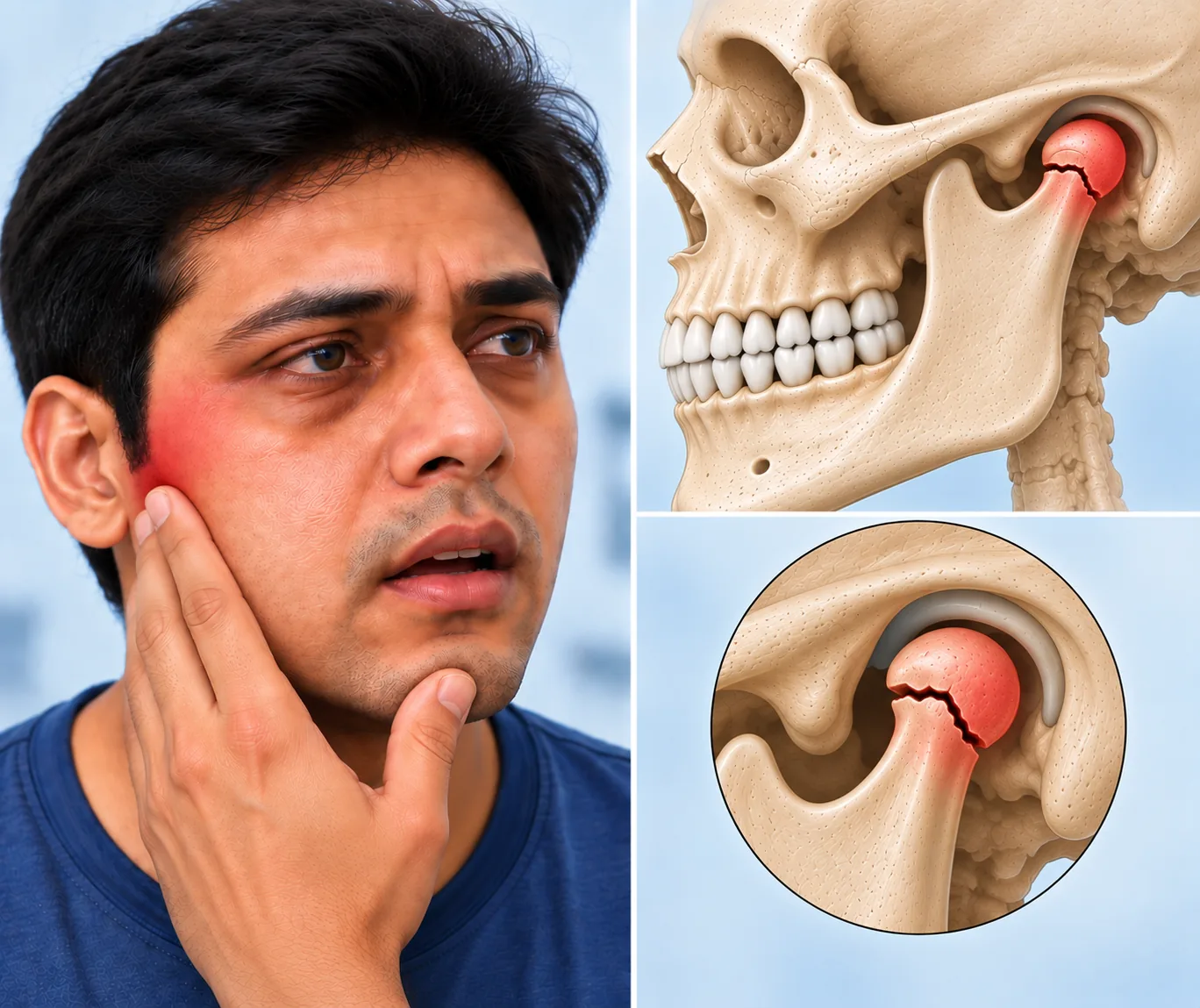
A condylar fracture is a break at the head of the lower jaw where it meets the skull, just in front of the ear. Many of these fractures are treated without plates, using a short period of elastics followed by guided jaw exercises. In children this closed approach is usually preferred, because the growing bone remodels and surgery near the joint carries its own risks.
Place a finger just in front of your ear and open your mouth. The lump that moves under your finger is the condyle, the head of the lower jaw sitting inside its joint. Because the jaw is a single arch, force applied to the chin travels backwards along the bone and often breaks it here, at the far end from the impact. That is why so many people arrive with a cut chin and pain in front of the ear.
Displacement varies widely. A minor crack may leave the bite untouched, while a badly shifted fracture shortens the jaw on that side, so the back teeth meet first and the chin drifts towards the injured side on opening. Fractures very close to the joint are handled with special caution, since the joint surface, the disc and the growth centre in children all sit within a few millimetres.
Treatment then splits into two paths. Closed care means restoring the bite with elastics for a short period, then guiding the jaw back into full movement with exercise. Open fixation means reaching the fragment and holding it with plates, which restores height precisely but works close to the nerve that moves the face. Neither is automatically right, and the choice depends on age, on displacement and on the bite.
Most condylar fractures can be managed without plates. Surgery is considered when the fragment has moved far enough that the bite cannot be restored, and it is approached differently in children.
The bite, the path of opening and the tenderness in front of the ear are recorded, and scans define how far the condyle has moved. Both joints are checked, since fractures often occur on both sides.
Age, displacement, the bite and whether other jaw fractures need fixing all shape the decision. For children the plan leans strongly towards closed treatment, and the reasons are explained to the family.
Arch bars or small bone screws carry elastics that pull the teeth into the correct bite. These are worn for a short period, then loosened so that guided movement can begin.
Under general anaesthesia the fragment is reached through a small incision placed in a skin crease or behind the ear. Plates restore the height of the jaw, working carefully around the facial nerve.
Jaw opening, side to side movement and the bite are measured at each visit. Exercises are progressed steadily, since regaining movement is as important as the bone uniting.
Pain in front of the ear is at its sharpest and opening is limited. Cool liquids, blended food and regular pain relief carry most people through this stage.
Elastics guide the bite while swelling settles. Speech becomes easier and most adults return to light work, keeping to soft food.
Elastics are usually finished. Opening exercises step up, and the diet widens gradually as the bite proves stable at review.
Movement usually approaches normal. Children stay under review for longer, so that growth of the jaw on that side can be watched over the years.
Most people regain a comfortable bite and good jaw movement, and children in particular often remodel a displaced condyle remarkably well. Some limits remain honest to state. Opening may stay slightly reduced, clicking or aching in the joint can persist, and a small number of children develop uneven jaw growth that needs attention years later. Exercise, done steadily, has more influence on the final result than most patients expect.
Risks differ between the two routes, so the discussion at consent covers both what is being done and what is being avoided.
The exercise programme is the treatment, not an optional extra, and families are shown exactly how to supervise it.
At the condyle, many fractures do better with elastics and exercise, and children are usually treated this way on purpose rather than to save cost.
Closed care involves elastics, repeated bite checks and a demanding exercise programme, and it works only if all of that is followed.
Clicking is common after joint injury and often settles. It is reviewed, but by itself it does not mean the bone healed badly.
Growth at the condyle continues for years, so a child needs follow up long after the bone has united, to catch any change in facial shape.
At Elegance Clinic in Surat, condylar fractures in children are approached conservatively by preference, and the reasoning is set out for parents before any decision is made.

Care for a condylar fracture is medically necessary and is usually covered by mediclaim, whether treatment is closed or involves fixation. The estimate depends on the route chosen, on whether other jaw fractures are being fixed in the same sitting, on implants, room category and length of stay. Closed treatment usually costs less in hospital terms while requiring more review visits and a longer programme of exercises. A written estimate is given before admission.
These are the questions that come up most often in consultation. If yours is not here, send it on WhatsApp and the team will reply, usually the same day.
Ask your question →Young bone at the joint remodels well, and surgery there sits close to the growth centre, the joint surface and the nerve that moves the face. Elastics with a guided exercise programme usually give a good result while avoiding those risks.
It still needs assessment and review. An undisplaced fracture with a normal bite often does well, but movement must be watched, because a joint that stiffens is far harder to treat than one kept moving early.
Open fixation needs a small incision, usually hidden in a natural crease in front of the ear or behind it. Scars generally fade well. When the fracture can be managed closed, no skin incision is made at all.
Opening usually improves over several weeks and can keep improving for months. Progress depends on how consistently the exercises are done. Opening that stays very restricted is reviewed promptly, since early action matters.
Fracture treatment after injury is generally covered by mediclaim, including closed care. The extent of cover depends on the policy and on insurer approval, and paperwork is easier when the injury and the treatment plan are documented clearly from the start.
It is uncommon, but it can happen after joint injury, especially in children whose jaw was kept still for a long period. Guided movement started early is the main way this outcome is avoided.
For adults, ongoing joint pain, clicking or a bite that changes. In children, watch for a chin that begins to sit off centre or a face that grows unevenly. Both are reasons to return rather than wait.
Seeing patients from across the city and beyond: read about the practice on the plastic surgeon in Surat page, or check what a written estimate covers on the costs and insurance page.
