The coronoid process is a thin triangle of bone at the top of the jaw, hidden behind the cheekbone, where a powerful closing muscle attaches. Fractures here are uncommon and most of them need movement rather than metal.
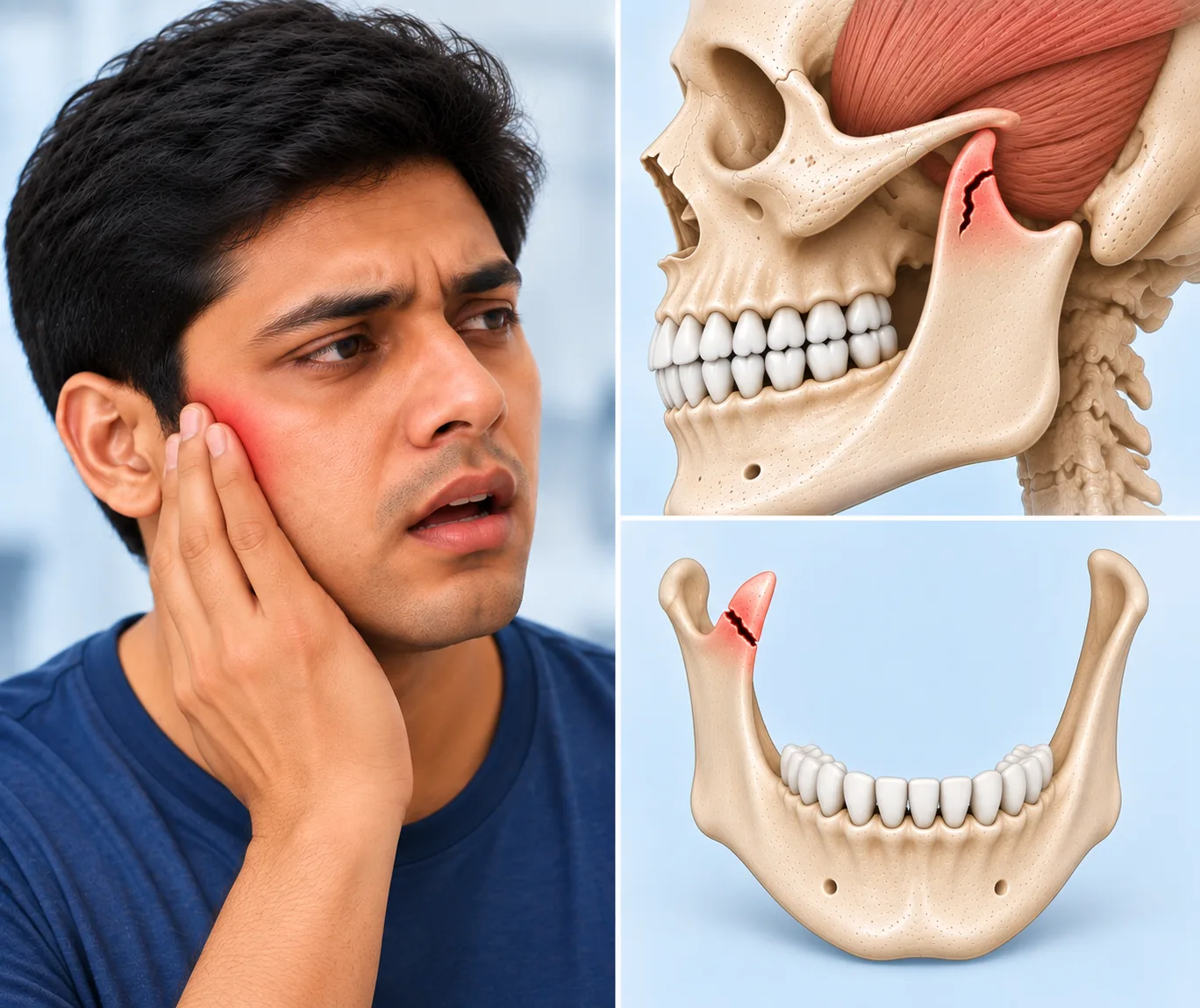
A coronoid fracture is a break of the thin, pointed process at the top of the lower jaw, tucked behind the cheekbone. It rarely occurs alone and often needs no fixation, because the tendon attached to it holds the fragment. Treatment usually means pain relief, a soft diet and early jaw exercises, with surgery reserved for a fragment that blocks movement.
The top of the jaw ramus splits into two projections. Behind sits the condyle, which forms the joint. In front sits the coronoid process, a flat spike of bone that slides up behind the cheekbone every time you close your mouth. A fan shaped muscle running down from the side of the skull grips it, and that tendon is what usually keeps a broken coronoid from drifting far.
Because of its position, this bone is hard to hit directly. Most coronoid fractures happen alongside another injury, typically a fractured cheekbone or a break elsewhere in the jaw, and some are found only when a scan is taken for something else. Symptoms are often vague: aching deep in the cheek, discomfort on chewing and a jaw that will not open as wide as usual.
Management follows from that. Since the bite is not affected and the tendon holds the fragment, the sensible course is nearly always pain relief, soft food and early exercise. The real danger is not the broken bone but the stiffness that follows if the jaw is rested too long, or a fragment that heals against the cheekbone and mechanically blocks opening.
Most people never need an operation for this fracture. Surgery is considered only when the fragment physically limits movement or when a nearby fracture already requires access.
Mouth opening is measured in millimetres and recorded, and the cheek and bite are examined. That first measurement becomes the reference against which progress is judged.
Imaging shows the fragment, how far it has moved and whether the cheekbone or another part of the jaw is broken. The full pattern decides whether any surgery is needed at all.
For most people treatment means pain relief, anti inflammatory medicine if suitable, a soft diet and a structured programme of jaw opening exercises started early.
If the fragment blocks movement, it is removed under general anaesthesia through a cut inside the mouth. Muscle attached to it is released so the jaw can move freely again.
Whether or not surgery is done, mouth opening is measured at every review and the exercise programme is adjusted to match. Physiotherapy carries on until movement stops improving, and only then is the range accepted as settled.
Pain deep behind the cheek limits chewing. Soft food, regular pain relief and gentle opening within comfort make up the early routine.
Discomfort eases and opening usually improves. Most people are back at work, still avoiding hard or chewy food.
Opening is reassessed against the first measurement. The diet widens when chewing is comfortable, and exercises continue if movement is still short.
Movement has usually settled at its final range. Any opening that remains restricted is investigated, since a fragment fused to the cheekbone can be treated.
Most coronoid fractures settle with conservative care and leave no lasting problem, provided the jaw is kept moving. A minority end with opening that stays a little short of what it was, and a few need the fragment removed later because it has fused to neighbouring bone. Progress varies with the other injuries present and with how faithfully the exercises are done during the first weeks.
Risk here is mainly about movement rather than bone, and it is discussed openly at the first visit.
Since exercise is the mainstay, home routine matters more here than in most fracture care.
The coronoid is held by a strong tendon and does not carry the bite, so fixation is rarely needed and is not the default here.
Rest is what causes the trouble at this site. Stiffness from prolonged rest is far harder to reverse than the discomfort of early gentle movement.
The coronoid carries no teeth, so the bite often stays normal while the fracture is real and still worth reviewing.
It usually does with exercise, but movement lost during weeks of disuse can become fixed, and by then treatment is more involved.
At Elegance Clinic in Surat, an uncommon fracture like this is judged on mouth opening and function rather than on the scan alone, and surgery is advised only when it will change the outcome.

Most coronoid fractures are managed without an operation, so the cost is limited to consultation, imaging, medicines and review visits. When surgery is needed, either to remove a blocking fragment or because a neighbouring fracture is being fixed in the same sitting, the admission is treated as necessary medical care and mediclaim usually applies. The estimate then depends on the full set of fractures being treated, the implants used, room category and length of stay. A written estimate is given before admission.
These are the questions that come up most often in consultation. If yours is not here, send it on WhatsApp and the team will reply, usually the same day.
Ask your question →On its own it is usually the least troublesome jaw fracture, because the bite is unaffected and a strong tendon holds the fragment. What matters is protecting mouth opening and checking whether other facial bones were broken at the same time.
This part of the jaw carries no teeth and takes no load from the bite, so fixation adds little. Movement is what determines the outcome, which is why exercises and review replace surgery in most cases.
Your opening is measured at the first visit and compared at each review. What matters is steady improvement towards your own normal rather than hitting a fixed number, since baseline opening differs between people.
Usually yes. This bone sits behind the cheekbone and is difficult to assess by examination alone, and a scan also shows whether the cheekbone or another part of the jaw has been broken alongside it.
When admission and surgery are needed, mediclaim generally applies because the treatment follows an injury. Outpatient care such as consultations, imaging and medicines is often not covered, and that is explained at the first visit.
That is a reason to return rather than persist at home. Sometimes the exercise programme simply needs adjusting, and occasionally a scan shows the fragment has healed against the cheekbone and needs to be removed.
Soft food is advised while chewing is painful, usually for a few weeks, and firmer food is added as comfort allows. Since the bite is not disturbed by this fracture, diet is guided mostly by pain rather than by a fixed timetable.
Seeing patients from across the city and beyond: read about the practice on the plastic surgeon in Surat page, or check what a written estimate covers on the costs and insurance page.
