Behind the brow lies an air space that empties into the nose through a narrow channel. When a blow breaks the bone around it, both the shape of the forehead and the drainage of that space have to be judged together.
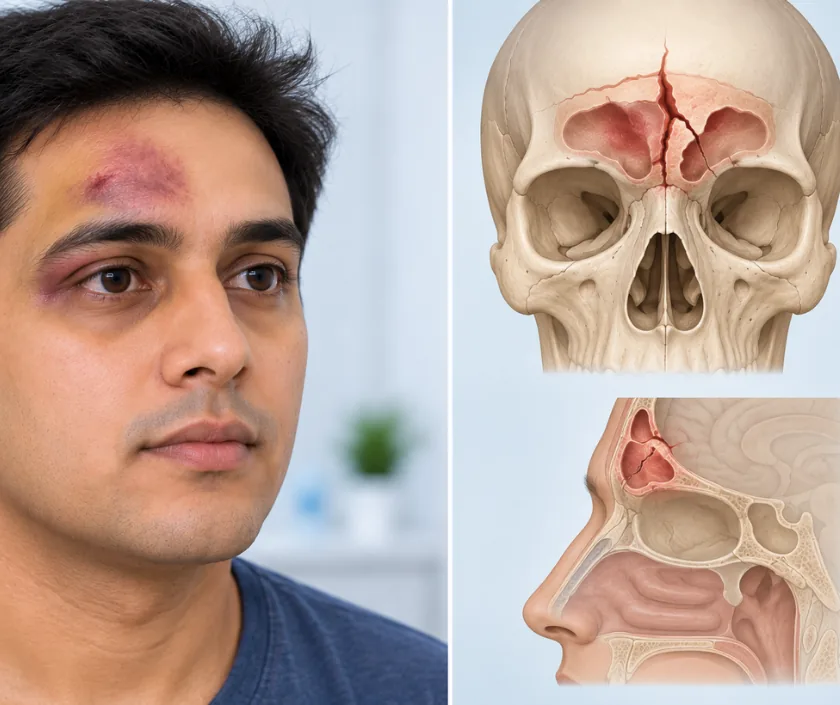
A frontal sinus fracture is a break in the bone around the air space inside the forehead. The front wall governs the contour of the brow, while the back wall lies against the covering of the brain. Treatment depends on which walls have moved and whether the sinus can still empty into the nose.
Most adults have a hollow space inside the forehead bone, lined with the same moist tissue that lines the nose. Two walls enclose it. The front wall lies just under the skin and gives the brow its curve, while the back wall separates the sinus from the covering of the brain. A narrow channel behind the eyebrow lets the space drain into the nose.
One heavy blow can break either wall, or both at once. Damage to the front wall shows itself as a dent once swelling goes down. Movement of the back wall matters far more, because the lining of the brain can be torn and fluid can leak into the nose. Injury to the drainage channel is quieter still, since nothing may be visible at all until trapped mucus builds up later.
Because of that, decisions rest on the CT scan rather than on how the brow looks. Some fractures are simply watched, with imaging repeated over time. Others need the sinus cleaned, the front wall rebuilt, or the space closed off altogether so that it can no longer trap fluid.
Not every sinus fracture needs surgery. The decision turns on which wall has moved, whether the space can still drain and whether the covering of the brain has been breached.
Head injury, vision and any fluid from the nose are checked first. A fine cut CT scan then shows which walls have moved and whether the drainage channel is open, which decides the whole plan.
Surgery may be aimed at contour alone, at restoring drainage, or at closing the sinus so it can never trap fluid again. Where the back wall has moved, a neurosurgical colleague joins the discussion.
Through an incision in the hairline, or through an existing wound, the sinus is opened and cleaned. Damaged lining is removed carefully, because any left behind can form a swelling in later years.
The front wall is rebuilt with the bone fragments themselves, held by small plates. When the space cannot be made to drain safely, it is filled or closed off instead of being left as a pocket.
Wounds are closed in layers and swelling is watched for a day or two. Scans at intervals afterwards confirm that nothing is collecting inside the healed sinus.
Swelling around the brow and eyes is at its worst. Staff watch alertness, vision and any fluid from the nose, while pain relief and a raised head position keep things comfortable.
Wound stitches come out and bruising fades. Blowing the nose is still avoided, and most people manage quiet activity at home although the brow feels numb.
Bone has knitted well by this stage. Desk work and ordinary routine are usually fine, while contact sport, swimming and heavy lifting wait for clearance.
Contour settles fully and sensation improves. Review continues at longer intervals, because a blocked sinus can announce itself years rather than weeks later.
Brow shape usually improves a great deal, and many people end up with a forehead that looks close to how it did before. Slight unevenness can remain where bone was shattered into small pieces. Numbness above the incision often lingers for months. Sinus problems are far less likely once the space drains or has been closed, though review over years is still the honest advice rather than a discharge after one visit.
Sinus surgery on the forehead is well described, and the risks are worth hearing plainly so you can weigh them against the reason for operating.
Healing inside the sinus is helped mainly by keeping pressure and germs away from it during the first weeks.
Brow shape matters, but so does drainage. A sinus that cannot empty may cause infection or a swelling months later, which is why the scan is studied so carefully.
Damage sits behind bone that can appear intact from outside. Only imaging shows whether the back wall has moved or the drainage channel is blocked.
Most people need nothing further, yet late problems do occur. Review over the following years is part of the treatment rather than an optional extra.
Medicine can settle an infection for a time. Where the channel is blocked by displaced bone, the drainage itself has to be dealt with surgically.
At Elegance Clinic in Surat these injuries are planned from fine cut imaging and reviewed for as long as the sinus needs watching, with eye and neurosurgical colleagues brought in whenever the scan calls for it.

Cost varies with the walls involved, whether the sinus is rebuilt or closed off, whether a neurosurgical team shares the operation and how long admission lasts. All of that follows the scan, so an estimate is put in writing after assessment instead of being guessed in advance. Because this is injury treatment, most health insurance and accident policies apply, and the team will help you assemble the documents.
These are the questions that come up most often in consultation. If yours is not here, send it on WhatsApp and the team will reply, usually the same day.
Ask your question →It depends on which walls are involved, whether the sinus is rebuilt or closed, the implants used and the length of admission. A written estimate is given after examination and a scan, since quoting a figure before those is not honest.
Injury repair is medical treatment, not cosmetic surgery, so most health policies and accident cover include it. Emergency notes, scan reports and photographs are usually needed for approval. Policy waiting periods and room rent limits still apply as written.
The operation is well described and carried out under general anaesthesia. Risks that deserve mention include infection, fluid leak from around the brain and lasting forehead numbness. Where the back wall has moved, a neurosurgical colleague shares the planning and the operation.
Swelling settles over a fortnight and most people manage light work within a few weeks. Nose blowing, swimming and flying wait longer. Recovery can vary, so activity is cleared at review rather than by a fixed calendar.
Once the space drains freely or has been closed properly, later trouble becomes far less likely. Even so, trapped lining can form a swelling after years. Scans at intervals are advised so anything developing is caught while it is small.
Not at all. A fracture that has kept its position, with a sinus that still empties into the nose, is usually watched. Surgery is advised for a sunken brow, a blocked channel, a displaced back wall or a leak of fluid.
Bring all scan images and reports, hospital papers from the injury, insurance documents and your regular medicine list. Mention smoking, diabetes or blood thinning tablets. Writing your questions down helps, because several treatment routes may be discussed.
Seeing patients from across the city and beyond: read about the practice on the plastic surgeon in Surat page, or check what a written estimate covers on the costs and insurance page.
