The forehead bone sits at the front of the skull and shapes the brow, so a break there is felt as much as it is seen. Careful assessment decides whether the bone can settle on its own or needs repair.
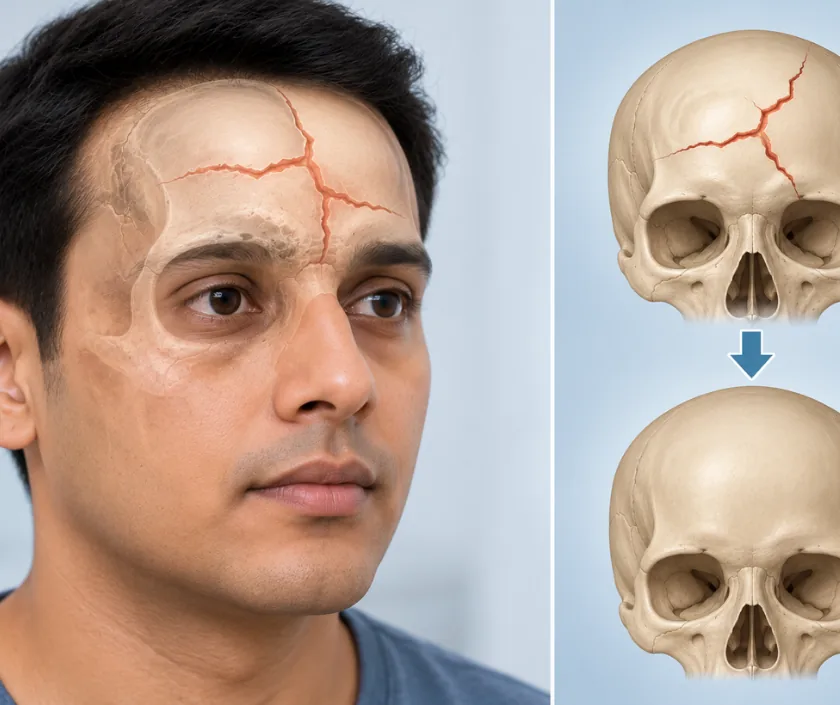
A frontal bone fracture is a break in the bone of the forehead, usually after a road crash, a fall or a heavy blow. Some breaks stay in line and heal with watching alone. Others push inwards, disturb the sinus behind or press towards the eye socket, and those are lifted back and held with small plates through a hidden incision.
The forehead bone forms the front of the skull. It curves over the brow, dips into the roof of each eye socket and, in most adults, surrounds an air space called the frontal sinus. A heavy impact can crack this bone, push a section of it inwards or drive fragments towards the sinus and the eye.
Assessment starts with the injury itself and then widens out. Because a force strong enough to break the forehead can also shake the brain, the head injury is checked first. After that a CT scan maps the break in fine detail, showing whether the outer wall alone has given way, whether the inner wall next to the brain has moved, and whether the drainage channel of the sinus is blocked.
Treatment follows what the scan shows. Cracks that remain in line often heal without an operation and the brow keeps its curve. When bone has sunk, when a dent is visible, or when the sinus or the eye socket is disturbed, the fragments are eased back into position and held with small plates and screws until the bone knits.
Surgery is offered when the shape of the forehead, the health of the sinus or the safety of the eye and brain would suffer without it. Plenty of fractures need nothing more than time and review.
Before anything is planned the head injury is assessed, vision and eye movement are tested and a CT scan is taken. That scan shows the pattern of the break and guides the choice between watching and repair.
Surgery is done under general anaesthesia. An incision is usually placed within the hairline so the skin can be lifted forward and the bone reached without leaving a scar across the face.
Fragments that have sunk inwards are eased back to their correct level. Where the sinus is involved, it is cleaned and its lining is dealt with before the outer wall is rebuilt.
Small titanium plates and screws hold the pieces steady while healing happens. They sit under the skin, stay in place afterwards and are rarely felt from outside.
Layers of the scalp are closed, sometimes over a small drain. Swelling and alertness are watched for a day or two, and the plan for dressings and review is explained before discharge.
Swelling and bruising around the brow and eyes reach their peak. Pain relief, keeping the head raised and gentle wound care are the focus, while nursing staff watch alertness and vision closely.
Stitches or clips in the scalp come out and much of the swelling drops away. Light activity at home is usually comfortable, although the forehead may still feel numb and tight.
Bone is healing well by now. Most people are back at desk work and ordinary routine, while contact sport, heavy lifting and helmet pressure are still avoided.
Contour and sensation carry on settling. Numbness fades slowly, and any remaining unevenness can be reviewed once swelling has fully gone.
Most people regain a smooth brow line and a face that still looks like their own. Small differences in contour can remain, especially where the impact was severe or swelling took a long time to settle. Forehead numbness is common and improves gradually rather than overnight. Where the eye socket was involved, vision and eye movement recover on their own timetable, and review is planned around that.
Repair of the forehead is a well established operation, yet like any surgery on the facial skeleton it carries risks that deserve a plain explanation before you agree to it.
Once you are home, the aim is to protect the repair while swelling settles. Simple habits make a real difference over the first few weeks.
Many cracks stay in line and heal on their own. Surgery is chosen when bone has moved, when the sinus cannot drain or when the eye socket is threatened.
Access is usually taken through an incision inside the hairline. Skin is lifted forward from there, which keeps the visible part of the face free of a long scar.
Titanium plates are designed to stay where they are placed. Removal is only considered if they cause trouble, which is uncommon, and they do not set off airport alarms.
Serious injury can hide behind normal vision and clear speech. A scan is what shows whether the sinus, the eye socket or the lining of the brain is involved.
Facial fracture work at Elegance Clinic in Surat is planned from scans rather than from appearance alone, and the same team follows a patient from the first assessment through surgery to late review.

What this treatment costs depends on how much bone is involved, whether the sinus or the eye socket needs work, the implants used and the length of the hospital stay. Those details only become clear after examination and a CT scan, so the figure is prepared in writing after assessment rather than quoted over the phone. Injury admissions are usually covered by health insurance and accident policies, and the team helps with the paperwork.
These are the questions that come up most often in consultation. If yours is not here, send it on WhatsApp and the team will reply, usually the same day.
Ask your question →Charges depend on whether an operation is needed, how much bone is involved, the implants chosen and the length of stay. For that reason a written estimate is prepared after examination and a scan, rather than a figure being quoted before anyone has seen the injury.
Repair after injury counts as treatment rather than cosmetic work, so most health policies and accident cover include it. Approval usually needs the emergency notes, the scan report and photographs. Room rent limits and waiting periods written into your policy still apply.
This is a well established repair carried out under general anaesthesia, with vision and alertness watched closely afterwards. Real risks remain, among them infection, lasting numbness of the forehead and fluid leak when the inner wall has moved. Each one is explained before consent is taken.
Swelling peaks over the first days and settles across a fortnight. Many people return to desk work within a few weeks, while contact sport and heavy lifting wait longer. Recovery can vary with the size of the fracture and with any other injuries present.
The aim is a smooth brow line that matches the other side. Small differences in contour can remain after a heavy impact, and numbness fades slowly. Appearance is reviewed once swelling has gone, when any further step can be discussed honestly.
No. Cracks that have kept their position are often watched with scans and clinic review. Surgery is advised when bone has sunk, the sinus cannot drain or the eye is threatened, and it is usually planned within the first week or two.
Bring the scan images and reports, emergency and discharge papers, insurance documents and a list of your regular medicines. Mention smoking, diabetes or blood thinning tablets, since these change planning. Having a family member with you helps, because a good deal is discussed.
Seeing patients from across the city and beyond: read about the practice on the plastic surgeon in Surat page, or check what a written estimate covers on the costs and insurance page.
