A patient specific implant is designed for one person alone, built from their own CT scan rather than picked off a shelf. Planning happens on screen well before surgery, so the piece fitted in theatre already matches the bone it has to sit against.
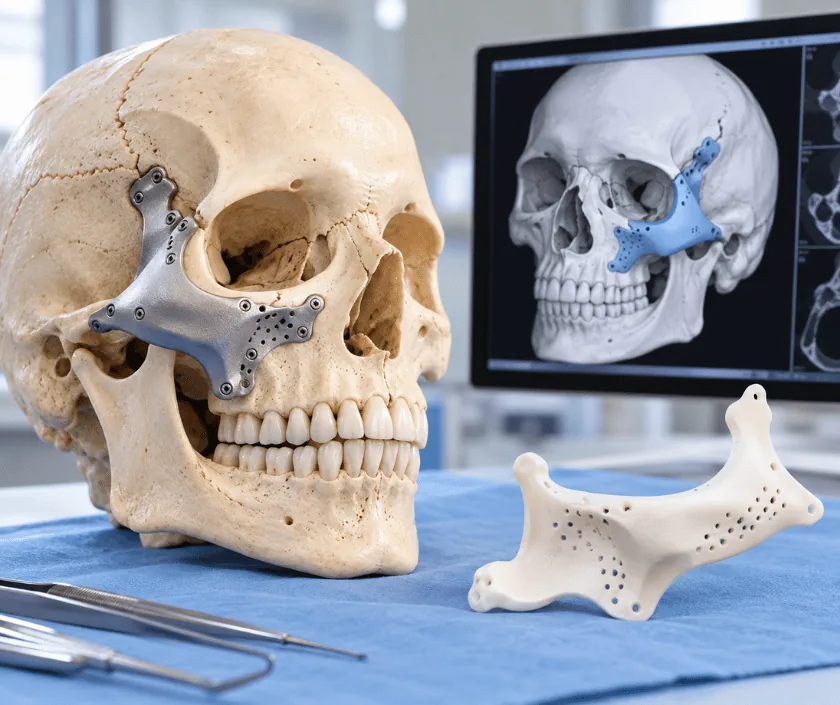
Patient specific implants, often shortened to PSI, are plates or contour pieces manufactured for a single patient from their own CT scan. Bone is modelled on a computer, the implant is designed against that model, and the piece is then made in titanium or a medical polymer. Fit is checked on screen long before the operation.
Work begins with a fine cut CT scan of the face. That scan is turned into a three dimensional model of the skull on a computer, which the surgeon and the design engineer study together. Where bone is missing, damaged or uneven, the healthy opposite side can often be mirrored across to show what the shape ought to be.
An implant is then drawn to fill that space. Thickness, screw positions and the line of the edges are all settled at this stage, along with the route the surgeon will take to reach the bone. Once everyone agrees the design, the piece is manufactured in titanium or in a medical polymer, and it arrives sterile and ready for the day of surgery.
In theatre the implant should sit against the bone without much adjustment, because the fitting has already been rehearsed on screen. Guides showing where to cut or drill are sometimes made alongside it. Small adjustments on the day remain normal, since living tissue never behaves exactly like a model.
Custom made implants are worth the extra planning when the shape being rebuilt is complicated. Simpler problems are often handled just as well with standard plates.
Your face is examined and a fine cut CT scan is arranged. Photographs and, where teeth are involved, dental models are added so the whole picture is available for planning.
The scan becomes a model on screen. Surgeon and engineer agree the shape, the thickness and where screws will sit, then revise the plan until everyone is satisfied.
Your implant is produced and sterilised, and cutting guides are made if the plan needs them. This step takes some weeks, which is why the date is fixed in advance.
Under general anaesthesia the bone is exposed through a planned cut, the implant is placed and checked against the surrounding contour, then fixed with screws.
Position is confirmed, often with a scan, before the wound is closed in layers. A drain is used at some sites and comes out within a day or two.
Swelling and bruising are at their worst. Pain relief, cold packs and rest are the priority, and any drain is removed once it stops filling.
Bruising fades and stitches are checked or removed. Many people feel ready for light activity, though the area still feels numb and tight.
Swelling has largely gone and the new contour becomes clearer. Most normal activity resumes, with contact sport still on hold.
Shape settles fully and sensation keeps returning. Reviews confirm the implant is stable and the skin over it is healthy.
Planning on screen brings the bone shape close to what was intended, and most people see a clear improvement in contour and symmetry. Soft tissue over the implant behaves in its own way, though, so the surface result is never quite as exact as the model. Swelling takes months to settle before the final shape can be judged, and minor adjustment is occasionally needed.
These operations are planned carefully, yet placing a foreign material under the skin of the face carries risks that deserve a plain discussion.
Simple care through the first weeks protects the wound and gives the implant its best chance of settling quietly.
Planning gets the bone shape close. Skin, fat and muscle over it are never identical, so a clear improvement in symmetry is realistic while an exact match is not.
Design, approval and manufacture take weeks. That is why this route is used for planned reconstruction and not for fresh injuries needing urgent fixation.
Bending works well for many fractures. For large or one sided defects, judging the curve by hand during surgery is far harder, which is where a designed implant helps.
Material is chosen for the job. Medical polymers suit some skull and forehead sites well, while titanium is preferred where load or screw grip matters more.
Custom implant work at Elegance Clinic in Surat is planned on screen with the patient present for the discussion, so the intended shape is agreed before anything is manufactured.

Two things drive the cost of a patient specific implant. One is the design and manufacture of the piece itself, the other is the operation to place it. Scan quality, the size of the defect, the material chosen and the length of theatre time all matter. A written estimate is given after assessment, once the design brief is clear. Reconstruction after injury, infection or tumour is usually covered by mediclaim, while purely cosmetic contouring is not.
These are the questions that come up most often in consultation. If yours is not here, send it on WhatsApp and the team will reply, usually the same day.
Ask your question →Two parts make up the figure, the design and manufacture of the implant and the operation to place it. Size, material and theatre time all shift the total. A written estimate is shared after assessment, once the design brief and surgical plan are settled.
Reconstruction after injury, infection or tumour removal is usually covered by mediclaim, since it restores function and form. Purely cosmetic contouring generally is not. Approval needs scans, clinical notes and the design plan, and the team helps assemble that paperwork.
Titanium and medical polymers are well tolerated, and most implants settle quietly. Infection or wound breakdown over the implant remains the main concern, and it is more likely where skin is thin or scarred. Early review of any redness matters.
Swelling is worst in the first three days and much better by two weeks, when many people return to light work. Contact sport waits longer. The final contour becomes clear only after a few months, because deep swelling takes that long to clear.
Bone shape can be planned very closely from a mirrored scan. Skin, fat and muscle above it behave differently, so the visible result is an improvement in symmetry rather than an exact match. Photographs at review help you judge it fairly.
Design, approval and manufacture usually take several weeks. Surgery is booked once the piece is ready, which is why this route suits planned reconstruction and not emergencies where bone has to be fixed straight away.
You will be examined, and a fine cut CT scan arranged if you do not already have one. The model is shown to you on screen and the proposed shape discussed. Questions about material, scars and cost are answered before anything is ordered.
Each technique below has its own page explaining how it works and when it is chosen.
Seeing patients from across the city and beyond: read about the practice on the plastic surgeon in Surat page, or check what a written estimate covers on the costs and insurance page.
