In jaw joint ankylosis the moving joint is replaced by solid bone, so the mouth will barely open. Surgery removes that bony bridge, and the physiotherapy that follows decides whether the opening gained is kept.
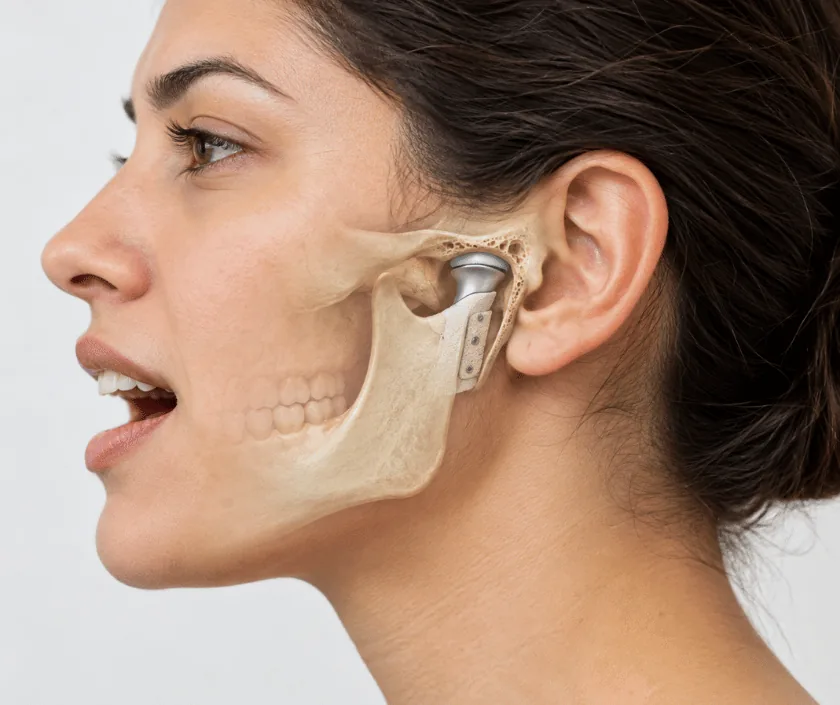
Jaw joint ankylosis means the lower jaw has fused to the skull, so the mouth opens barely a few millimetres. Surgery removes the block of fused bone, releases the muscles pulling the jaw and creates a gap that can move again, sometimes with tissue placed in between. Daily physiotherapy from the first days afterwards is what keeps the opening that surgery creates.
The jaw joint sits just in front of the ear and lets the lower jaw swing open, slide forward and move sideways. When that joint is injured, most often by a fall onto the chin in childhood, blood can collect inside it and slowly turn to bone. Over months and years the jaw becomes welded to the skull, and the mouth stops opening. Many reach the clinic having lived this way for years, eating what fits through a gap of a few millimetres.
The consequences run beyond eating. Teeth cannot be cleaned properly, so decay is widespread. A jaw fused during childhood stops growing normally, leaving a small chin and a face that looks foreshortened. Because the tongue and jaw sit further back, breathing during sleep is often disturbed. Even the anaesthetic differs, since the mouth cannot open for a breathing tube, so it is passed through the nose with a flexible camera.
Surgery removes the fused mass through an incision near the ear, opens a gap so the jaw can move again, and releases the thin process of bone in front that also tethers the jaw. Sometimes tissue is placed in the gap to discourage bone forming again. In children the jaw may need reconstruction so it can keep growing. Movement then begins within days, deliberately and under supervision.
Surgery suits people whose jaw is genuinely fused and who are willing and able to follow a demanding exercise programme afterwards. That second requirement is not a formality.
Mouth opening is measured, scans map the fused mass and its relation to the skull base, and the airway is assessed. In children, growth and sleep breathing are reviewed as part of the plan.
Since the mouth cannot open, the breathing tube is passed through the nose using a flexible camera. This step is planned with the anaesthetic team well before the day of surgery.
Through an incision hidden near the ear, the fused block is removed to create a gap. The jaw is then tested, and if it still will not open the thin process of bone in front is released as well.
Tissue such as local muscle may be placed into the gap to discourage bone forming again. In a growing child the jaw may be rebuilt so that growth can continue.
Opening is measured on the operating table and exercises begin within the first days. Physiotherapy is taught to the patient and to a family member before discharge.
Pain and swelling around the ear are managed while gentle opening exercises start. Nursing staff and physiotherapists supervise every session at this stage.
Exercises step up in frequency and range, often with a stretching device. Soft food is taken by mouth and the wound near the ear is checked.
Opening is measured against the range achieved during surgery. Any loss triggers a review of technique, effort and frequency rather than simply more time.
Exercises continue daily even when opening feels settled. Dental treatment that was impossible before can now be completed, and children stay under review for growth.
Surgery reliably creates opening on the operating table. Keeping it is the harder part, and that depends on daily exercise for months. Many people gain enough opening to eat and clean their teeth normally, though few return to the range of an uninjured joint. Fusion can return, especially when exercises lapse. Facial shape, particularly in someone whose jaw stopped growing years ago, usually needs separate treatment later.
This is major surgery in a difficult area, and the risks deserve plain discussion before consent is given.
Everything gained in the operating room is either kept or lost at home, which is why the routine below is treated as part of the treatment.
Surgery creates the space, and exercises maintain it. Without the physiotherapy that follows, opening can shrink again over months.
Muscle spasm, scarring of the cheek lining from tobacco use and growths can all restrict opening, and each needs quite different treatment.
Long standing fusion is still treatable, though the plan is larger and may include separate surgery later for facial shape.
That is the point at which many people lose ground. Continuing exercises is what protects the range that has been gained.
At Elegance Clinic in Surat, ankylosis is treated as a programme rather than a single operation, with physiotherapy planned and supervised from the first day after surgery.

No two ankylosis operations are alike, so a single price would be misleading. Cost depends on whether one joint or both are fused, whether tissue is placed in the gap, whether a growing jaw needs reconstruction, how long the anaesthetic takes and how many days are spent in hospital. Physiotherapy, stretching devices and the dental treatment that becomes possible afterwards add further items. Because release of a fused joint restores function after injury or infection, mediclaim often applies, and the position is checked with the insurer during assessment. A written estimate is prepared once the scans and the airway assessment are complete.
These are the questions that come up most often in consultation. If yours is not here, send it on WhatsApp and the team will reply, usually the same day.
Ask your question →Most often after an injury to the joint in childhood, where bleeding inside the joint slowly turns into bone. Infection reaching the joint and long standing inflammatory joint disease can do the same thing over time.
Opening is created during the operation and measured there, but the range you keep depends on exercises. Many people regain enough to eat and clean their teeth comfortably, while few reach the range of a joint that was never injured.
Because the space made during surgery tends to close again with scar and new bone. Daily stretching keeps that space open. The operation and the exercises are two halves of one treatment, not a procedure followed by advice.
It can, particularly when exercises are stopped early. That risk is the reason for long review and for teaching a family member to supervise the routine at home. Any loss of opening should be reported straight away.
Often yes, since releasing a fused joint restores function after injury or infection rather than changing appearance. Cover depends on the policy and on approval, and dental treatment that follows is usually billed separately.
The operation restores movement rather than facial shape. When a jaw stopped growing in childhood, a small chin and an uneven face usually remain, and reshaping surgery is planned separately once opening is stable.
Usually within two to three weeks, once the wound is comfortable and the routine is established. Exercises then continue at home and at school, and soft food is packed until chewing becomes easier.
Seeing patients from across the city and beyond: read about the practice on the plastic surgeon in Surat page, or check what a written estimate covers on the costs and insurance page.
