Virtual surgical planning moves the thinking part of an operation onto a computer, using a scan of your own face. Cuts, movements and plate positions are decided in advance, then carried into theatre with guides made to match that plan.
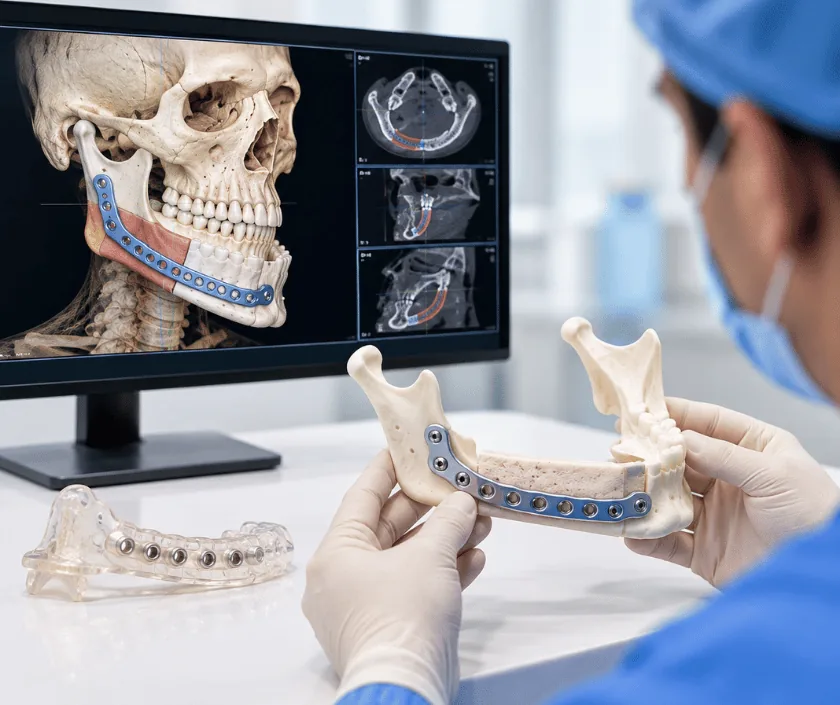
Virtual surgical planning means rehearsing an operation on a three dimensional model of your skeleton before the day itself. CAD CAM stands for computer aided design and computer aided manufacture, the pair of steps that turn that plan into physical guides, splints or implants. Its aim is a result closer to what was intended, with less improvising in theatre.
Everything starts with imaging. A fine cut CT scan of the facial skeleton is combined with a scan of the teeth, since bite position governs so much of what can be done to the jaws. Software turns these into one model that can be rotated, measured and cut on screen.
On that model the surgeon carries out the operation in advance. Bone is divided where it will be divided, segments are moved to the planned position, and the effect on bite, chin projection and facial balance is checked. Different options can be compared before one is chosen, and you can be shown what each would mean for you.
Once the plan is agreed, manufacturing takes over. Cutting guides, drilling guides, bite splints or custom plates are produced so the planned movement can be repeated in theatre. On the day the surgeon still uses judgement, because soft tissue, bleeding and small anatomical surprises are real. What the plan removes is guesswork about the parts that could be worked out beforehand.
Planning earns its cost when the movement is complicated or the margin for error is small. Simple fractures of a single bone rarely need it.
Scans of the face and teeth are taken along with photographs and bite records. Accurate records matter, because every later step is built upon them.
Bone is cut and moved on screen and the effect on bite and profile is reviewed. Options are compared and the chosen plan is confirmed with you.
Guides, splints or custom plates are produced from the agreed plan. Because this takes some weeks, the surgery date is set once everything is ready.
Your guides are seated on the bone, cuts follow the planned lines, and segments are fixed in the new position with plates and screws.
Bite and position are checked before closing, sometimes with a scan. Small adjustments on the day are normal and form part of good surgery.
Swelling peaks and the jaw feels stiff. Liquids, pain relief and mouth care are the focus, and light elastics may be used to guide the bite.
Swelling drops noticeably. Soft food is managed more easily and many people return to desk work towards the end of this period.
Bone has usually knitted enough to widen the diet in stages. Jaw movement exercises and any orthodontic adjustment continue.
Bite settles and swelling finishes clearing. Sensation keeps improving, and the final result can usually be judged around this time.
Bone usually ends up close to the planned position, and bite correction in jaw surgery is generally reliable. Soft tissue is the harder part, because how lips, cheeks and chin drape over moved bone can only be estimated. Predictions of the final face are therefore a guide rather than a promise. Swelling takes months to settle, and small revisions are occasionally needed.
Planning reduces uncertainty about position, yet the operation it supports carries its own risks, and these are explained before consent.
Healing after planned jaw work depends heavily on what happens at home through the first six weeks.
Every cut is still made by the surgeon. Software and guides carry the plan into theatre, and judgement on the day continues to count.
Bone position is reliable. Soft tissue drape, swelling and healing vary between people, so predictions of the final face remain estimates.
Most simple fractures are treated well without it. Planning is worth the added time and cost mainly in complex or asymmetric cases.
Records, design, approval and manufacture together take weeks. Urgent injuries are therefore treated straight away by other means.
Planning at Elegance Clinic in Surat is done with the patient in the room for the discussion, so the movement being proposed is understood before it is agreed.

Costs cover the imaging, the digital planning session, the guides or splints that are manufactured, and then the operation itself. Number of jaws moved, complexity of the reconstruction and length of stay all shift the total. A written estimate is issued after assessment, once the plan and its parts are known. Corrective and reconstructive jaw surgery is often covered by mediclaim where there is a functional problem.
These are the questions that come up most often in consultation. If yours is not here, send it on WhatsApp and the team will reply, usually the same day.
Ask your question →Planning adds imaging, a design session and the manufacture of guides or splints on top of the surgery. How much depends on the complexity of the movement. A written estimate is given after assessment so you can see each element separately.
Jaw surgery done for a functional problem, such as a bite that will not meet or difficulty breathing, is often covered by mediclaim. Purely cosmetic requests are not. Insurers usually want scans, orthodontic records and clinical notes before approval.
Planning involves imaging and computer work, so it adds no surgical risk beyond the radiation dose of a CT scan. Risks belong to the operation that follows, including numbness, infection and bite changes, and these are discussed before consent.
Swelling peaks in the first days and improves markedly by two weeks, when desk work often becomes possible. Diet widens in stages around six weeks. Sensation and the final bite settle over some months, and recovery can vary between people.
Bone position usually matches closely. How lips, cheeks and chin drape over the new bone can only be estimated, so the preview on screen is a guide rather than a picture of the finished face. Swelling hides the result for months.
Anyone needing urgent treatment, since design and manufacture take weeks. Untreated gum disease or decay is dealt with first. Simple fractures rarely justify the extra cost, and honest advice about that forms part of the consultation.
Records are taken, including scans of the face and teeth, photographs and bite impressions. Later the digital plan is shown to you and options compared. Nothing is manufactured until you have understood the plan and agreed to it.
Each technique below has its own page explaining how it works and when it is chosen.
Seeing patients from across the city and beyond: read about the practice on the plastic surgeon in Surat page, or check what a written estimate covers on the costs and insurance page.
