Your cheekbone gives the face its width and carries part of the floor and outer wall of the eye socket. When it is struck hard, the cheek can flatten, the cheek skin can go numb and the mouth may not open fully.
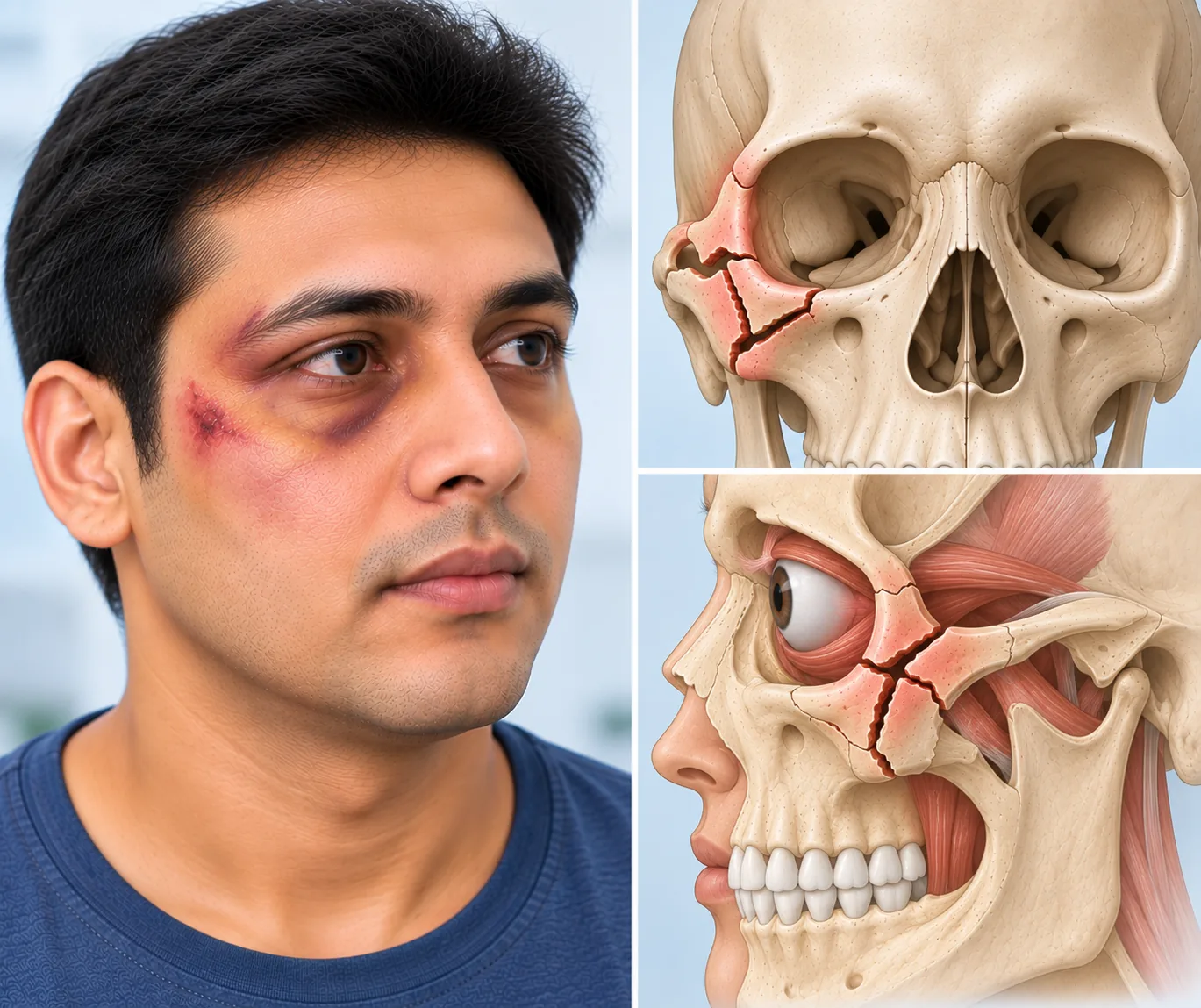
A zygomatic fracture is a break of the cheekbone, often called a zygomaticomaxillary complex or ZMC fracture because the bone separates at more than one junction. Injuries range from a hairline crack needing only observation to a sunken cheek that has to be lifted and held with small plates. Assessment covers the cheek shape, the eye, the nerve to the cheek and mouth opening.
The zygoma is the bone you feel as the prominence of the cheek. It links to the forehead bone beside the eyebrow, to the side of the skull through a slender arch, to the upper jaw below the eye and to a deeper bone within the eye socket. Because of those connections, a firm blow tends to separate it at several junctions and push the whole block backwards and inwards.
What people notice varies with how far the bone has moved. The cheek may look flat when compared with the other side, particularly once the swelling has gone. Numbness over the cheek, the side of the nose and the upper teeth is frequent, as the nerve to that area runs through the rim under the eye. Some patients find the mouth will not open fully, since a collapsed arch rubs against the muscle that closes the jaw. The eye deserves its own examination, because the floor of the socket often shares in the injury.
A computed tomography scan shows the pattern clearly and guides the decision. Undisplaced cracks are watched, while a sunken or rotated cheekbone is lifted back and fixed with small plates through hidden cuts.
Surgery is offered when the bone has moved enough to change the shape of the face, to affect the eye or to limit jaw movement. Many smaller injuries do not need it.
Your face, eye, cheek sensation and mouth opening are examined and compared side to side. A computed tomography scan then maps how many junctions have separated and in which direction the bone has moved.
Undisplaced fractures are managed without an operation. Where the bone has shifted, surgery is usually planned within the first two weeks while the pieces still move freely.
Access is gained through small cuts inside the upper lip, in the eyelid crease or within the hairline above the ear. These sites are chosen so scars are hard to see afterwards.
The cheekbone is lifted back into position and checked at more than one junction. Small titanium plates and screws hold it while it heals, and the socket floor is inspected when needed.
Most patients stay one or two nights. Reviews check the cheek shape, eye movement, mouth opening and the slow return of sensation over the following months.
Swelling and bruising around the eye are heaviest now. Cold packs, head elevation and the prescribed medicines make this stage manageable, and diet stays soft.
Swelling falls noticeably and any skin stitches are removed. Mouth opening improves with gentle exercises, and the cheek shape starts to show through.
Bone has united well. Normal diet is usually back, work has restarted and jaw movement is close to what it was before the injury.
Numbness of the cheek and upper teeth continues to recover slowly, sometimes not completely. Final contour of the cheek can be judged fairly by now.
Most cheeks come back close to their earlier shape when the bone is repositioned early and checked at several points. A small difference in fullness between the two sides is common and often noticed only by you. Numbness of the cheek and upper teeth recovers over months and may not return fully, since nerve healing follows its own pace. Where the eye socket was badly damaged, some difference in eye position can persist.
This is established surgery, and the risks below are explained before you consent to it.
The bone needs protection while it unites, and a few habits speed the swelling down.
Cracks that have not moved heal with observation, a soft diet and review. Fixation is for bone that has shifted enough to change the face, the eye or jaw movement.
Numbness usually comes from the injury itself, since the nerve is bruised or stretched as the bone moves. It is often present before any operation and recovers slowly.
Swelling can fill a flattened cheek and hide the deformity for a week or more. Limited mouth opening or numbness may be the only early clue.
Repositioning is far easier in the first two weeks. After that the fracture lines begin to fuse and correction becomes a longer procedure with a less predictable result.
Cheekbone injuries at Elegance Clinic in Surat are assessed with the eye, the jaw and the shape of the face all considered together, and imaging is reviewed with you before any decision is taken.

Cost depends on how many junctions need fixing, how many plates are used, whether the eye socket floor is repaired at the same time and how long you stay in hospital. Anaesthesia, theatre and imaging all form part of the total. Because these details follow the scan, a written estimate is given once your pattern of injury is clear. Accident related facial surgery is usually covered by mediclaim, and the team assists with the claim.
These are the questions that come up most often in consultation. If yours is not here, send it on WhatsApp and the team will reply, usually the same day.
Ask your question →The total reflects how many points need fixation, the number of plates, whether the eye socket is repaired at the same time and the length of stay. A written estimate is shared once the scan has been reviewed, so the figure matches your actual injury pattern.
Fracture fixation after an accident counts as reconstructive treatment, so most policies consider it. Claims usually need the accident record, the scan report and operative notes. Room rent limits and waiting periods in your policy still apply, so check them before admission.
Surgery near the eye socket is done carefully and with the eye examined before and after. Problems affecting vision are uncommon, though double vision, a change in eye position and infection are possible and are discussed with you beforehand.
Swelling and bruising ease over two weeks, and most people restart light work by then. Bone unites at around six weeks, when normal diet and exercise usually resume. Mouth opening improves steadily with the exercises you are given.
Repositioning done early usually restores the cheek close to its earlier shape. A small difference in fullness between the two sides is common. Numbness of the cheek recovers over months and may not come back entirely, which is worth expecting.
Yes, when the bone has not moved and the eye and mouth opening are normal. Those injuries are managed with a soft diet and review. Surgery is reserved for a shifted bone that affects appearance, the eye or jaw function.
Ideally within the first two weeks, while the pieces still move freely. Swelling is allowed to settle a little first. Beyond that window the fracture begins to fuse and correction becomes a bigger and less predictable operation.
Seeing patients from across the city and beyond: read about the practice on the plastic surgeon in Surat page, or check what a written estimate covers on the costs and insurance page.
