The forehead offers little spare skin, sits directly over bone and greets everyone you meet. Reconstruction here restores cover without pulling an eyebrow out of place or leaving a scar that cuts across the face.
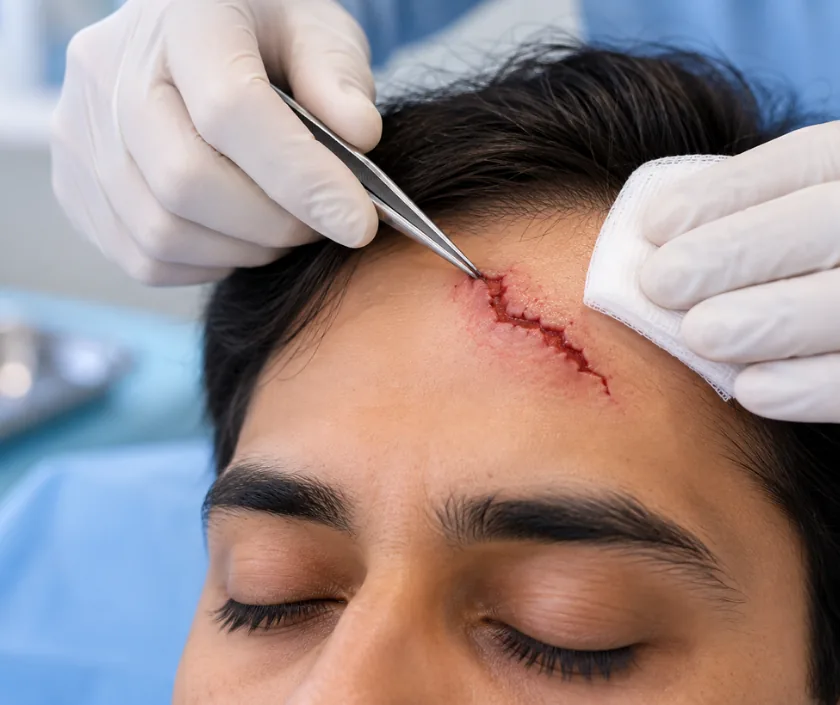
Forehead reconstruction restores skin and soft tissue lost from the forehead after injury, burn or removal of a lesion. Because forehead skin is thin and tight, the surgeon usually borrows nearby tissue as a local flap rather than stretching the wound closed. The plan protects eyebrow position, the hairline and the natural creases in which scars hide best.
Skin over the forehead is thin, firmly attached and stretched across bone, with muscle underneath that lifts the eyebrows. Little slack exists. Lose a patch of it to a road accident, a burn or the removal of a growth, and the wound cannot simply be pulled shut without dragging an eyebrow upward or narrowing the space between the brows.
Reconstruction starts by mapping what is missing: how wide the area is, how deep it goes, and whether bone or the covering over it is exposed. Small areas near the middle can sometimes be closed directly along a frown line. Larger ones are covered by rotating or advancing skin from the side of the forehead or from the scalp, so that the replacement matches in colour and thickness.
Where a wound is very large, the skin may be expanded first, using a balloon placed beneath it over several weeks to grow extra cover. Whatever the method, the surgeon works to keep both eyebrows level, to keep the hairline natural and to place the final scar where a crease or the hairline will hide it.
Reconstruction suits anyone left with missing or badly scarred forehead skin, once the wound is clean and stable. Timing depends on whether the injury is fresh, still healing or long settled.
The area of loss is measured and photographed, brow position is compared on both sides, and the creases of the forehead are marked while you frown and raise the eyebrows.
Direct closure, a local flap, a graft or tissue expansion is chosen according to size, depth and what lies at the base. The plan is drawn on the skin, so you can see where scars will fall.
Under anaesthesia the wound edges are freshened and any unhealthy tissue is removed. Bleeding is controlled carefully, since a collection under a flap is a common cause of trouble.
The flap is raised with its blood supply intact and eased into place without tension. Deep stitches hold the layers, and fine stitches settle the skin along the marked lines.
A light dressing supports the repair without pressing on it. Flap colour is checked in the first days, because early signs of poor circulation can often be acted upon.
Swelling and bruising rise, sometimes tracking down towards the eyelids. The head is kept raised, and the flap or graft is inspected for colour and warmth.
Stitches are usually removed within this period. Bruising fades, and the repair may look lumpy or uneven, which is normal at such an early stage.
The scar is red and firm but settling. Scar massage, silicone and sun protection are generally under way, and most people are back to their usual routine.
Colour and contour continue to improve for a year or more. Any small adjustment, such as thinning a bulky flap, is considered only after this settling period.
Most people end up with level eyebrows, a natural hairline and a scar that fades into the forehead creases over time. The reconstructed patch can stay slightly different in colour or texture, and a flap may look full for some months before it settles. Sensation over the area is often reduced at first and improves slowly. A second small procedure to refine the shape is not unusual, and it is planned once the scar has matured.
Forehead reconstruction is generally well tolerated, though the area is unforgiving of complications and the possibilities deserve a plain discussion.
The first fortnight protects the repair, and the months afterwards decide how the scar looks.
Grafts on the forehead often heal as a shiny patch of different colour. A local flap takes more planning, yet it usually matches the surrounding skin far better.
Forehead skin has very little give. Pulling a wide wound closed drags the eyebrow upward and leaves a stretched scar that widens with time.
Placed within frown lines or along the hairline, forehead scars settle surprisingly well. Direction and position matter more than the length of the scar.
Reconstruction often needs a refinement once tissue has settled, such as thinning a flap. Planning for that from the start avoids disappointment later.
Forehead reconstruction at Elegance Clinic in Surat is planned around eyebrow position and scar direction, with the options drawn on the skin before you agree to a date.

Forehead reconstruction after injury, burn or removal of a growth is reconstructive surgery, so most health insurance policies and many government schemes consider it once the cause is documented. Cost varies with the size of the area, the method chosen, the type of anaesthesia and whether tissue expansion forms part of the plan. A written estimate is given before admission.
These are the questions that come up most often in consultation. If yours is not here, send it on WhatsApp and the team will reply, usually the same day.
Ask your question →Cost depends on the size and depth of the area, whether closure is direct or needs a flap, the type of anaesthesia and whether tissue expansion is planned. More than one stage raises the total. A written estimate is given before admission.
Reconstruction after an accident, a burn or removal of a growth is treated as reconstructive rather than cosmetic, so mediclaim policies and government schemes usually consider it. Approval needs photographs, the diagnosis and hospital paperwork. Waiting periods and room limits in your policy still apply.
Neither is safer in every case. Flaps bring their own blood supply and match forehead skin better, while grafts suit shallow areas or a patient unfit for longer surgery. The choice is made from the size, depth and base of the wound.
Many people return to desk work within a week or two, once bruising fades and stitches are out. Swelling can track towards the eyelids for a few days. Exercise, heavy lifting and swimming usually wait until the repair is fully healed.
Keeping the brows level is a central aim, and it is planned before any tissue is moved. Small differences can remain, especially where scarring was extensive. Minor adjustment is possible later, once the tissue has softened and settled.
Fresh wounds are usually treated once they are clean and swelling has eased. Scars that pull the brow are best revised after the scar has matured, since operating early on an active scar tends to give a poorer result.
The area is measured and photographed, brow position is compared on both sides, and forehead creases are marked while you frown. Options are drawn on the skin and explained with their trade offs. You leave with a written plan and an estimate.
Each technique below has its own page explaining how it works and when it is chosen.
Seeing patients from across the city and beyond: read about the practice on the plastic surgeon in Surat page, or check what a written estimate covers on the costs and insurance page.
