Burn scar across the abdomen can tighten until bending, standing straight and sitting comfortably all become harder. This page explains the options from simple excision to expansion, how recovery goes in Surat and what treatment may cost.
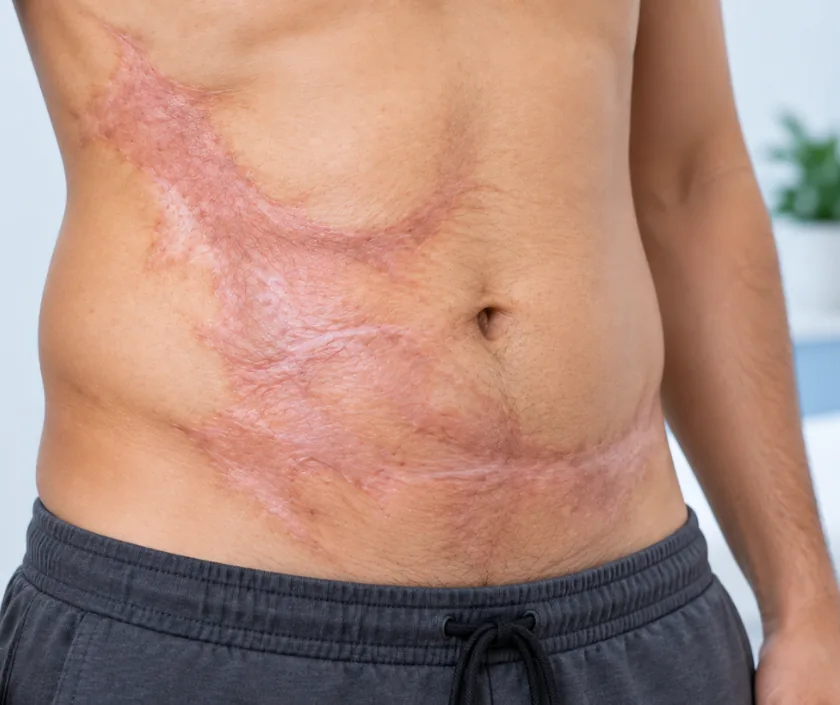
Abdominal burn scar treatment ranges from softening a raised scar to releasing tight bands that stop you standing straight. Surgeons may cut out a narrow scar and close it directly, lengthen a band with Z plasty flaps, or resurface a wide area with a graft or expanded skin. Choice depends on the width and behaviour of the scar.
Burns across the abdomen heal into scar that behaves in one of two troublesome ways. Raised, itchy scar sits proud of the surface and catches on clothing. Tight scar shortens across the waist, so bending forward, stretching upward or sitting for long feels restricted, and the navel may be dragged out of shape.
Treatment follows the pattern of the scar rather than a single recipe. Narrow bands are often removed and closed directly, or lengthened with Z plasty flaps that swap skin across the line of tension. Wider areas need resurfacing with a graft, or with skin grown beforehand under an expander when appearance matters to you.
Scar therapy runs alongside surgery in every plan. Pressure garments, silicone and massage keep new scar flat while it matures, and the abdomen tolerates these well because clothing hides them. Review continues for a year or more, since scar on the trunk stays active longer than many people expect.
Surgery suits scars that limit movement, break down repeatedly or bother you enough to accept a new scar in exchange. Mature scars respond better than fresh ones.
Bands are marked while you bend, stretch and stand tall, so the direction of tension is clear. Quality of the surrounding skin then decides whether direct closure, Z plasty or resurfacing suits you best.
Narrow scars are cut out and closed. Bands are lengthened with Z plasty flaps. Wide areas are resurfaced with a graft, or with expanded skin where a closer colour match is wanted.
Under anaesthesia the scar is removed or divided, and any planned flaps are raised and swapped. Layers are closed carefully, and a drain is sometimes left when the area is large.
Dressings protect the wound for the first days. An abdominal binder often follows, supporting the repair while you move and reducing tension across the closure.
Once healed, silicone, pressure garments and massage begin. Therapy continues for months, because it is what keeps the new line flat rather than raised, and reviews check that the scar is settling as expected.
Soreness across the abdomen is normal, especially on standing. Pain relief and a binder help. Short, frequent walks are encouraged to keep the circulation moving.
Stitches or clips are removed at review. Desk work is often possible, while lifting, long drives and gym training wait.
Most restrictions lift around now. Silicone, pressure and massage are in routine use, and the scar still looks red and firm at this stage.
Colour fades and softness returns slowly through the year. Any residual band or raised area is reviewed, and a small revision can be planned.
Function usually improves clearly, and a tight band that limited bending can be lengthened well. Appearance improves rather than disappears, since surgery trades a wide scar for a narrower line or a graft of different colour. New scar goes through a red, firm phase for several months before softening. Pressure therapy and massage make a real difference to how flat the final result looks.
Abdominal scar surgery is usually straightforward, though the trunk heals under more tension than the face. Knowing the risks helps you plan.
These practical points cover the first weeks and the months of scar therapy that follow.
Moisturiser helps itching, yet steady pressure, silicone and time do most of the flattening.
A wide scar is traded for a narrower line or a graft, so something visible always remains.
Not always, although a pregnancy planned soon is a good reason to delay, since the abdomen stretches again.
A true band shortens the skin and limits bending, and only lengthening or resurfacing changes that.
Scar work at Elegance Clinic starts with an honest conversation about what surgery can trade and what it cannot remove. Patients from across Surat are given a written plan that covers therapy as well as the operation.

Abdominal scar surgery is quoted after assessment, because plans vary from a short excision under local anaesthesia to staged expansion of a wide area. Anaesthesia, hospital stay, garments and dressings all feed into the figure. Release of a genuine contracture is reconstructive and is often considered by mediclaim, while purely cosmetic improvement of a settled scar usually is not. A written estimate makes that difference clear.
These are the questions that come up most often in consultation. If yours is not here, send it on WhatsApp and the team will reply, usually the same day.
Ask your question →Not completely. Surgery trades a wide scar for a narrower line, or replaces it with a graft of slightly different colour. Tight bands can be lengthened so bending is easier. Most people judge the result by comfort and movement as much as by appearance.
A written estimate follows assessment, since a short excision under local anaesthesia and a staged expansion sit at very different levels. Garments and dressings are included in that figure. Release of a true contracture is often considered by insurers, while cosmetic improvement usually is not.
Where a pregnancy is planned soon, waiting is sensible, because the abdomen stretches again and can widen a fresh scar. When a band is limiting movement or breathing, release is not delayed. Talk about your plans openly at the first visit.
Light lifting usually restarts around four to six weeks, depending on how much tension the closure carried. Heavier work waits longer. Straining too early is the commonest reason a scar on the trunk widens, so this advice is worth following.
It is generally straightforward, with the usual risks of bleeding, infection and wound separation. Trunk wounds heal under more tension than facial ones, so closures are supported with a binder. Stopping smoking and controlling blood sugar lower the risks noticeably.
Yes. Steady pressure with silicone remains one of the more useful ways to keep new scar flat and soft, particularly on the trunk where scars tend to thicken. Most people wear them for months, and clothing hides them easily.
You are examined standing, bending and stretching, so the bands show themselves. Photographs record the starting point. Options from simple excision to expansion are explained with their advantages and drawbacks, and a written estimate follows before anything is booked.
Each technique below has its own page explaining how it works and when it is chosen.
Seeing patients from across the city and beyond: read about the practice on the plastic surgeon in Surat page, or check what a written estimate covers on the costs and insurance page.
