Cell spray therapy takes a small piece of skin, separates the cells and sprays them across a prepared burn so they can resurface it. This page explains where the technique helps, where it does not, and how availability affects the plan.
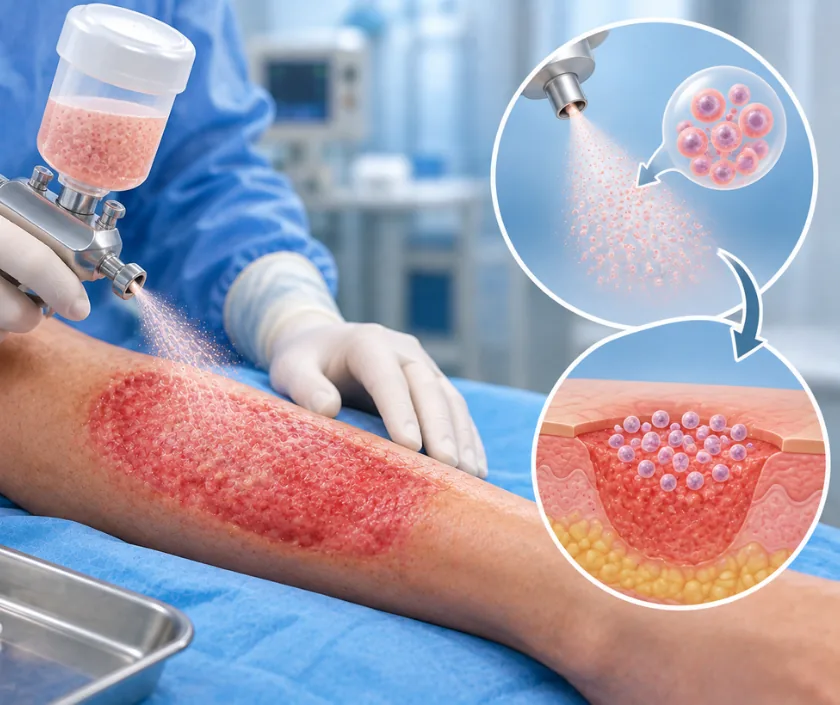
Cell spray therapy uses a small sample of skin taken from the patient. Cells are separated in theatre into a suspension and sprayed evenly across a prepared burn, where they can spread and resurface the area. The technique suits selected wounds, particularly shallower burns and widely meshed grafts, while deep burns still need conventional grafting.
Skin heals from cells that survive in the depths of a wound and at its edges. Where a burn is shallow enough to leave some of those cells behind, healing happens on its own. Cell spray therapy borrows that idea, reasoning that if healing depends on cells reaching the surface, then cells can be delivered there directly.
A small piece of unburned skin is taken, usually no larger than a postage stamp for a modest area. In theatre it is treated with an enzyme solution that separates the cells, which are then suspended in fluid and sprayed evenly over the prepared wound. The suspension can cover an area many times the size of the sample, which is the main attraction of the method.
What the technique cannot do is replace a dermis that has been destroyed. Deep burns still need a graft, and the spray is often used alongside one, laid over a widely meshed graft to help the gaps close faster. Results vary between wounds, so the approach is offered where the wound genuinely fits it.
This is a selective technique rather than a general one. Depth of the burn, quality of the bed and access to the equipment all decide whether it is offered.
Depth decides everything here. The burn is examined over several days, since a wound that looks borderline early can declare itself deeper later and need grafting instead.
Dead tissue is removed and bleeding is controlled. A clean surface is essential, because sprayed cells cannot survive on dead tissue or in the presence of infection.
A small piece of unburned skin is harvested, usually from the thigh. The sample site is dressed and heals like a shallow donor area, generally with little difficulty.
The sample is processed in theatre with an enzyme solution to release the cells. That suspension is sprayed evenly across the wound, sometimes over a meshed graft already in place.
A non adherent dressing is applied and left undisturbed. Movement is limited so the suspension is not wiped away before the cells have settled and started to spread.
Stillness matters most. Dressings stay in place and the treated part is supported or splinted. Pain relief is given regularly, and the sample site is dressed separately.
A first inspection shows how the surface is progressing. Some areas close quickly, others need continued dressings. Physiotherapy starts gently around the treated part.
New skin is usually fragile, dry and sensitive. Moisturiser and sun protection begin, and garments are introduced where thickened scar is a risk.
Colour evens out slowly and some areas stay different in tone. Reviews continue while the scar matures, and further treatment is considered only after that.
Outcomes vary with the depth and preparation of the wound, and honest expectations matter here. Where the burn is shallow and the bed is clean, the surface can close well with only a shallow sample site to heal. A burn that proves deeper than it first appeared still needs grafting afterwards. Colour and texture continue to differ from surrounding skin.
The method is less invasive than a large graft harvest, though it is not free of problems and it can fail to close the wound.
The first days set the outcome. Instructions are simple, although they are not optional.
Deep burns have no dermis left to build on. Cover from a graft is still needed, and the spray is often used with it rather than instead.
Newer does not mean better for every wound. Suitability depends on depth and bed quality, and a graft remains the more predictable option in deep burns.
A sample site is a real, if shallow, wound. It is dressed and cared for like any donor area, and it heals with a mark.
Equipment and kits are not stocked in every hospital. Availability is confirmed before the plan is agreed, so nothing is promised that cannot be delivered.
Elegance Clinic in Surat discusses this technique alongside conventional grafting, with the limits stated as plainly as the advantages. Availability is confirmed before anything is agreed with a family.

Cost depends on the kit used, theatre and anaesthesia time, the area treated and the dressings that follow. Where grafting is needed as well, either at the same sitting or later, that is added to the estimate. Because availability varies, the office confirms supply before quoting. A written estimate is prepared after assessment, along with a comparison against conventional grafting.
These are the questions that come up most often in consultation. If yours is not here, send it on WhatsApp and the team will reply, usually the same day.
Ask your question →Cost covers the kit, theatre and anaesthesia time, dressings and any grafting done alongside. Prices differ from conventional grafting in both directions depending on the wound. A written estimate is prepared after assessment, with a comparison against the standard approach so the choice is informed.
Not in general. For shallower burns and for closing the gaps in a meshed graft it can help considerably. In full thickness burns a graft provides the cover that sprayed cells cannot, so the two answer different problems rather than competing.
Healing varies with depth and preparation. Shallower wounds may close over a few weeks, while deeper areas take longer or need grafting after all. Reviews are arranged rather than a fixed date given, because progress guides the next step.
It leaves a shallow wound that heals like a small donor area, usually with a pale mark that fades slowly. Care is the same as for any donor site, meaning keep it dressed, keep it clean and protect the new skin from sun.
Then grafting is planned. This possibility is discussed before the procedure so it does not come as a shock. Depth in burns can be difficult to judge early, and a change of plan reflects how the wound behaved rather than a mistake.
Availability of equipment and kits varies between hospitals and can affect timing. Supply is confirmed before the plan is agreed with a family. Where it cannot be arranged in the time the wound allows, conventional grafting goes ahead instead.
Burn depth, the state of the bed and the area involved are assessed first. Options are compared honestly, including what happens if the wound proves deeper than it looks. Availability, the recovery routine and a written estimate are covered before consent.
Each technique below has its own page explaining how it works and when it is chosen.
Seeing patients from across the city and beyond: read about the practice on the plastic surgeon in Surat page, or check what a written estimate covers on the costs and insurance page.
