Scar across the chest can tighten the skin, limit shoulder movement and, in girls and women, change how the breast develops or sits. This page explains how release and reconstruction are staged in Surat, and what treatment may cost.
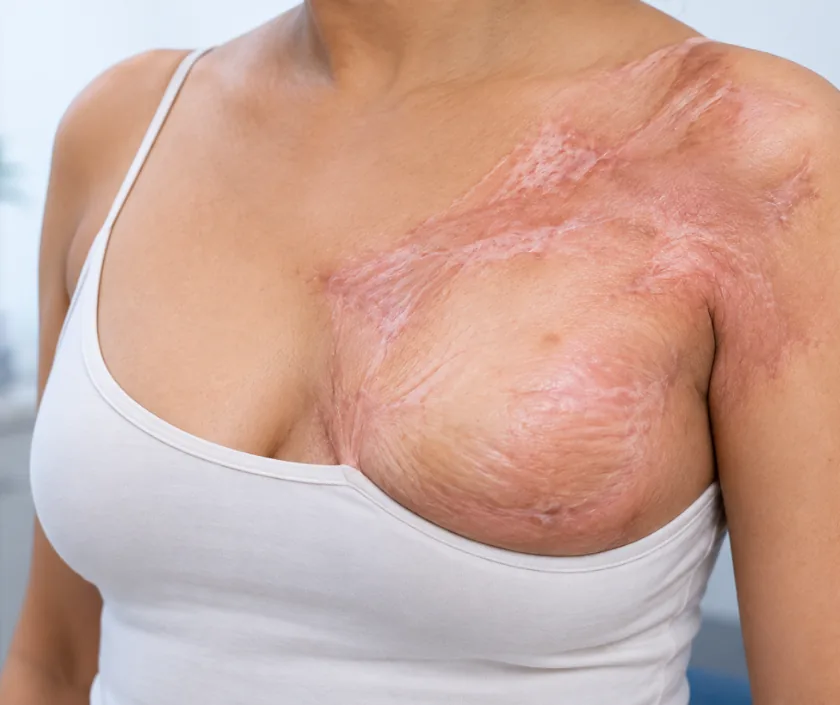
Chest and breast burn reconstruction releases tight scar over the chest wall and restores a breast that scar has flattened, pulled upward or held back. Release with a graft or expanded skin usually comes first, and shaping of the breast follows later. In girls, timing is planned around breast development rather than around a fixed age.
Deep burns across the chest heal into a broad sheet of scar. Because that sheet shortens, the shoulders round forward, the collarbone area feels tight and lifting the arms becomes harder. Breathing deeply can feel restricted in severe cases, and skin catches and itches with movement.
Where a burn crosses the breast area of a girl, the concern is different. Breast tissue beneath is often intact and will try to grow, yet tight scar over it acts like a band. Releasing that scar early gives the developing breast room, even though shaping operations wait until growth has settled.
Release is therefore the first step in most plans. Scar is divided across its lines of tension and the gap is resurfaced with a graft, a flap or expanded skin. Later stages restore the fold beneath the breast, improve projection and, when needed, rebuild the nipple. Choices at each point are explained in words the patient can weigh up herself.
Release suits anyone whose chest scar is limiting movement or breast development. Shaping operations suit those whose growth has settled and whose scars have matured.
Movement, scar quality and, in young patients, the stage of breast development are recorded. Photographs are taken with dignity and consent. Timing of each stage is then discussed with the family and the patient together.
Tight bands are divided across their direction of pull, so the shoulders sit back and the arms lift freely. Whatever gap opens up is resurfaced with a graft, a local flap or expanded skin.
Where scar sits over developing breast tissue, release lifts the constricting band away. Doing this early allows the breast underneath to grow instead of being held flat against the chest.
Once growth has settled, the fold beneath the breast is recreated and volume is adjusted. Options include local flaps, fat transfer or an implant, and the choice is discussed carefully beforehand.
A nipple can be rebuilt from local tissue, with colour added later by tattooing. Small adjustments to symmetry are usually left to this final stage, once everything else has settled.
Dressings stay in place and arm movement is kept gentle. Pain relief is given regularly. A drain is sometimes used and comes out before or soon after discharge.
Stitches are checked at review. Light daily activity resumes, while lifting and stretching above the head wait until your surgeon allows them.
Physiotherapy is usually in full swing, restoring shoulder range. Pressure garments, silicone and massage begin once the surface has healed.
Scar softens and fades through the year. Shape is reviewed, and any further stage is planned from here rather than rushed.
Movement and comfort usually improve a great deal, and most people notice that first. Shape can be improved substantially, though a reconstructed breast rarely matches an untouched one in texture or in how it moves. Resurfaced skin keeps a different colour. In young patients several stages spread across years are usual, and honest conversations at each visit matter more than promises made early.
These operations are generally safe, and clear information helps you weigh them up. The following are the more common concerns.
Recovery at home is mostly about protecting the repair while keeping the shoulder moving.
Breast tissue beneath the scar often survives, and releasing the tight skin early gives it room to grow.
Shaping waits for growth to settle, yet a constricting band is usually released much earlier than that.
Skin cover and scar quality decide what is possible, and an implant under tight scar rarely sits well.
Shoulder exercises are what keep released skin long, so therapy is part of the operation rather than an extra.
Elegance Clinic treats chest and breast burns with privacy, unhurried explanation and a plan set out stage by stage. Young patients in Surat are spoken to directly, in language they can follow, alongside their parents.

Cost depends on the stage being done, the area released, whether a graft, flap, expander or implant is used, anaesthesia time and hospital stay. Release of a burn contracture is reconstructive surgery, so many mediclaim policies consider it, particularly where movement or development is affected. Each stage is quoted separately in writing after examination, and our team helps families with the paperwork insurers ask for.
These are the questions that come up most often in consultation. If yours is not here, send it on WhatsApp and the team will reply, usually the same day.
Ask your question →Release of a tight band is usually done early, so growing breast tissue is not held flat. Shaping and matching the two sides wait until development has settled. Reviews every few months track growth, and each stage is discussed with the family before booking.
Often yes. Breast tissue lies deeper than the burn in many cases and survives, even where overlying skin was destroyed. Tight scar can hold it flat, which is why release matters. Regular review checks whether development is keeping pace with the other side.
Each stage is quoted separately after examination, since release, expansion and shaping differ widely in cost. Because these operations restore movement and development after an injury, many mediclaim policies consider them under reconstructive cover. A written estimate is given before admission.
Most people are home within a night or two and back to a light routine in about two weeks. Shoulder exercises continue for months, and scar keeps softening for a year. Lifting and gym work restart only when the surgeon confirms healing.
Yes, some difference remains. Resurfaced skin keeps a different colour and texture, and lines mark where scar was removed. Most people find comfort, movement and shape improve enough to be worth it, and clothing covers the area in daily life.
Anaesthesia and surgery in healthy teenagers are generally well tolerated, with the usual risks explained beforehand. Consent involves the young person as well as the parents. Timing is chosen so that operations support growth rather than interfere with it.
Movement, scar quality and development are examined privately, with a female attendant present. Photographs are taken only with consent. Options and their timings are explained to the patient and family together, and a written estimate follows.
Seeing patients from across the city and beyond: read about the practice on the plastic surgeon in Surat page, or check what a written estimate covers on the costs and insurance page.
